Course Hero Scraper for Course Codes and Document Metadata

The documents here were uploaded by students, and a great many of them belong to the institution that set the assignment. The metadata is collectable; the files are not.

Course Hero Scraper
Solutions

Managed study material metadata, run end to end by us

ScrapeIt runs the collection as a managed service. You name the institutions, subjects or courses; we build the pipeline within the paths the site leaves open, and hand back CSV, JSON, Excel or a push into your warehouse with institutions, course codes and volumes structured.

Cadence is slow by design. Course catalogues and document libraries change on academic terms rather than daily, so termly or monthly collection with change records suits every brief we have seen here.

We collect metadata about the library, not content from it. Uploaded documents are frequently institutional copyright and always somebody's work, and we do not collect them, their authors or anything identifying a student. Bring the use case to your own counsel before the project starts, particularly if it touches academic integrity.

Course Hero fields in every export

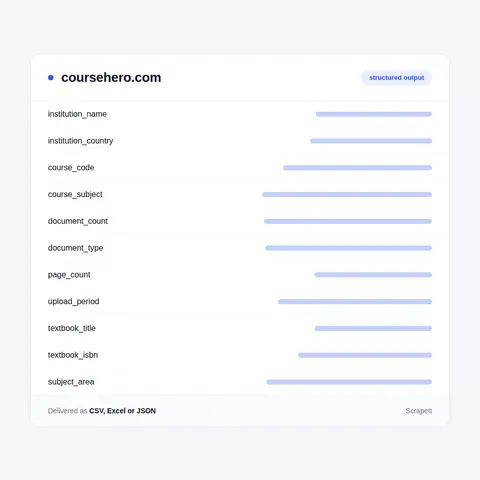
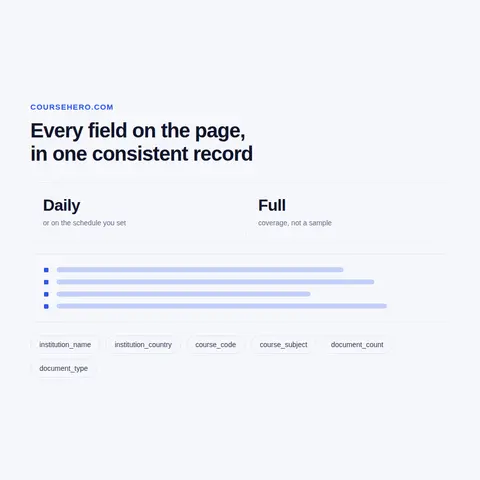
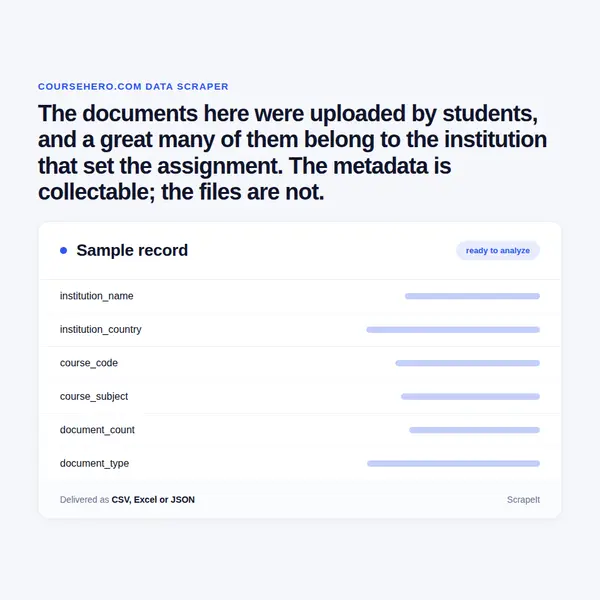
Institution records carry the institution name, country, the course codes listed under it and the document counts per course. That is the backbone of any analysis here, and it is metadata about the library rather than content from it.

Course records carry the course code as the institution writes it, the subject area, the document count by type where the platform distinguishes them, and the date range the uploads span.

Document metadata covers the document type, the course it is filed under, the upload period and the page count where shown. Titles are collected where they are descriptive rather than a filename, because a great many are not.

What we do not collect is the document content, the uploader identity or anything that would let a person be identified from an upload. Students uploading their own coursework did not consent to appearing in a commercial dataset, and the institutional material is not the platform's to license either.

Every row carries the collection timestamp and the surface it came from, which matters on a source where some paths are open and others are closed.

Course Hero fields in every export
Institution coverage, trends and what we decline

Institution coverage, trends and what we decline

Institution coverage analysis is the most common output. Which universities are well represented, which are barely present, and how that maps against enrolment gives a picture of where the platform actually has reach, which is different from where it claims to.

Trend analysis needs repeat collection. Document volume per course over successive terms shows which courses are growing, which are being retired and where new subjects are appearing, and none of that exists in a single snapshot.

Textbook association is available through the path the crawl rules leave open, which makes it possible to connect courses to the textbooks they use. For a publisher that is the most directly commercial cut of this source.

What we decline is worth stating in the proposal rather than the small print: we do not collect uploaded documents, uploader identities or anything that identifies a student. If a brief depends on those, we are the wrong supplier and we will say so on the first call.

A document library built from student uploads

Course Hero is a study materials platform. Students upload notes, past assignments, problem sets and solutions, organised by institution and course code, and other students read them. It is one of the largest such libraries and its institution and course structure is unusually well organised.

That structure is the collectable part and it is genuinely useful. Institutions, the course codes taught at each, how many documents exist per course, what subjects they cluster in and how that changes over time is a real dataset about what is actually being studied and where.

The documents themselves are a different matter entirely, and anyone scoping a project here needs to be clear about it before starting rather than after. A large share of uploaded material is institutional copyright - the problem set the university wrote, the exam the department set - uploaded by a student who did not hold the rights to it. Collecting those files is not a technical question.

The crawl rules are specific and worth reading. Several paths are disallowed including search and the general interface path, while a textbook data path is explicitly allowed. We stay inside that line, and where a client needs more the answer is a conversation with the platform rather than a workaround.

Get a Quote
dev_w
25

Developers

customers
500+

Customers worldwide

pages
1 500 000 000+

Pages extracted

stime
15000+

Hours saved for our clients

Plans

Airplane

€199 / one-time

setup fee - included

Data limits100,000
Frequencyone-time
Run timeup to 5 days
Data storing7 days

Helicopter

€169 / mo

setup fee €499

Data limits250,000
Frequencymonthly
Run timeup to 5 days
Data storing14 days

Glasses

€229 / mo

setup fee €499

Data limits1,000,000
Frequencyweekly
Run timeup to 5 days
Data storing30 days

DNA

€549 / mo

setup fee €799

Data limits3,000,000
Frequency3 times daily
Run timesame day
Data storing90 days

Why the metadata answers the questions and the files do not

Clients arrive wanting the documents and leave wanting the metadata, because the metadata is what answers their questions and the documents come with problems nobody wants.

The questions are these. Which courses generate the most study material, and at which institutions. How curriculum coverage differs between universities teaching the same subject. Which textbooks and topics dominate a field. Where demand for tutoring or supplementary content concentrates. Every one of those is answerable from institution, course and volume data without touching a single uploaded file.

For an education company planning where to build content, that map is the brief. For a publisher it shows which courses actually use which material. For a university it shows what its own students are circulating, which is occasionally uncomfortable and always informative.

The files themselves answer almost nothing additional and carry real exposure: institutional copyright on the assignments, student authorship on the notes, and academic integrity questions on the solutions. A dataset of them is not something a company can defend, and we would rather say that at the scoping call than build it and watch somebody else find out.

The last consideration is the platform's own position, which is worth reading in its crawl rules before deciding what is reasonable. They are specific about what is open and what is not, and staying inside that line is also what keeps access stable.
Our Blog

Reads Our Latest News & Blog

Learn how to use web scraping to solve data problems for your organization

How Artificial Intelligence Is Used In Web Scraping

How Artificial Intelligence Is Used In Web Scraping

Leveraging advances in technology, the AI-powered web scraper has skyrocketed in demand and is helping to expand capabilities by automating tedious daily tasks and speeding up data collection from thousands of websites several times over.

What is Web Scraping and What is it Used For?

What is Web Scraping and What is it Used For?

Web scraping is a method of obtaining web data by extracting it from pages of web resources with the help of a program, that is, in automatic mode. It is used to syntactically convert web pages into more usable forms.

Web Scraping for Machine Learning

Web Scraping for Machine Learning

If you specialize in machine learning, you need to feed large amounts of data to the algorithms. Web scraping is the easiest and the most efficient method of collecting the data from all over the Internet.

scrapeit logo

Who builds and keeps your study material feed

ScrapeIt is a managed extraction company, not a tool you have to learn. Our team builds the pipeline, watches it as the site and its crawl rules change, and repairs it before your coverage map goes stale.

You see a sample first, in your format, over the institutions and subjects you actually care about, so you can confirm the metadata answers your question before anything larger is built.

FAQ

Can you collect the uploaded documents themselves?

No. A large share of them are institutional copyright - the problem set the university wrote, the exam the department set - uploaded by a student who did not hold the rights. The rest is student work. A dataset of those files is not something a company can defend, and we say so at the first call rather than after building it.

What can you collect, then?

The library metadata, which is what answers the questions people actually have: institutions, the course codes taught at each, document counts and types per course, subject clustering and how all of that changes over terms. No content, no uploader identities, nothing that identifies a student.

What is that data actually used for?

Curriculum and coverage mapping. Which courses generate the most material and where, how coverage of the same subject differs between universities, which textbooks and topics dominate a field, and where demand for supplementary content concentrates. For a publisher or an education company that map is the planning document.

Does the site allow this?

Its crawl rules are specific: several paths are disallowed, including search and the general interface path, while a textbook data path is explicitly allowed. We stay inside that line, which is both the right answer and the reason access stays stable. Where a brief needs more, the route is a conversation with the platform.

How often should this refresh?

Slowly. Course catalogues and document libraries move on academic terms, not days, so termly or monthly with change records suits every brief we have seen. Delivery is CSV, Excel, JSON, JSONLines or XML over FTP, SFTP, Amazon S3, Google Cloud Storage, Dropbox, Google Drive or email, or written straight into your database.

How does it Work?

Step 1 - Make a Request

You share your needs, expectations, and desired timeframe. We’ll suggest the best solution based on your request and budget.

Step 2 - Configuring Custom Web Crawlers

Our specialists configure the crawlers and extract a sample dataset for your review before proceeding with the full-scale extraction.

Step 3 - Collect and Deliver

Once you approve the sample, we launch the project and start full data collection. We gather, filter, and structure the data for easy use, delivering it on time in your preferred format.

Step 4 - Maintain and Support

Our team manages ongoing processes, monitors website changes, and supports all data extraction cycles. We can also help integrate data into your systems or create dashboards to simplify analysis.

Request a Quote

Tell us more about you and your project information.
Which sites, which fields, how often. A couple of lines is enough.

We reply within 1 business day. No obligation.

scrapiet

Scrapeit Sp. z o.o.
10/208 Legionowa str., 15-099, Bialystok, Poland
NIP: 5423457175
REGON: 523384582