Common App Scraper for Deadlines, Fees and Requirements

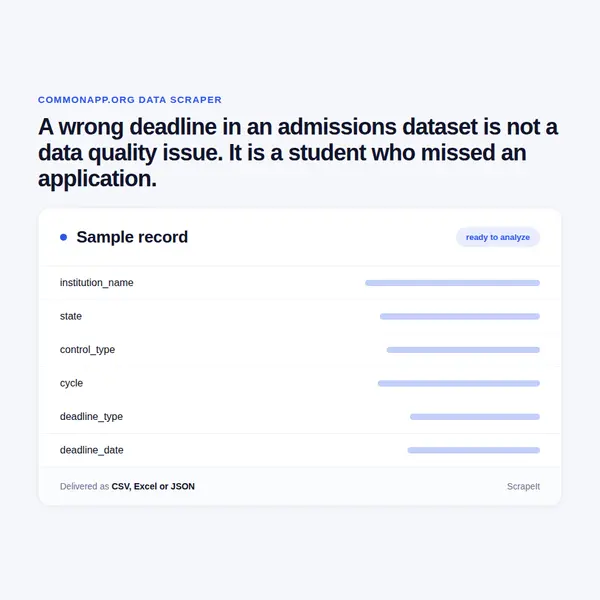
A wrong deadline in an admissions dataset is not a data quality issue. It is a student who missed an application.

Common App Scraper
Solutions

Managed admissions requirement data, run end to end by us

ScrapeIt runs the collection as a managed service. You name the institution set or take the full member list; we build the pipeline, run it on the admissions calendar rather than a flat interval, and hand back CSV, JSON, Excel or a push into your warehouse with deadlines as rows, cycles on every field and changes as their own records.

Parsing failures are surfaced rather than defaulted. On this source a field that silently keeps last year's value is worse than one that is visibly missing, and we build it that way deliberately.

We collect institutional requirement data published for applicants. No applicant data of any kind is involved, and none would be collectable in any case. Bring the use case to your own counsel before the project starts if the output will be given to students as advice.

Common App fields in every export

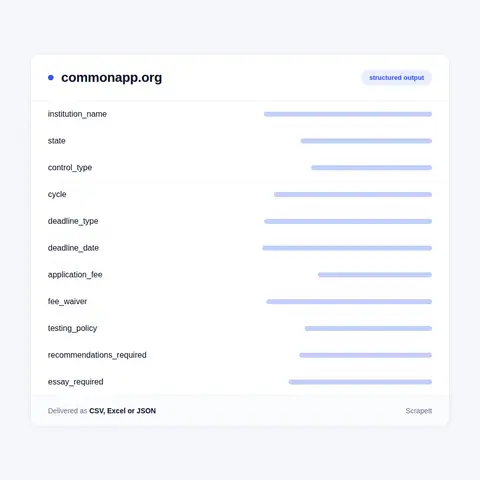
Each member record carries the institution name, state and country, control type where published, the application platforms it accepts, and the identifiers used on the platform.

Deadline fields are delivered as rows rather than a column, because most institutions have several: early decision, early action, regular decision, rolling and transfer, each with its own date, and several run more than one early round. A single deadline column is wrong for most members.

Requirement fields cover the application fee and whether waivers are offered, testing policy including test optional and test free where stated, recommendation requirements by type and count, essay and supplemental question requirements, and portfolio or audition expectations where they apply.

Cycle is recorded on every row. A requirement without the admission year it applies to is not usable, and mixing cycles in one table is how an advice product starts telling students the wrong thing.

Change records are delivered alongside: what moved since the previous collection, for which institution and when we saw it, because mid cycle amendments are exactly the thing a counsellor needs to hear about.

Common App fields in every export
Cycle handling, change alerts and counsellor products

Cycle handling, change alerts and counsellor products

Cycle handling is designed in rather than added. Historical cycles are retained rather than overwritten, which makes it possible to show how an institution's requirements have moved - a question counsellors ask constantly and nobody can answer from a current snapshot.

Change alerting is the output most advice products want. A mid cycle amendment to a deadline or a testing policy needs to reach a counsellor within days, not at the next annual refresh, so the collection runs frequently through the active season and the changes are delivered as records that can drive a notification.

Comparison sets are the common analytical use: a student's list of institutions side by side on deadlines, fees, testing and essay load, which is exactly the table a counsellor builds by hand today. Structured collection turns hours of manual work into a query.

Off season the cadence drops sharply. Requirements for the next cycle appear at a predictable point in the year, and collecting weekly in between buys nothing, so the schedule follows the admissions calendar rather than a fixed interval.

One application, hundreds of member colleges, different rules each

Common App is the shared application platform most United States undergraduate admissions run through. Students complete one core application and submit it to member colleges, each of which sets its own requirements on top: deadlines, fees, testing policy, essay questions, recommendation rules and portfolio expectations.

That per member variation is the dataset. The shared core is uniform and uninteresting; the differences between hundreds of institutions are what students, counsellors and admissions software all need, and they are published on the platform's explore surfaces.

The cycle matters more than on almost any source we work with. Requirements are set annually, published ahead of the application season and occasionally amended mid cycle, and last year's values are not merely stale, they are wrong in a way that costs somebody an application.

The explore surface responds and crawl rules are published. Volume is moderate by web standards - hundreds of institutions rather than hundreds of thousands of pages - which makes completeness achievable in a way it rarely is elsewhere.

Get a Quote
dev_w
25

Developers

customers
500+

Customers worldwide

pages
1 500 000 000+

Pages extracted

stime
15000+

Hours saved for our clients

Plans

Airplane

€199 / one-time

setup fee - included

Data limits100,000
Frequencyone-time
Run timeup to 5 days
Data storing7 days

Helicopter

€169 / mo

setup fee €499

Data limits250,000
Frequencymonthly
Run timeup to 5 days
Data storing14 days

Glasses

€229 / mo

setup fee €499

Data limits1,000,000
Frequencyweekly
Run timeup to 5 days
Data storing30 days

DNA

€549 / mo

setup fee €799

Data limits3,000,000
Frequency3 times daily
Run timesame day
Data storing90 days

Why accuracy here carries a different weight

Most datasets we build inform a business decision. This one informs a seventeen year old deciding when to submit an application, and a mistake in it has a consequence that cannot be fixed the following week.

That changes how the pipeline should be built. Every field carries the cycle it belongs to; changes are delivered as records rather than silently overwritten; and anything that fails to parse is flagged loudly rather than defaulting to a previous value. A stale deadline that quietly persists is worse than a missing one, because the missing one gets noticed.

The second reason for care is testing policy, which has moved more than any other field in recent admission cycles. Institutions have shifted between requiring tests, being optional and not considering them at all, and some have changed position mid cycle. A product carrying last year's policy gives students advice that is not merely outdated but actively harmful to their chances.

The third is fees and waivers. Application fees are a real barrier and waiver availability differs by institution, so a dataset that carries the fee but not the waiver policy tells half a story to exactly the students for whom the other half matters most.

The fourth is completeness. Because the member list is in the hundreds rather than the millions, a complete dataset is achievable, and partial coverage in this domain is not a reasonable place to stop.

Our Blog

Reads Our Latest News & Blog

Learn how to use web scraping to solve data problems for your organization

How Artificial Intelligence Is Used In Web Scraping

How Artificial Intelligence Is Used In Web Scraping

Leveraging advances in technology, the AI-powered web scraper has skyrocketed in demand and is helping to expand capabilities by automating tedious daily tasks and speeding up data collection from thousands of websites several times over.

What is Web Scraping and What is it Used For?

What is Web Scraping and What is it Used For?

Web scraping is a method of obtaining web data by extracting it from pages of web resources with the help of a program, that is, in automatic mode. It is used to syntactically convert web pages into more usable forms.

Web Scraping for Machine Learning

Web Scraping for Machine Learning

If you specialize in machine learning, you need to feed large amounts of data to the algorithms. Web scraping is the easiest and the most efficient method of collecting the data from all over the Internet.

scrapeit logo

Who builds and keeps your admissions data feed

ScrapeIt is a managed extraction company, not a tool you have to learn. Our team builds the pipeline, watches it through the admissions cycle when requirements actually move, and repairs it before a deadline goes stale in your product.

You see a sample first, in your format, over your institution list, with deadlines as rows and the cycle on every field so you can confirm the shape before the season starts.

FAQ

Why are deadlines delivered as rows rather than a column?

Because most institutions have several: early decision, early action, regular decision, rolling and transfer, and several run more than one early round. A single deadline column is simply wrong for most members, and collapsing them is how a product ends up showing a student the wrong date.

How do you handle testing policy changes?

As a per cycle field with change records, and collected frequently through the active season. Testing policy has moved more than any other field in recent cycles, including mid cycle, and a product carrying last year's value gives advice that actively harms a student's chances.

What happens if a field fails to parse?

It is flagged loudly rather than defaulted to the previous value. On this source a stale value that quietly persists is worse than a missing one, because the missing one gets noticed and the stale one gets trusted. We build it that way deliberately.

Can you keep previous cycles?

Yes, and they are retained rather than overwritten. That makes it possible to show how an institution's requirements have moved over years, which counsellors ask about constantly and nobody can answer from a current snapshot.

How often does this need refreshing?

On the admissions calendar rather than a flat interval: frequently through the active season when amendments happen, sparsely in between when nothing moves. Weekly collection in the off season buys nothing, and monthly collection during the season misses the amendments that matter.

How does it Work?

Step 1 - Make a Request

You share your needs, expectations, and desired timeframe. We’ll suggest the best solution based on your request and budget.

Step 2 - Configuring Custom Web Crawlers

Our specialists configure the crawlers and extract a sample dataset for your review before proceeding with the full-scale extraction.

Step 3 - Collect and Deliver

Once you approve the sample, we launch the project and start full data collection. We gather, filter, and structure the data for easy use, delivering it on time in your preferred format.

Step 4 - Maintain and Support

Our team manages ongoing processes, monitors website changes, and supports all data extraction cycles. We can also help integrate data into your systems or create dashboards to simplify analysis.

Request a Quote

Tell us more about you and your project information.
Which sites, which fields, how often. A couple of lines is enough.

We reply within 1 business day. No obligation.

scrapiet

Scrapeit Sp. z o.o.
10/208 Legionowa str., 15-099, Bialystok, Poland
NIP: 5423457175
REGON: 523384582