Complete University Guide Scraper for UK League Tables

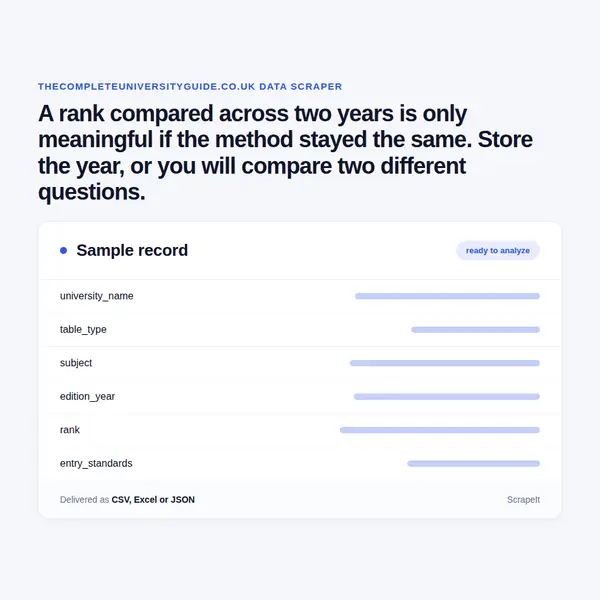
A rank compared across two years is only meaningful if the method stayed the same. Store the year, or you will compare two different questions.

Complete University Guide Scraper
Solutions

Managed rankings data, run end to end by us

ScrapeIt runs the collection as a managed service. You name the subjects or take every table; we build the pipeline with year and subject on every row and component scores kept alongside the rank, and hand back CSV, JSON, Excel or a push into your warehouse.

Editions are annual, so this is usually a yearly collection with the back series built once rather than a monitored feed, and we quote it that way.

We collect published table data only and honour the crawl rules the site publishes - search, enquiry, profile and sorted table addresses are disallowed and we do not use them. The rankings are the publisher's product and terms restrict reuse, so the dataset is for internal analysis rather than republication. Your counsel should see the use case before the project starts.

Complete University Guide fields in every export

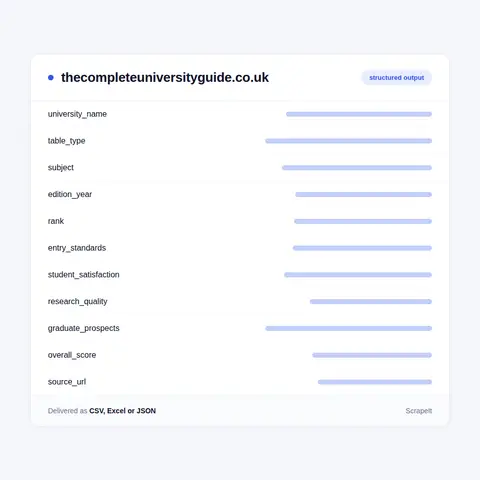
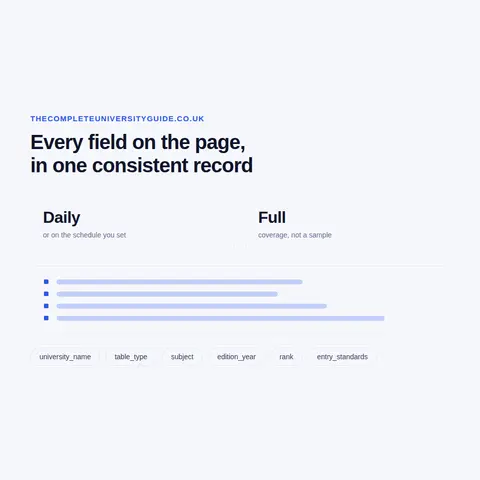
The ranking record covers the university name, the table it appears in - overall or a named subject - the edition year, the rank, and the component scores as published such as entry standards, satisfaction, research quality and graduate prospects.

Edition year is mandatory on every row. Without it a ranking dataset cannot be compared across time without quietly assuming the methodology never changed, which is the single most common error made with league table data.

Subject is a first class field rather than a table name embedded in a label, because subject level movement is usually the interesting part and it is invisible when subject tables are merged into one sheet.

Component scores are kept separate from the rank. The rank is the output; the components are what moved, and an analysis that only has the rank cannot say why anything changed.

Every row carries the collection timestamp and the source address, so any figure traces back to the table that produced it.

Complete University Guide fields in every export
Multi-year series, compiler comparison and limits

Multi-year series, compiler comparison and limits

Multi-year series are the main deliverable and need the year field to be trustworthy. Built properly they show movement at institution and subject level, with component scores attached so movement can be explained rather than just reported.

Compiler comparison is the analysis that most protects a client from a wrong conclusion. Where two compilers disagree about the same department, the disagreement is information about methodology, and surfacing it is more useful than picking whichever table suits.

Subject benchmarking is the direct institutional use: where a department sits against named competitors on each component, which is the form a planning conversation actually needs.

Limits worth stating: the crawl rules disallow the search, enquiry and profile paths along with sorted table variants, so we work from the published tables rather than from filtered views. The content is copyrighted and the rankings are the publisher's product, so the dataset is for internal analysis rather than republication.

Rankings, subjects and the tables behind them

The Complete University Guide publishes UK university league tables: an overall ranking plus subject tables, built from measures such as entry standards, student satisfaction, research quality and graduate prospects.

What makes it a data source rather than a page of numbers is the structure underneath. A ranking is not a property of a university - it is a property of a university within a subject within an edition, produced by a specific methodology. Collected as a single rank per institution, the numbers look tidy and cannot answer any question involving time or subject.

Methodology matters more than it first appears. League table compilers adjust their measures and weightings between editions, and a university moving ten places may reflect a changed formula rather than a changed institution. A dataset that carries the edition year lets that be checked; one that does not invites a false conclusion.

Table pages respond directly with substantial content. Crawl rules are published and need respecting for scope reasons: the search, enquiry and profile paths are disallowed, as are sorted and filtered variants of table addresses.

Get a Quote
dev_w
25

Developers

customers
500+

Customers worldwide

pages
1 500 000 000+

Pages extracted

stime
15000+

Hours saved for our clients

Plans

Airplane

€199 / one-time

setup fee - included

Data limits100,000
Frequencyone-time
Run timeup to 5 days
Data storing7 days

Helicopter

€169 / mo

setup fee €499

Data limits250,000
Frequencymonthly
Run timeup to 5 days
Data storing14 days

Glasses

€229 / mo

setup fee €499

Data limits1,000,000
Frequencyweekly
Run timeup to 5 days
Data storing30 days

DNA

€549 / mo

setup fee €799

Data limits3,000,000
Frequency3 times daily
Run timesame day
Data storing90 days

Why the year and the method belong in the data

League table data is unusually easy to misuse, and almost all of the misuse traces to one missing field.

A rank means something only relative to the method that produced it. Compilers revise measures and weightings between editions, so a university that moved may have moved because the formula did. Carrying the edition year, and the component scores alongside the rank, is what lets an analyst separate a real change from a methodological one. Without them the dataset supports confident wrong answers.

The second reason is subject granularity. Institutional rankings are the headline and subject rankings are where decisions actually get made - by applicants choosing a course and by departments benchmarking themselves. Those tables behave differently from the overall table and belong as their own rows.

The third is that component scores are the diagnostic. A department whose rank fell because of graduate prospects has a different problem from one whose satisfaction dropped, and only the components distinguish them.

The fourth is scope. This is one compiler's view of UK higher education. Other compilers rank differently using different measures, and a serious analysis reads more than one - we will say so rather than presenting a single table as the answer.

Our Blog

Reads Our Latest News & Blog

Learn how to use web scraping to solve data problems for your organization

How Artificial Intelligence Is Used In Web Scraping

How Artificial Intelligence Is Used In Web Scraping

Leveraging advances in technology, the AI-powered web scraper has skyrocketed in demand and is helping to expand capabilities by automating tedious daily tasks and speeding up data collection from thousands of websites several times over.

What is Web Scraping and What is it Used For?

What is Web Scraping and What is it Used For?

Web scraping is a method of obtaining web data by extracting it from pages of web resources with the help of a program, that is, in automatic mode. It is used to syntactically convert web pages into more usable forms.

Web Scraping for Machine Learning

Web Scraping for Machine Learning

If you specialize in machine learning, you need to feed large amounts of data to the algorithms. Web scraping is the easiest and the most efficient method of collecting the data from all over the Internet.

scrapeit logo

Who builds and keeps your rankings feed

ScrapeIt is a managed extraction company, not a tool you have to learn. Our team builds the pipeline, watches it as table layouts and measures change between editions, and flags a methodology change rather than letting it arrive as an unexplained jump in your series.

You see a sample first, in your format, over the subjects you actually track, with component scores separated so you can judge on a real table whether the structure answers your questions.

FAQ

Why is the edition year mandatory?

Because compilers revise measures and weightings between editions, so a university that moved may have moved because the formula did. Without the year a dataset quietly assumes the method never changed, which is the most common error made with league table data.

Do you collect subject tables as well as the overall one?

Yes, with subject as its own field. Subject rankings are where applicants and departments actually make decisions, and merging them into one sheet makes subject level movement invisible.

Why keep the component scores?

Because the rank is the output and the components are what moved. A department that fell on graduate prospects has a different problem from one that fell on satisfaction, and only the components tell you which.

Can you build a back series?

Where past editions remain published, yes, collected once rather than as a feed since editions are annual. We will tell you how far back the tables actually go rather than implying a longer series than exists.

Is one league table enough?

No, and we say so rather than selling a single source as the answer. Other compilers rank differently using different measures, and where they disagree about the same department that disagreement is information about methodology worth having.

How does it Work?

Step 1 - Make a Request

You share your needs, expectations, and desired timeframe. We’ll suggest the best solution based on your request and budget.

Step 2 - Configuring Custom Web Crawlers

Our specialists configure the crawlers and extract a sample dataset for your review before proceeding with the full-scale extraction.

Step 3 - Collect and Deliver

Once you approve the sample, we launch the project and start full data collection. We gather, filter, and structure the data for easy use, delivering it on time in your preferred format.

Step 4 - Maintain and Support

Our team manages ongoing processes, monitors website changes, and supports all data extraction cycles. We can also help integrate data into your systems or create dashboards to simplify analysis.

Request a Quote

Tell us more about you and your project information.
Which sites, which fields, how often. A couple of lines is enough.

We reply within 1 business day. No obligation.

scrapiet

Scrapeit Sp. z o.o.
10/208 Legionowa str., 15-099, Bialystok, Poland
NIP: 5423457175
REGON: 523384582