Studocu Scraper for Universities, Courses and Study Documents

Studocu files student notes by country, institution and course, and tags every document with a category, an academic year and votes. We turn that into clean rows keyed by document ID.

Plans from €169/month · Free project assessment · Reply within 1 business day

Studocu Scraper
Solutions

Studocu Data Scraping as a Managed Service

ScrapeIt runs Studocu data scraping as a managed service: we build the collector, host it and keep it working as the site changes. Studocu guards its pages hard, and suspected bots can be served decoy pages with the real layout and invented titles, courses and counts, so anti-bot handling, proxy rotation and CAPTCHA solving are part of the job, and every row is matched against the course and institution in its address before it is kept. We extract Studocu data from public pages only, never from behind a login or the Premium wall. A sample comes first; after sign-off, runs follow your schedule and arrive as CSV, JSON or XLSX, in S3, SFTP or your warehouse, or through the Studocu scraper API we host.

Studocu Data Fields on Every Document Page

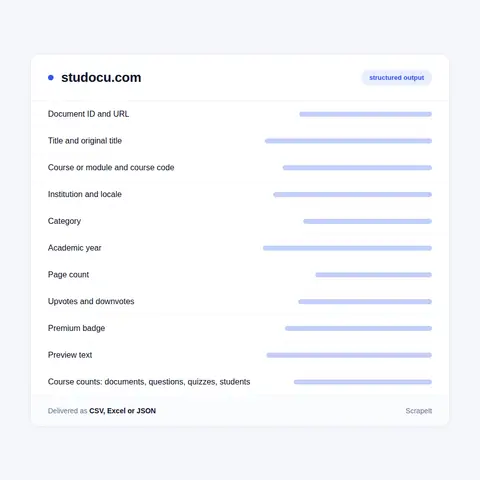
Each document page becomes one row, keyed by the document ID at the end of its address. These are the fields Studocu shows to a visitor who is not signed in.

  • Title and original title. The display title and, where Studocu has rewritten it for readability, the original title the uploader gave the file, shown under About this document.
  • Course and institution. Course or module name, course code, the course document count, institution name and short name, and whether the school is a university or a high school.
  • Category. Lecture notes, Summaries, Practice materials, Assignments, Essays, Tutorial work, Coursework, Rulings or Other at universities; Class notes, Reports, Book reports and Cheat sheets join the list at high schools.
  • Academic year and page count. The academic year in the form 2024/2025 and the number of pages, which course lists also print next to each title.
  • Votes. Upvotes and downvotes from the Was this document helpful? buttons; course pages show them as a share of positive votes with the vote count in brackets.
  • Dates and status. The publication date the page carries, the Premium badge, and whether pages after the preview are blurred.
  • Text. The preview text block and a short AI summary where Studocu shows one; for documents that open in full, the rendered text of every page. Premium documents stop at the preview.
  • Links. The documents under Students also viewed and Related documents, and any AI quiz or flashcards built from the document.

Studocu documents are uploaded by students; uploader names and profiles are not collected.

Studocu Data Fields on Every Document Page
Scrape Studocu Data from Course, School and Premium Pages

Scrape Studocu Data from Course, School and Premium Pages

Course pages add the numbers behind each course: documents, questions, quizzes and students, a Highest rated list, and one list per category with title, page count, academic year and rating for every document. Similar courses, the best flashcards for the course and a short course description complete the page, and questions answered with Ask AI are filed under the course, each on a page of its own.

Institution pages list every module or course with its code from A to Z, Popular and Recent documents, a total of all documents split by category, and a University details block with address, website and student population. Book pages group documents on one textbook by country, with the author and the number of students following it.

Studocu Premium adds a price layer. The plans page lists each plan with its period, the Studocu price per month, the total, the currency, the free trial and the saving against the shorter plan, and the Studocu Premium price changes with the country of the visitor. A Studocu price tracker reads the plans market by market - Australia, Canada, the Philippines, South Africa - and keeps each reading with its date.
Studocu University Courses by Country, School and Level

A Studocu scraper works on a library that students build themselves. Studocu started in 2013 as StudeerSnel.nl, built by four students at TU Delft, and grew from a Dutch notes site into a platform run from Amsterdam with country sites across Europe, the Americas, Africa, Asia and Oceania. Most markets sit on studocu.com under a locale path such as /en-gb/, /en-us/, /en-za/ or /pl/; the Netherlands keeps StudeerSnel at studeersnel.nl, and Indonesia and Vietnam run on studocu.id and studocu.vn.

Every country site splits into University and High School. On the university side the chain is institution, course, document, and each level carries a numeric ID in its address: /en-gb/institution/{school}/{ID}, /en-gb/course/{school}/{course}/{ID} and /en-gb/document/{school}/{course}/{title}/{ID}. The Studocu High School section adds levels on top of schools: in Great Britain Sixth Form (A Levels), GCSE, IGCSE, IB, AP and further education colleges, in South Africa Further Education and Training for grades 10 to 12, each with subject courses such as A level Chemistry.

The same object has local names. Studocu courses are called modules on the British site and courses on the American one, and a course code such as MRKTNG 3000 or BMAN23000 sits next to the name wherever the school uses one. That is why every row keeps the locale, the institution ID and the course ID: they join a document to its school and course across country sites and across runs.

Get a Quote
dev_w
25

Developers

customers
500+

Customers worldwide

pages
1 500 000 000+

Pages extracted

stime
15000+

Hours saved for our clients

Plans

Studocu Scraping Plans and Pricing

Airplane

€199 / one-time

setup fee - included

Data limits100,000
Frequencyone-time
Run timeup to 5 days
Data storing7 days

Helicopter

€169 / mo

setup fee €499

Data limits250,000
Frequencymonthly
Run timeup to 5 days
Data storing14 days

Glasses

€229 / mo

setup fee €499

Data limits1,000,000
Frequencyweekly
Run timeup to 5 days
Data storing30 days

DNA

€549 / mo

setup fee €799

Data limits3,000,000
Frequency3 times daily
Run timesame day
Data storing90 days

Why Teams Build a Studocu Database of Courses and Notes

Publishers, tutoring companies and edtech teams read Studocu as a map of demand. Document counts, votes and student numbers per course show which subjects generate the most lecture notes and practice materials at which universities, how that differs between Great Britain, the United States and South Africa, and which modules fill up before exams. A monthly snapshot turns it into a series by academic year.

Universities and exam boards watch what is filed under their own course codes and papers. Past exam questions are uploaded like any other document, as Practice materials, Assignments or Other, often with the board, paper and sitting in the title, and Studocu past papers from A Level and GCSE courses sit next to university finals. A list of titles, categories and years per course is what an academic integrity or copyright team works from.

Competitors and investors watch Studocu itself: how fast the catalogue grows per country, which institutions add courses, how the Studocu AI tools - Ask AI, AI Notes and the AI Quiz - spread across course pages, and how Studocu prices move from market to market. Text-analysis teams use titles, categories and preview text to sort study material by subject and level.

Our Blog

Reads Our Latest News & Blog

Learn how to use web scraping to solve data problems for your organization

How Artificial Intelligence Is Used In Web Scraping

How Artificial Intelligence Is Used In Web Scraping

Leveraging advances in technology, the AI-powered web scraper has skyrocketed in demand and is helping to expand capabilities by automating tedious daily tasks and speeding up data collection from thousands of websites several times over.

What is Web Scraping and What is it Used For?

What is Web Scraping and What is it Used For?

Web scraping is a method of obtaining web data by extracting it from pages of web resources with the help of a program, that is, in automatic mode. It is used to syntactically convert web pages into more usable forms.

Web Scraping for Machine Learning

Web Scraping for Machine Learning

If you specialize in machine learning, you need to feed large amounts of data to the algorithms. Web scraping is the easiest and the most efficient method of collecting the data from all over the Internet.

scrapeit logo

Ordering a Studocu Dataset or API Feed

ScrapeIt is a managed web scraping agency. You name the countries, institutions, courses or high school levels; we map them to IDs, run the crawl and deliver a Studocu dataset in three linked tables - institutions, courses and documents - plus Premium prices if you track them. Most projects start with one country and a list of universities, then widen once the fields are signed off. A Studocu export can be a one-time extract or a monthly refresh, and you check a sample before committing.

FAQ

Do you offer a Studocu API?

Yes. The ScrapeIt Studocu API returns JSON records for institutions, courses and documents: document ID and URL, title and original title, category, academic year, page count, upvotes and downvotes, Premium badge, course name and code, institution and locale, with course and institution counts as linked records. It runs on the schedule you set, from a weekly pass over chosen courses to a monthly snapshot of a whole country, and the same data ships as CSV and XLSX files.

What data can you extract from Studocu?

Everything a visitor sees on institution, course, document and book pages: names and IDs, course codes, document titles, categories, academic years, page counts, votes, Premium badges, preview text and related documents, plus course counts of documents, questions, quizzes and students, and university details such as address, website and student population. For price work we add the Premium plans as each country sees them.

How much does Studocu cost, and can you track the Studocu price by country?

Studocu is free to browse; Premium unlocks every page and unlimited downloads. In the US App Store the Studocu app lists Standard Premium at $79.99 a year or $34.99 a quarter (September 2026), while the plans page on the web lists quarterly and yearly plans with a monthly price, a total and a free trial in the visitor's currency. We track both: one reading per country and plan, with currency and date, so the Studocu subscription price in each market becomes a series.

Which countries and school levels can you cover?

Any country site Studocu runs, from Great Britain, the United States, Canada, Australia and Ireland to South Africa, India, the Philippines, Germany, Italy, Poland, Brazil and the Dutch StudeerSnel. Each site has its own universities, high schools and levels, such as A Levels, GCSE, IGCSE, IB and AP in Great Britain, so a project can take one university, one level or a whole country, keyed by locale. Documents stay in the language they were written in; page labels follow the locale.

Is it legal to scrape Studocu?

We collect only publicly available data - everything a visitor can see on Studocu - and we collect it legally. That covers institution, course, document and book pages, the preview text and the pages that open to every visitor, and the Premium plans page. No logins, no paywalls: Premium content beyond the preview is not part of it, and any personal data is handled under GDPR.

How does it Work?

Step 1 - Make a Request

You share your needs, expectations, and desired timeframe. We’ll suggest the best solution based on your request and budget.

Step 2 - Configuring Custom Web Crawlers

Our specialists configure the crawlers and extract a sample dataset for your review before proceeding with the full-scale extraction.

Step 3 - Collect and Deliver

Once you approve the sample, we launch the project and start full data collection. We gather, filter, and structure the data for easy use, delivering it on time in your preferred format.

Step 4 - Maintain and Support

Our team manages ongoing processes, monitors website changes, and supports all data extraction cycles. We can also help integrate data into your systems or create dashboards to simplify analysis.

Request a Quote

Tell us more about you and your project information.
Which sites, which fields, how often. A couple of lines is enough.

We reply within 1 business day. No obligation.

scrapiet

Scrapeit Sp. z o.o.
10/208 Legionowa str., 15-099, Bialystok, Poland
NIP: 5423457175
REGON: 523384582