UCAS Scraper for Courses, Entry Requirements, Fees and Clearing Vacancies

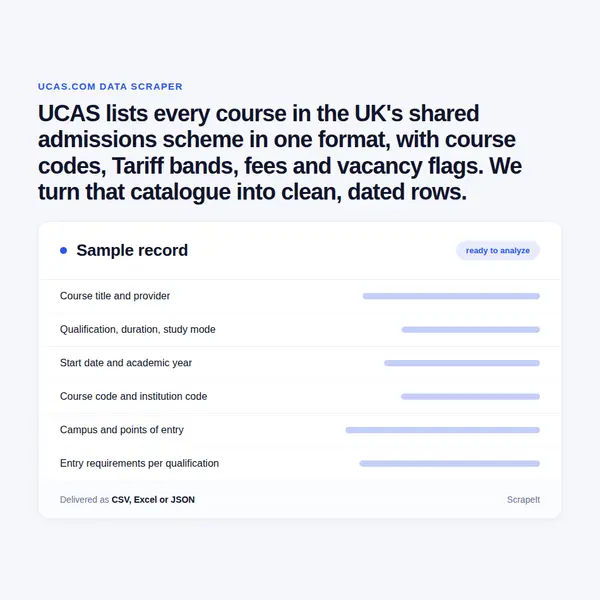
UCAS lists every course in the UK's shared admissions scheme in one format, with course codes, Tariff bands, fees and vacancy flags. We turn that catalogue into clean, dated rows.

Plans from €169/month · Free project assessment · Reply within 1 business day

UCAS Scraper
Solutions

How We Scrape UCAS Data Across Subjects, Regions and Years

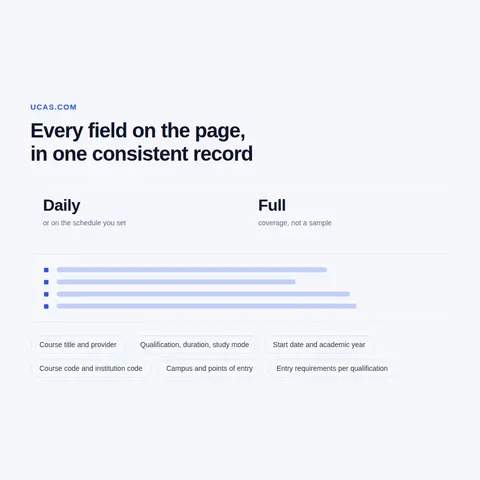
ScrapeIt runs UCAS data scraping as a managed service: we build the collector, host it and repair it when the site changes. The course search, course pages and provider pages sit behind a Cloudflare challenge, so anti-bot handling, proxy rotation and CAPTCHA solving are part of the job. We slice the search by subject, region, study type and academic year, open every course and each study option, and extract UCAS data from public pages only, with no logins. Every row keeps the course UUID, course code, institution code, campus code and study year. A sample comes first; after sign-off, runs follow your schedule and arrive as JSON, CSV or XLSX in S3, SFTP or your warehouse, or through the UCAS API we host.

UCAS Course List Fields: Codes, Tariff Points, Fees, Vacancies

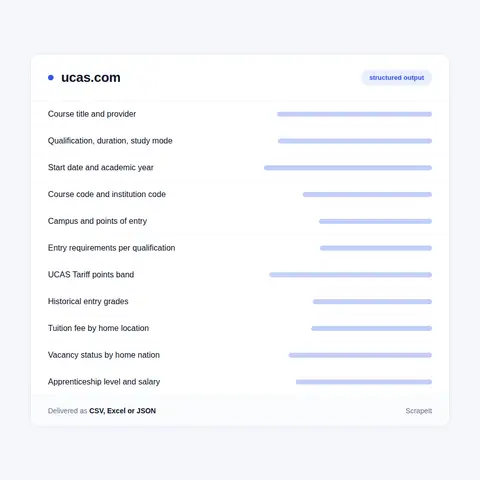
A search result row already carries course title, provider, campus, qualification, duration, study mode, start month and a Tariff band such as UCAS Tariff: 112 - 120 points, or N/A where no Tariff figure is given. The course page adds the rest, and we keep one row per course, study option and academic year.

  • Course and option. Title, provider, the Awarded by body where the page names one, qualification (BSc (Hons), MEng (Hon), MA (Hons), HNC), duration, study mode (Full-time, Part-time, Sandwich, Distance learning, Full-time including foundation year), campus, start date and the search subjects the course is tagged with. Start dates arrive in mixed formats, from a full date to a numeric date or a bare month and year, so we keep the text and a normalized date.
  • Application codes. Course code, institution code, campus name and code, points of entry (Foundation, Year 1, Year 2) and the Apply by date with its rule, such as the 14 January equal consideration deadline.
  • UCAS entry requirements. One row per qualification: A level (ABB), BTEC National Extended Diploma (D*D*D*), Scottish Higher (AABBB), International Baccalaureate (30 points), Access to HE Diploma, T Level and Irish Leaving Certificate, plus UCAS Tariff points where given, GCSE conditions, IELTS scores and extra checks such as interview, portfolio, DBS or health checks.
  • Historical entry grades. The beta block with the grades that earlier accepted offer holders held (UK A levels or BTEC National Extended Diplomas), or the notice that no grades are shown for the course.
  • Tuition fees. Fee per home location (England, Northern Ireland, Scotland, Wales, Channel Islands, Republic of Ireland, EU, International), its basis (Year 1, per year or whole course) and the additional fee text. UCAS prices come in two kinds: these fees, and the UCAS application fee of GBP 34.50 for up to five choices for 2027 entry.
  • Vacancies and provider. Has vacancies or does not have vacancies for each home nation, the Clearing notice, Teaching Excellence Framework ratings, the provider's UKPRN and the campus address and region.

UCAS Course List Fields: Codes, Tariff Points, Fees, Vacancies
UCAS Statistics, Apprenticeships, Providers and Scholarships

UCAS Statistics, Apprenticeships, Providers and Scholarships

UCAS apprenticeships come from a separate search of vacancies and graduate jobs. Each listing gives title, employer, location, level as printed (England - Advanced Apprenticeship - Level 3), salary, industry, Apply by and start date, sortable by closing date or recently added. Degree apprenticeships also appear in the course search as a study type.

Provider pages add location type (City or Town), open days with date, time and format, course locations and a Stats tab of HESA student figures: sex, domicile (UK, EU, International), full-time or part-time, entrants and study level. Scholarships and bursaries have records with amount, domicile, study level, awarding body and funding application deadline. Searching UCAS is free; turning it into a table means opening every course and study option one by one.

UCAS statistics are published, not shown on course pages, and we keep them as released, with release name and date: applicant figures after the October, January and June deadlines, daily Clearing analysis on August weekdays with a final release in September, and end of cycle data at sector and provider level, with offer rates and placed applicants by sex, area background (POLAR4, SIMD) and ethnic group. UCAS notes that about a third of young full-time undergraduate study in Scotland sits outside its figures.

UCAS Data: Courses, Providers, Codes and Key Dates

A UCAS scraper reads ucas.com, the site of the Universities and Colleges Admissions Service, the independent charity that runs the UK's shared admissions service for higher education. In September 2026 UCAS put its scale at almost three million applications a year from about 700,000 people, for full-time undergraduate courses at over 380 universities and colleges. Its course search puts every listed course in one format: degrees, foundation years, HNCs and HNDs, degree apprenticeships, higher technical qualifications, conservatoire courses, postgraduate taught and research courses, and teacher training in Scotland and Wales.

A course page sits on a UUID address such as /explore/courses/{id}/computer-science, with studyYear for the academic year and optionId for each study option, so one course can carry several modes, durations and start dates. Applicants use shorter codes: a four-character course code such as G401, an institution code such as L34 and a campus code. UCAS providers have an eight-character ID (/explore/unis/01b03c44/university-of-manchester) and tabs for About us, Stats, Student life, Courses, Apprenticeships and International.

The cycle runs on fixed dates: next year's courses appear in late April, 15 October is the equal consideration date for Oxford, Cambridge and most medicine, dentistry and veterinary courses, most other courses follow in mid-January, UCAS Extra runs from late February to 1 July, the 30 June UCAS application deadline sends later applications into Clearing, and Clearing opens on 2 July.

Get a Quote
dev_w
25

Developers

customers
500+

Customers worldwide

pages
1 500 000 000+

Pages extracted

stime
15000+

Hours saved for our clients

Plans

UCAS Scraping Plans and Pricing

Airplane

€199 / one-time

setup fee - included

Data limits100,000
Frequencyone-time
Run timeup to 5 days
Data storing7 days

Helicopter

€169 / mo

setup fee €499

Data limits250,000
Frequencymonthly
Run timeup to 5 days
Data storing14 days

Glasses

€229 / mo

setup fee €499

Data limits1,000,000
Frequencyweekly
Run timeup to 5 days
Data storing30 days

DNA

€549 / mo

setup fee €799

Data limits3,000,000
Frequency3 times daily
Run timesame day
Data storing90 days

Why Recruitment and Admissions Teams Buy a UCAS Dataset

University planning teams benchmark their portfolio against the UCAS course catalogue: which subjects competitors run, at what Tariff band, in which study modes and at what international fee. Sorting by Tariff requirements shows the ladder for one search; a full pull by subject and region gives a table you can analyse, and options filed under the next academic year show launches and withdrawals early.

Clearing is the second reason. From 2 July vacancies appear in the UCAS course search, and each course page says for every home nation whether places remain. Recruitment agencies, international counsellors and comparison apps track UCAS courses in Clearing daily, because a course can close to applicants from Scotland while it stays open to England or International, and the difference between two runs is exactly what changed.

The third is matching. Careers platforms, tutoring firms and school advisers turn predicted grades into Tariff points and match them to entry requirements, key dates and apprenticeship vacancies. Applicants often ask how many courses they can apply for through UCAS: five choices, then one at a time in Extra or Clearing. Researchers join course rows to UCAS admission statistics by provider and subject.

Our Blog

Reads Our Latest News & Blog

Learn how to use web scraping to solve data problems for your organization

How Artificial Intelligence Is Used In Web Scraping

How Artificial Intelligence Is Used In Web Scraping

Leveraging advances in technology, the AI-powered web scraper has skyrocketed in demand and is helping to expand capabilities by automating tedious daily tasks and speeding up data collection from thousands of websites several times over.

What is Web Scraping and What is it Used For?

What is Web Scraping and What is it Used For?

Web scraping is a method of obtaining web data by extracting it from pages of web resources with the help of a program, that is, in automatic mode. It is used to syntactically convert web pages into more usable forms.

Web Scraping for Machine Learning

Web Scraping for Machine Learning

If you specialize in machine learning, you need to feed large amounts of data to the algorithms. Web scraping is the easiest and the most efficient method of collecting the data from all over the Internet.

scrapeit logo

UCAS Data Scraping Delivered as Files or a UCAS API

ScrapeIt is a managed web scraping agency. You choose subjects, providers, regions, study types and entry years; we deliver a UCAS database that loads without cleaning: tables for courses, study options, entry requirements, fees, vacancy status, providers, apprenticeships and statistics, joined on UCAS's own IDs and codes, so the output doubles as a UCAS course codes list. Pricing follows scope and refresh rate, from one snapshot before the cycle opens to daily Clearing runs, and you check a sample before committing.

FAQ

Do you offer a UCAS API?

Yes. The ScrapeIt UCAS API returns courses and study options as JSON: title, provider, qualification, duration, study mode, start date, course code, institution code, campus, entry requirements per qualification, Tariff points, fees per home location and vacancy status by home nation, plus providers, apprenticeship vacancies and published statistics. You set the schedule, from a weekly catalogue refresh to daily runs in Clearing. The same data comes as CSV and XLSX exports, or lands in S3, SFTP or your warehouse.

How often do you refresh UCAS courses with vacancies during Clearing?

Daily from 2 July, when Clearing opens and vacancies show in the search, and several times a day around results days if you need it. Each run records every course's status for England, Scotland, Wales, Northern Ireland, the Republic of Ireland, the EU and International, plus the Clearing notice on the page, so each change arrives as a dated row. UCAS courses in Clearing keep moving until the last date to add a Clearing choice in October.

How do you handle UCAS Tariff points and grade requirements?

We keep both. Entry requirements stay one row per qualification, as the provider wrote them (A level ABB, BTEC D*D*D*, Scottish Higher AABBB), and the Tariff band from the search result sits beside them as a minimum and a maximum, even where the band is printed high to low, such as 112 - 96 points. Where a course gives grades only, we can add a Tariff value from UCAS's published tables. For the new V Levels, UCAS has already set A* at 56 points down to P at 12.

Which UCAS statistics can you deliver, and how are they dated?

The figures in UCAS data releases: applicant counts at the October, January and June deadlines (the October release, taken at the deadline for medicine, dentistry and veterinary courses, is where UCAS medicine statistics start each cycle), UCAS Clearing statistics day by day, and end of cycle resources, where UCAS application statistics by university include offer rates and placed applicants. Each figure keeps its cycle, release name and publication date from the UCAS data release schedule; releases go out at 00:01 unless UCAS says otherwise, so a morning run picks them up.

Is it legal to scrape UCAS?

We collect only publicly available data - everything a visitor can see on UCAS - and we collect it legally. That covers the course search, course pages, provider pages, apprenticeship and scholarship listings, key dates and published statistics. No logins, no paywalls: applications, offers and anything else in the UCAS Hub stay out, student ambassador profiles and names in testimonials are dropped, and personal data is handled under GDPR.

How does it Work?

Step 1 - Make a Request

You share your needs, expectations, and desired timeframe. We’ll suggest the best solution based on your request and budget.

Step 2 - Configuring Custom Web Crawlers

Our specialists configure the crawlers and extract a sample dataset for your review before proceeding with the full-scale extraction.

Step 3 - Collect and Deliver

Once you approve the sample, we launch the project and start full data collection. We gather, filter, and structure the data for easy use, delivering it on time in your preferred format.

Step 4 - Maintain and Support

Our team manages ongoing processes, monitors website changes, and supports all data extraction cycles. We can also help integrate data into your systems or create dashboards to simplify analysis.

Request a Quote

Tell us more about you and your project information.
Which sites, which fields, how often. A couple of lines is enough.

We reply within 1 business day. No obligation.

scrapiet

Scrapeit Sp. z o.o.
10/208 Legionowa str., 15-099, Bialystok, Poland
NIP: 5423457175
REGON: 523384582