Our Live Nation API: What the Public Pages Give You and What They Never Will
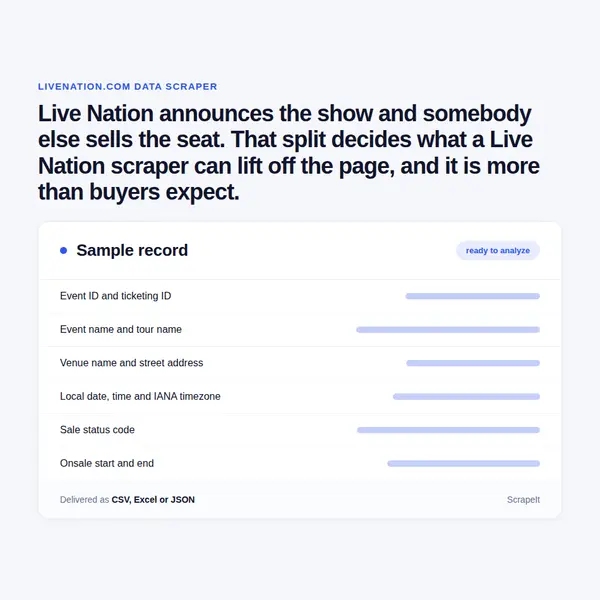
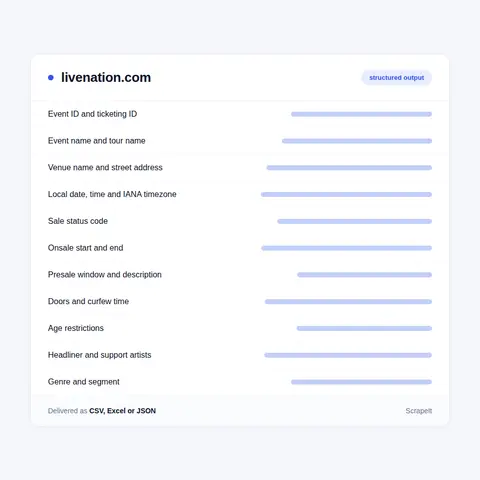
The ScrapeIt Live Nation API returns what the public pages publish - event ids, local dates, billing order, venues, presales and onsale windows - as JSON from an endpoint we host. Because the North American pages reuse the same attraction and venue identifiers as Ticketmaster, a Live Nation scraping project can join the two catalogues on ids rather than on fuzzy name matching.
That join does not make the promoter layer redundant. is_livenation_owned, the upsell catalogue, the door and parking text in important_info, curfew and age limits, festival lineups by stage and the tour announcement notes exist only here.
Neither stack publishes an XML sitemap, so crawl design leans on the HTML indexes: an A to Z artist index, an A to Z venue index that also lists third-party clubs and college halls, a genre browse, a shows-near-you feed and, internationally, an event calendar with numbered pages. Listing modules default to the nearest city and the root domain sends visitors to their own market, so national coverage comes from slicing by market, city and date range.
Be honest about the ceiling first. A Live Nation price feed cannot come from these pages, and neither can availability, fee breakdowns or seat geometry. Price monitoring on a Live Nation tour runs against the outlet the page names, while Live Nation supplies the calendar, the billing order and the rules of the night.