Ticketmaster Scraper for Event, Venue and Ticket Price Data

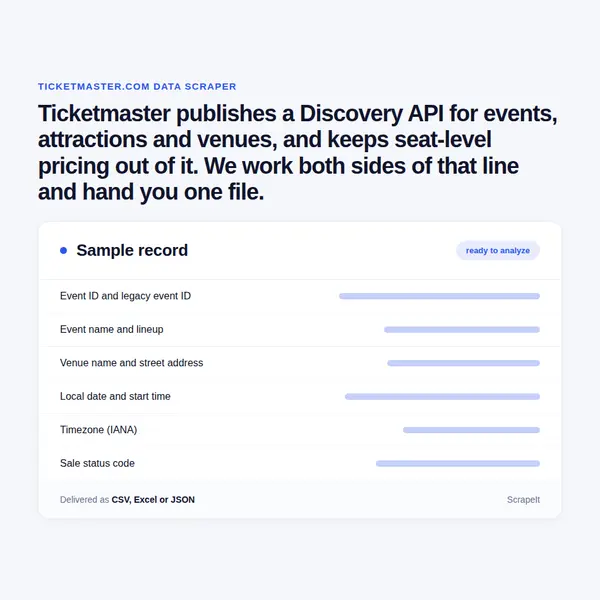
Ticketmaster publishes a Discovery API for events, attractions and venues, and keeps seat-level pricing out of it. We work both sides of that line and hand you one file.

Ticketmaster Scraper
Solutions

How ScrapeIt Runs Ticketmaster Extraction and Ships It

ScrapeIt builds the collector, runs it on our own infrastructure and repairs it when the platform moves. Anti-bot handling, proxy rotation and CAPTCHA solving are part of the managed service, and this site needs all three: the storefront meets automated clients with an identity check before it renders a single event card.

We take the API route wherever the Discovery API already covers a field, collect public pages for what it caps or omits, and merge both into one file with no visible seam. We do not join queues, sign in, buy, or touch account pages and buyer names. A sample extract arrives before the full run so field names and coverage can be checked against what you expected. After sign off we run to your schedule, hourly through monthly, and watch for endpoint and layout changes. Delivery is CSV, JSON, XLSX or an endpoint you call, pushed to S3, SFTP or your warehouse.

The Ticketmaster Event Record: Dates, Sale Windows, Price Bands and Seat Categories

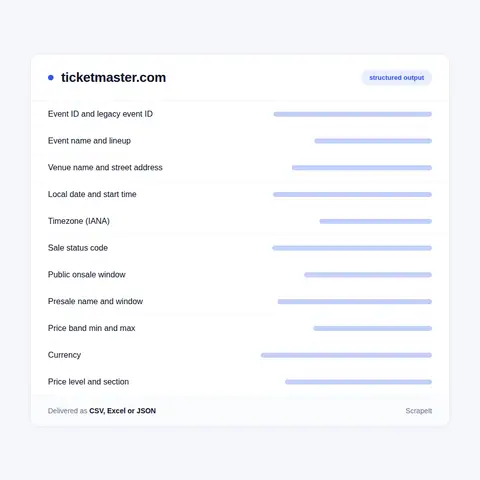
A single event record is wider than buyers expect. The field names below are the platform's own.

  • When it happens. dates.start carries localDate and localTime as the venue reads them, dateTime in UTC, and four honest flags - dateTBD, dateTBA, timeTBA and noSpecificTime - for announcements that are not settled. dates.timezone holds an IANA zone such as America/Chicago, so a Ticketmaster price or a door time never has to be inferred from the city name.
  • Whether it is selling. dates.status.code takes onsale, offsale, canceled, postponed or rescheduled. sales.public gives startDateTime, endDateTime and a startTBD flag. sales.presales is a list, each entry with its own name, description, link and window, which is how fan club, card holder and venue presales stay apart instead of collapsing into one date.
  • What it costs. priceRanges is an array of currency, min and max, and its type is standard: the primary face value band, not the seat you will be offered. The storefront record goes deeper and splits each offer into face_value, face_value_tax, facility, service, service_tax and distance, then reports faceValue, combinedFees and a rolled up all-in figure per seat.
  • Where you sit. areaGroups list sections with a description and a locationSecname; secnames map price level codes such as P1 onto their labels; quantities carry minimum, limit, exact and multiple, so a pair-only or no-single-seat rule is machine readable; seatmap is a static image URL rather than geometry.
  • The venue. Name, street lines, city, stateCode, countryCode, postalCode, latitude, longitude, timezone, default currency, market and DMA membership, plus box office detail - phone number, opening hours, accepted payment, will call - and parkingDetail, accessibleSeatingDetail, generalRule and childRule.
  • The rest of the card. pleaseNote for event notes, ticketLimit and accessibility text, ageRestrictions, promoter and promoters, products and outlets for packages and partner sites, images in 16_9, 3_2 and 4_3 ratios with a fallback flag when the picture belongs to the artist rather than the show, aliases, upcomingEvents counts, and the flags that decide behaviour: isResaleEligible, f2fexchange, isSecureEntry and disableTransfer.

The Ticketmaster Event Record: Dates, Sale Windows, Price Bands and Seat Categories
Platinum, All In Pricing, Verified Resale and the Onsale Queue

Platinum, All In Pricing, Verified Resale and the Onsale Queue

Platinum is a ticket type, not a package. Official Platinum seats are priced by the event organizer and move with demand, and the platform states it runs no algorithmic surge pricing. They sit on the same map as ordinary inventory, and the legend keeps Available, Platinum, VIP, Verified Resale, Face Value Exchange and Accessibility apart, so a Ticketmaster price feed that flattens it blends four economics into one number.

Fees are folded in, taxes are not. The site displays an All In Price that folds required fees into the number: a service fee, plus a facility charge set by the venue. Delivery fees appear only if you pick paid delivery, and local taxes land at checkout unless the market includes them. On the European stack the split is explicit - price ranges arrive twice, once excluding ticket fees and once including them.

Resale lives inside the storefront. Verified Resale listings are priced by the seller, labelled before purchase, and may sit above or below face value. Where an artist caps resale at the price paid, the listing becomes a Face Value Exchange with no resale fee. A resale ticket can still print the original buyer's name and price; the barcode is what admits you.

Big onsales run through a queue. A waiting room opens ahead of the sale, the queue screens for bots and hands out places in line, and a turn is held for ten minutes. The queue path is closed to crawlers in robots.txt along with the seating chart and internal availability endpoints, and ticket limits are set per event and checked on every transaction.

How Ticketmaster Is Wired: Events, Attractions, Venues and Two Sets of IDs

Ticketmaster is the primary ticketing arm of Live Nation Entertainment, and its catalogue rests on four entities a Ticketmaster scraper has to keep straight: the event, the attraction, the venue and the classification.

An attraction is whoever is on the bill - an artist, a team, a play, a parking pass. An event is one performance, on one date, at one venue, and it can carry several attractions at once, which is how a festival bill appears. A venue owns the address, the IANA timezone and the default currency for everything sold there. A classification is a five-level chain: segment, genre and sub-genre say what the event is (Music, Sports, Arts and Theatre, Film, Miscellaneous), while type and sub-type say what the item is (Parking, Band, Individual), plus a family flag.

There is no tour object. A tour is an event name repeated across dates that share an attraction, so pulling a full run means filtering events by attraction id, not asking for a tour.

Identifiers come in pairs, and mixing them up is the first mistake. The modern id is an opaque string: events read like G5diZfkn0B-bh, attractions begin with K8vZ, venues with KovZ, classification levels with KnvZfZ7v. The legacy storefront id is a sixteen character uppercase hex string for an event and a plain number for an artist or a venue. The platform's own feed carries both: eventId beside legacyEventId, venueId beside legacyVenueId. Public addresses use the legacy half: /{name}-{city}-{state}-{MM-DD-YYYY}/event/{HEX}, /{name}-tickets/artist/{number} and /{name}-tickets-{city}/venue/{number}. Browse pages sit under /discover/, one per city and one per segment, and their genre filter takes the same classificationId the API uses.

Get a Quote
dev_w
25

Developers

customers
500+

Customers worldwide

pages
1 500 000 000+

Pages extracted

stime
15000+

Hours saved for our clients

Plans

Airplane

€199 / one-time

setup fee - included

Data limits100,000
Frequencyone-time
Run timeup to 5 days
Data storing7 days

Helicopter

€169 / mo

setup fee €499

Data limits250,000
Frequencymonthly
Run timeup to 5 days
Data storing14 days

Glasses

€229 / mo

setup fee €499

Data limits1,000,000
Frequencyweekly
Run timeup to 5 days
Data storing30 days

DNA

€549 / mo

setup fee €799

Data limits3,000,000
Frequency3 times daily
Run timesame day
Data storing90 days

What the Ticketmaster Discovery API Covers, and Where It Runs Out

There is a public API, and it deserves a straight answer. The Discovery API v2 answers at app.ticketmaster.com/discovery/v2/, takes its key in the apikey query parameter, returns JSON only, and opens nine resources: event search and details, event images, attraction search and details, classification search and details, venue search and details. It reads several platforms at once - ticketmaster, tmr for resale, universe and frontgate - and a source parameter narrows the mix. The developer portal currently puts coverage above 230K events (September 2026).

Then the ceiling. A default key is currently quoted at 5,000 calls a day, and deep paging stops at the 1,000th item, so a national sweep has to be sliced rather than paged straight through. The filters exist for that: countryCode, stateCode, city, postalCode, geoPoint with a radius, marketId, dmaId, classificationId, promoterId, and date ranges on both event start and onsale start.

The public tier withholds the half buyers came for: live availability, per-section and per-seat pricing, resale listing prices, and the fee breakdown behind the headline. Those sit behind approval - an inventory status service for availability and price bands, a partner-tier international service for event prices, areas and seat maps, and commerce endpoints for offers and carts. The API terms also bar caching event content beyond what your service needs and bar reselling access. That is why Ticketmaster scraping and a Ticketmaster API key answer different halves of the question, and why price monitoring runs on both.

Our Blog

Reads Our Latest News & Blog

Learn how to use web scraping to solve data problems for your organization

How Artificial Intelligence Is Used In Web Scraping

How Artificial Intelligence Is Used In Web Scraping

Leveraging advances in technology, the AI-powered web scraper has skyrocketed in demand and is helping to expand capabilities by automating tedious daily tasks and speeding up data collection from thousands of websites several times over.

What is Web Scraping and What is it Used For?

What is Web Scraping and What is it Used For?

Web scraping is a method of obtaining web data by extracting it from pages of web resources with the help of a program, that is, in automatic mode. It is used to syntactically convert web pages into more usable forms.

Web Scraping for Machine Learning

Web Scraping for Machine Learning

If you specialize in machine learning, you need to feed large amounts of data to the algorithms. Web scraping is the easiest and the most efficient method of collecting the data from all over the Internet.

scrapeit logo

Working With ScrapeIt on Ticketmaster Data

ScrapeIt is a managed web scraping agency. You name the markets, genres and fields you need; we design the crawl, run it, watch it and hand back a file that loads without cleaning. Pricing follows volume and refresh rate, and the first sample costs nothing. In practice a Ticketmaster project starts with one tour or one market, a field list agreed in writing, and a cadence that keeps onsale dates and price bands current without leaning on the site harder than it tolerates.

FAQ

Does Ticketmaster have a public API, and what does that API leave out?

Yes. The Discovery API v2 is open to anyone with a free key and returns JSON for event search and details, event images, attractions, classifications and venues. It carries dates, timezone, sale windows, presales, venue address and geo, classifications, images and a primary price band of type standard. What it does not carry is live availability, per-section or per-seat prices, resale listing prices or the fee breakdown. Those belong to partner tiers that need approval. A default key is currently capped at 5,000 calls a day with deep paging stopping around the 1,000th item.

Which fields can you deliver for each Ticketmaster event?

Event id in both forms, event name, lineup of attractions, venue with street address, city, state, country, postal code and coordinates, local date and time plus the IANA timezone, sale status, public onsale window, every presale with its own name and window, price band minimum and maximum with currency, price level and section labels, ticket limit text, accessibility and age notes, promoter, seat map image, images in three ratios, and the resale and secure-entry flags. Anything the public tier omits we take from public pages, and we say in the sample which field came from where.

How often can Ticketmaster prices and onsale status be refreshed?

Hourly is the practical ceiling and it matches the platform: the partner availability service refreshes its own price bands at most once an hour, so anything faster mostly repeats itself. Status codes flip fast around an announcement - offsale to onsale, then postponed or rescheduled - so a tight schedule pays off in the week of a sale and rarely after it. For catalogue work, daily is normal, and we can run a fast lane on a watchlist of events while the wider market refreshes on a slower loop.

Which countries and languages does Ticketmaster cover?

Coverage is filtered by ISO alpha-2 country code and spans North America, the United Kingdom and Ireland, Australia and New Zealand, Mexico, most of western and central Europe, the Nordics, plus markets such as South Africa, the United Arab Emirates, Singapore, Japan and Brazil. Under country sit marketId groupings and, in the United States, DMA ids. Language is a locale parameter that accepts a comma separated list and a trailing wildcard. European storefronts run on a separate stack addressed by domain names such as unitedkingdom or sweden, each with its own default language, currency and numeric event ids.

Is it legal to scrape Ticketmaster data, and what do you not collect?

We collect public pages and the documented API only. No accounts, no logins, no queue jumping, no purchase flow, and no personal data: buyer names, seller identities and order details stay untouched. Site terms restrict automated access, so we keep request rates polite, honour crawl directives and prefer the official endpoint wherever it answers the question. Ownership of event content stays with the organizers and the platform, so we recommend a short legal review of your own use case before a long-running feed goes live.

How does it Work?

Step 1 - Make a Request

You share your needs, expectations, and desired timeframe. We’ll suggest the best solution based on your request and budget.

Step 2 - Configuring Custom Web Crawlers

Our specialists configure the crawlers and extract a sample dataset for your review before proceeding with the full-scale extraction.

Step 3 - Collect and Deliver

Once you approve the sample, we launch the project and start full data collection. We gather, filter, and structure the data for easy use, delivering it on time in your preferred format.

Step 4 - Maintain and Support

Our team manages ongoing processes, monitors website changes, and supports all data extraction cycles. We can also help integrate data into your systems or create dashboards to simplify analysis.

Request a Quote

Tell us more about you and your project information.
Which sites, which fields, how often. A couple of lines is enough.

We reply within 1 business day. No obligation.

scrapiet

Scrapeit Sp. z o.o.
10/208 Legionowa str., 15-099, Bialystok, Poland
NIP: 5423457175
REGON: 523384582