Ents24 Scraper for UK Events, Venues and Artists

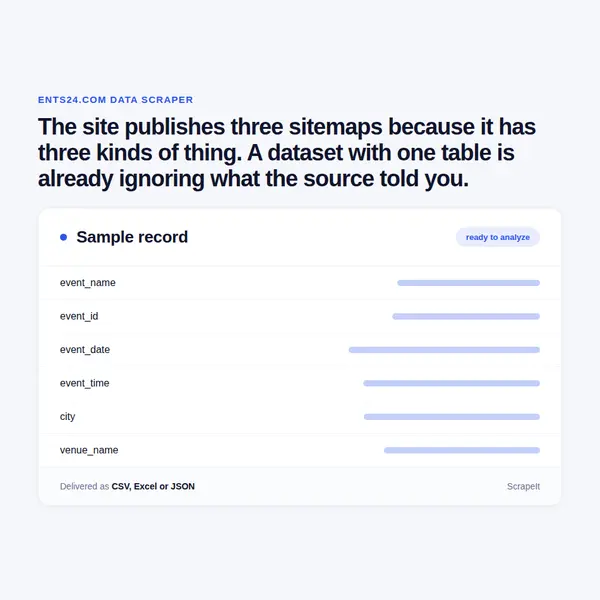
The site publishes three sitemaps because it has three kinds of thing. A dataset with one table is already ignoring what the source told you.

Ents24 Scraper
Solutions

Managed UK listings data, run end to end by us

ScrapeIt runs the collection as a managed service. You name the categories, cities or the full listing; we build events, venues and artists as linked entities using the sitemaps the site publishes for each, and hand back CSV, JSON, Excel or a push into your warehouse.

Because the archive cannot be crawled backwards, we start the forward record immediately where history matters and say plainly how long it will take to become useful.

We collect published listing data only and honour the crawl rules the site publishes - the outbound ticket link and past event paths are disallowed and we do not go near them. No user data, no account access. Terms restrict commercial reuse, so the dataset is for analysis rather than republication, and your counsel should see the use case before the project starts.

Ents24 fields in every export

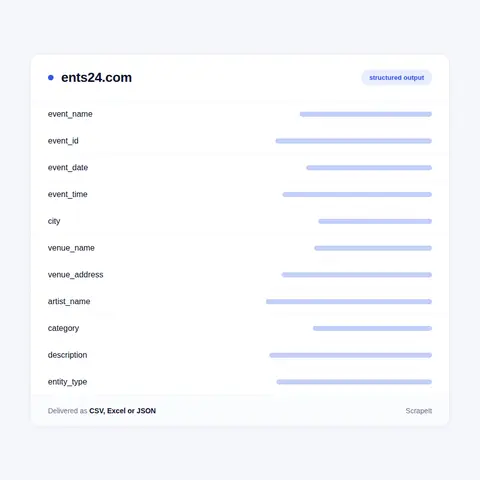
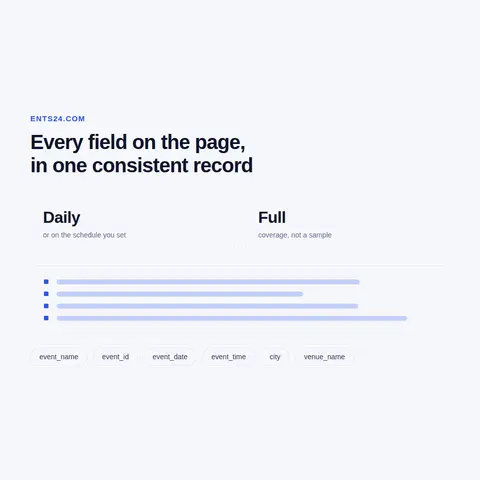
Event records carry the event name, date and time as published, city, venue, the performing artists, category, description and the event identifier from its address.

Venue records are their own table: name, city, address, and the events held there. Once venues are entities rather than strings, a venue's programming history is a query rather than a text search, and the same venue written two ways stops being two venues.

Artist records work the same way, which is what makes tour reconstruction possible - a run of dates by one artist across venues is obvious in a linked model and invisible in a flat one.

Relationships are explicit rows connecting events to venues and artists, since an event with three acts is three relationships and a comma-separated field is not.

Every row carries the collection timestamp and the source address, so any figure can be traced back to the page that produced it.

Ents24 fields in every export
Tour reconstruction, venue histories and limits

Tour reconstruction, venue histories and limits

Tour reconstruction is the most valuable output of the linked model: an artist's dates across venues and cities, assembled from listings that individually say nothing about being part of a tour. It falls out of the artist entity almost for free once the relationships exist.

Venue programming history answers what a venue books, how often and in which categories, which is the analysis venue operators and promoters use to position against each other.

Category coverage across the UK - where comedy is thin, where theatre concentrates - is a market structure question that this source is well placed to answer because it spans categories rather than specialising.

The limits are the ones the crawl rules set: no seller attribution, no historical archive by crawling backwards, and no price or availability data because the site does not sell tickets. We state all three at scoping rather than at delivery.

A UK listings guide with three entity types

Ents24 is a long-running UK entertainment listings guide covering concerts, theatre, comedy and club events across the country. It lists what is on, where, and who is playing, and links out to wherever tickets are actually sold.

Its structure is unusually explicit about what it contains. The address of an event page carries the city, the venue and the artist in the path, and the site publishes separate sitemaps for events, venues and artists. That is the source telling you plainly that it holds three kinds of record with relationships between them, and a collector that produces one flat table of events is discarding that for no reason.

Modelled properly, venues and artists become entities in their own right with their own histories, which is what supports questions about programming and touring rather than just about next weekend.

Crawl rules are published and need reading carefully, because two of the disallowed paths matter to scope rather than just to politeness.

Get a Quote
dev_w
25

Developers

customers
500+

Customers worldwide

pages
1 500 000 000+

Pages extracted

stime
15000+

Hours saved for our clients

Plans

Airplane

€199 / one-time

setup fee - included

Data limits100,000
Frequencyone-time
Run timeup to 5 days
Data storing7 days

Helicopter

€169 / mo

setup fee €499

Data limits250,000
Frequencymonthly
Run timeup to 5 days
Data storing14 days

Glasses

€229 / mo

setup fee €499

Data limits1,000,000
Frequencyweekly
Run timeup to 5 days
Data storing30 days

DNA

€549 / mo

setup fee €799

Data limits3,000,000
Frequency3 times daily
Run timesame day
Data storing90 days

Why the crawl rules shape the scope here

Two of the disallowed paths on this site change what a project can honestly promise, and it is better to say so before quoting than to discover it in delivery.

The outbound ticket link paths are disallowed. That means the dataset can tell you an event exists, where and when, and who is playing, but not where its tickets are sold from this source. Anyone wanting seller attribution needs it from the ticketing platforms directly, and we will scope that separately rather than quietly leaving a hole.

The past event paths are disallowed too. So this source supports what is coming, not what happened, and a historical archive cannot be built by crawling backwards. It can only accumulate forward from the day collection starts, which is a meaningful difference if somebody is expecting last year's data.

What the source is genuinely good for is breadth of current UK listings across several categories at once, with the entity structure to make it analysable. Concerts, theatre, comedy and clubs in one consistent model is rarer than it sounds.

The fourth point is that a listings guide is an index rather than a seller. It is strong on what exists and says nothing about availability or price, and a brief that needs those needs a ticketing source alongside it.

Our Blog

Reads Our Latest News & Blog

Learn how to use web scraping to solve data problems for your organization

How Artificial Intelligence Is Used In Web Scraping

How Artificial Intelligence Is Used In Web Scraping

Leveraging advances in technology, the AI-powered web scraper has skyrocketed in demand and is helping to expand capabilities by automating tedious daily tasks and speeding up data collection from thousands of websites several times over.

What is Web Scraping and What is it Used For?

What is Web Scraping and What is it Used For?

Web scraping is a method of obtaining web data by extracting it from pages of web resources with the help of a program, that is, in automatic mode. It is used to syntactically convert web pages into more usable forms.

Web Scraping for Machine Learning

Web Scraping for Machine Learning

If you specialize in machine learning, you need to feed large amounts of data to the algorithms. Web scraping is the easiest and the most efficient method of collecting the data from all over the Internet.

scrapeit logo

Who builds and keeps your Ents24 feed

ScrapeIt is a managed extraction company, not a tool you have to learn. Our team builds the pipeline, maintains venue and artist resolution as names drift, and repairs the collector before a forward archive develops a gap that cannot be filled.

You see a sample first, in your format, over the categories you actually track, with venues and artists as real entities so you can judge the model on a real tour rather than on a description.

FAQ

Why three tables instead of one list of events?

Because the site itself holds three kinds of record and publishes a separate sitemap for each. Flattened into one table, venue programming and artist touring become text searches instead of queries, and the same venue written two ways becomes two venues.

Can you tell me where tickets are sold?

Not from this source. The outbound ticket link paths are disallowed by its crawl rules, so seller attribution has to come from the ticketing platforms directly. We scope that separately rather than leaving a quiet hole in the delivery.

Can you collect last year's events?

No. The past event paths are disallowed, so the archive cannot be crawled backwards. History accumulates forward from the day collection starts, which matters if somebody is expecting a back catalogue and is better said before the quote than after.

Does it include ticket prices?

No, and not because of a crawl restriction - the site is a listings guide rather than a seller, so price and availability simply are not there. A brief needing those needs a ticketing source alongside this one.

What is it actually best at?

Breadth. Concerts, theatre, comedy and club events across the UK in one consistent model, with the entity structure to make it analysable. Covering several categories at once is rarer than it sounds and is what makes tour and venue analysis work here.

How does it Work?

Step 1 - Make a Request

You share your needs, expectations, and desired timeframe. We’ll suggest the best solution based on your request and budget.

Step 2 - Configuring Custom Web Crawlers

Our specialists configure the crawlers and extract a sample dataset for your review before proceeding with the full-scale extraction.

Step 3 - Collect and Deliver

Once you approve the sample, we launch the project and start full data collection. We gather, filter, and structure the data for easy use, delivering it on time in your preferred format.

Step 4 - Maintain and Support

Our team manages ongoing processes, monitors website changes, and supports all data extraction cycles. We can also help integrate data into your systems or create dashboards to simplify analysis.

Request a Quote

Tell us more about you and your project information.
Which sites, which fields, how often. A couple of lines is enough.

We reply within 1 business day. No obligation.

scrapiet

Scrapeit Sp. z o.o.
10/208 Legionowa str., 15-099, Bialystok, Poland
NIP: 5423457175
REGON: 523384582