Wegow Scraper for Concerts, Tours and Festival Data

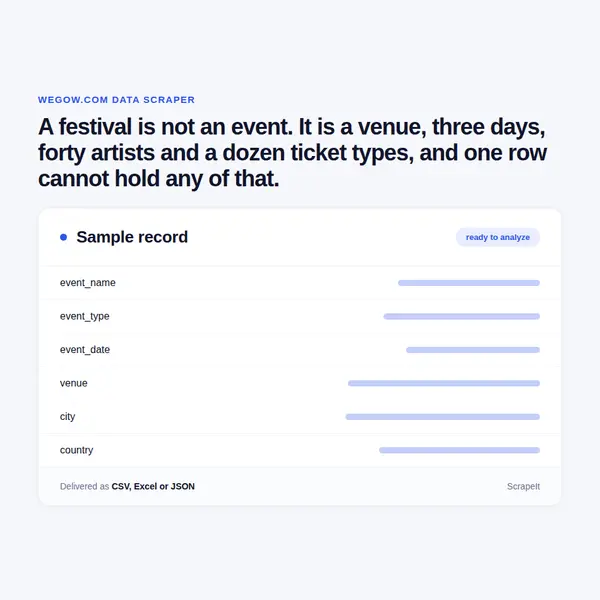
A festival is not an event. It is a venue, three days, forty artists and a dozen ticket types, and one row cannot hold any of that.

Wegow Scraper
Solutions

Managed live music data, run end to end by us

ScrapeIt runs the collection as a managed service. You name the cities, artists or genres; we build the pipeline with event types separated, tours captured where stated, festival lineups as rows, and hand back CSV, JSON, Excel or a push into your warehouse.

Where announcement timing matters - when a date went on sale, when a lineup was completed - we run repeat collection and keep every observation, because those are change facts rather than page facts.

We collect published listing data only, honour the crawl rules the site publishes and pace requests. No user data, no social graph, no account access. Terms restrict commercial reuse, so the dataset is for analysis rather than republication, and your counsel should see the use case before the project starts.

Wegow fields in every export

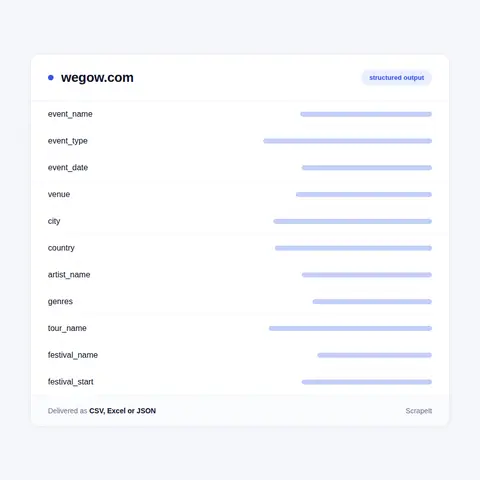
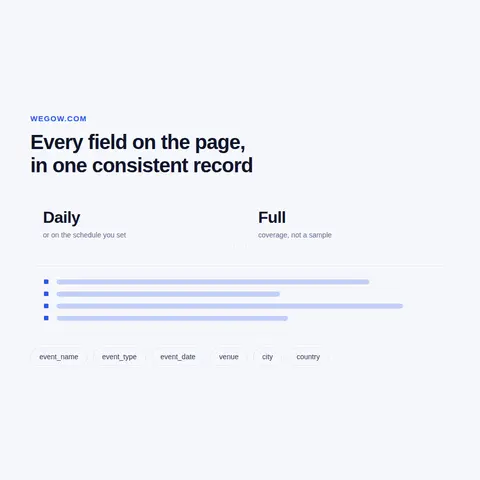
Event records carry the event name, event type, date and time, venue, city, country, the artists performing, genres, and the tour or festival it belongs to where stated.

Event type separates concert, tour date and festival from the start, because the three need different handling and a single type column is the cheapest way to keep aggregates honest.

Festival records carry their own fields: start and end dates, stages where published, and the full lineup as rows rather than a block of text. A forty artist lineup is forty relationships and the only useful form for it is rows.

Ticket types are their own records with name, price and currency, which covers both the tier structure of a concert and the day pass and full pass structure of a festival without forcing either into the other's shape.

Every row carries the collection timestamp and, where the platform is multilingual, the language the values were read in.

Wegow fields in every export
Tour mapping, festival lineups and limits

Tour mapping, festival lineups and limits

Tour mapping is the clearest output: which artists are touring, where they go, in what order and at what frequency. With the tour field captured it is a query; without it, it is an inference nobody should rely on.

Festival lineup analysis is the second, and once lineups are rows it supports the questions festival bookers actually ask - which artists appear across how many festivals in a season, which are exclusive, and how a lineup compares with a competitor's.

City coverage analysis shows where live music concentrates and where it thins out, which matters to promoters planning routing and to anyone studying cultural supply outside capital cities.

What stays out of scope is the audience. The platform has a social dimension - following artists, attending - and none of it is collected. Artists as billed publicly are professional credits; users are not part of the dataset in any form.

Concerts, tours and festivals in one catalogue

Wegow is a live music platform built around artists and their audiences, strongest in Spain and active in other European markets. It lists concerts, tours and festivals, with the artist rather than the venue as the organising idea.

That artist-first structure is useful, because it means tour relationships are closer to the surface than on a venue-led listings site. A run of dates belongs to something, and having that something as a field rather than an inference is a real advantage.

Festivals are where this catalogue needs the most care. A festival is a multi-day event with a large lineup, several stages and a set of ticket types - day tickets, full passes, camping - that have nothing to do with the single-price model of a concert listing. Held in one row alongside concerts, a festival is a data point that distorts every aggregate it appears in.

Listing pages respond directly and crawl rules are published and permissive, allowing the site generally and disallowing only sign in, sign up and promoter registration.

Get a Quote
dev_w
25

Developers

customers
500+

Customers worldwide

pages
1 500 000 000+

Pages extracted

stime
15000+

Hours saved for our clients

Plans

Airplane

€199 / one-time

setup fee - included

Data limits100,000
Frequencyone-time
Run timeup to 5 days
Data storing7 days

Helicopter

€169 / mo

setup fee €499

Data limits250,000
Frequencymonthly
Run timeup to 5 days
Data storing14 days

Glasses

€229 / mo

setup fee €499

Data limits1,000,000
Frequencyweekly
Run timeup to 5 days
Data storing30 days

DNA

€549 / mo

setup fee €799

Data limits3,000,000
Frequency3 times daily
Run timesame day
Data storing90 days

Why festivals and tours need modelling before collection

The two structures that make this source interesting are also the two that break a naive collector, and both have to be decided before the first request rather than cleaned up after.

Tours first. A tour is a sequence of dates by one artist, and knowing that six listings belong to one run changes what they mean: it is one commercial decision rather than six. Where the platform states the tour, capturing it is nearly free. Reconstructed later from artist and date proximity it is guesswork, and it is wrong exactly when an artist plays two cities in one week for unrelated reasons.

Festivals second. A three day festival with forty artists across several stages, sold as day tickets and full passes, is not comparable to a Tuesday night club show, and any average that contains both describes neither. Typed separately, both are usable; merged, the festivals dominate every artist count and the concerts dominate every event count.

The third reason is that artist-first organisation makes this a good source for coverage questions: which artists tour Spain, how often, in which cities, and how that compares with neighbouring markets.

The fourth is scope. Wegow is strong in Spain and lighter elsewhere, so it is a Spanish live music source with European coverage rather than a European source, and we describe it that way.

Our Blog

Reads Our Latest News & Blog

Learn how to use web scraping to solve data problems for your organization

How Artificial Intelligence Is Used In Web Scraping

How Artificial Intelligence Is Used In Web Scraping

Leveraging advances in technology, the AI-powered web scraper has skyrocketed in demand and is helping to expand capabilities by automating tedious daily tasks and speeding up data collection from thousands of websites several times over.

What is Web Scraping and What is it Used For?

What is Web Scraping and What is it Used For?

Web scraping is a method of obtaining web data by extracting it from pages of web resources with the help of a program, that is, in automatic mode. It is used to syntactically convert web pages into more usable forms.

Web Scraping for Machine Learning

Web Scraping for Machine Learning

If you specialize in machine learning, you need to feed large amounts of data to the algorithms. Web scraping is the easiest and the most efficient method of collecting the data from all over the Internet.

scrapeit logo

Who builds and keeps your Wegow feed

ScrapeIt is a managed extraction company, not a tool you have to learn. Our team builds the pipeline, maintains artist and tour resolution as listings are updated, and repairs the collector before a festival season goes unrecorded.

You see a sample first, in your format, over the cities and genres you actually track, with festivals typed separately and lineups expanded so you can judge the model on a real season.

FAQ

Why separate festivals from concerts?

Because a three day festival with forty artists and several ticket types is not comparable to a Tuesday club show, and an average containing both describes neither. Merged, festivals dominate every artist count while concerts dominate every event count.

Can you group dates into tours?

Where the platform states the tour, yes, and capturing it then is nearly free. Reconstructed afterwards from artist and date proximity it is guesswork, and it goes wrong exactly when an artist plays two cities in a week for unrelated reasons.

How are festival lineups delivered?

As rows linking artists to the festival, with stage where published. A forty artist lineup in one text field cannot answer which artists appear across how many festivals in a season, which is the question festival bookers actually have.

Does this cover all of Europe?

Not evenly. It is strong in Spain and lighter elsewhere, so it is a Spanish live music source with some European coverage rather than a European one. We scope briefs on that basis rather than letting coverage be assumed from the domain.

Do you collect user or following data?

No. The platform has a social dimension and none of it is collected - no users, no follows, no attendance. Artists as billed publicly are professional credits; the audience is not part of the dataset in any form.

How does it Work?

Step 1 - Make a Request

You share your needs, expectations, and desired timeframe. We’ll suggest the best solution based on your request and budget.

Step 2 - Configuring Custom Web Crawlers

Our specialists configure the crawlers and extract a sample dataset for your review before proceeding with the full-scale extraction.

Step 3 - Collect and Deliver

Once you approve the sample, we launch the project and start full data collection. We gather, filter, and structure the data for easy use, delivering it on time in your preferred format.

Step 4 - Maintain and Support

Our team manages ongoing processes, monitors website changes, and supports all data extraction cycles. We can also help integrate data into your systems or create dashboards to simplify analysis.

Request a Quote

Tell us more about you and your project information.
Which sites, which fields, how often. A couple of lines is enough.

We reply within 1 business day. No obligation.

scrapiet

Scrapeit Sp. z o.o.
10/208 Legionowa str., 15-099, Bialystok, Poland
NIP: 5423457175
REGON: 523384582