Bandsintown Scraper for Artist Tour Dates, Ticket Links and Follower Counts

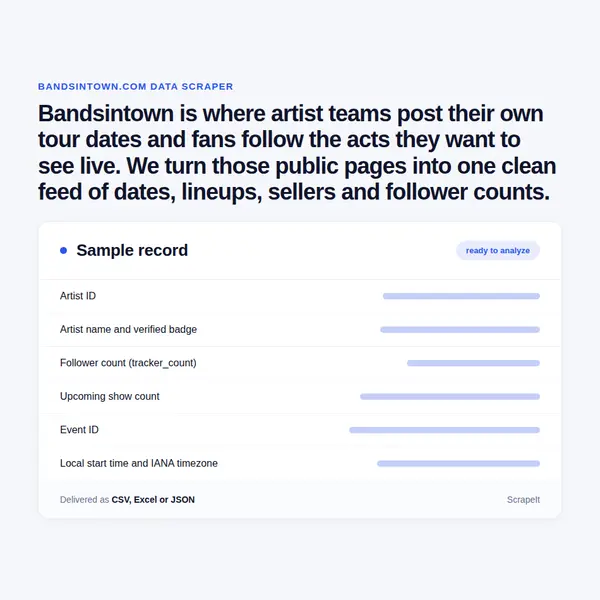
Bandsintown is where artist teams post their own tour dates and fans follow the acts they want to see live. We turn those public pages into one clean feed of dates, lineups, sellers and follower counts.

Bandsintown Scraper
Solutions

Bandsintown Scraping Delivered as a Feed or Event Data API

ScrapeIt collects Bandsintown data as a managed service, and the platform calls for one: artist, event and city pages, and even the sitemap files, sit behind a browser challenge, so anti-bot handling, proxy rotation and CAPTCHA solving come built into the work. To scrape Bandsintown at market scale we walk the artist, venue and city indexes of the sitemap plus the festival lists, and slice cities by date window and genre; we extract Bandsintown data such as seller rows straight from the event page rather than through the closed redirect path. Records are keyed on event id, lineups fold into one row per night, venue names and genre tags are normalized, and artists join MusicBrainz through the mbid where one is set. No sign-in and no fan pages. Output lands in your warehouse, as JSON, CSV or XLSX files, or behind an endpoint you query like an event data API.

Bandsintown Concerts and Festivals: Event, Venue, Lineup, Seller and Status Fields

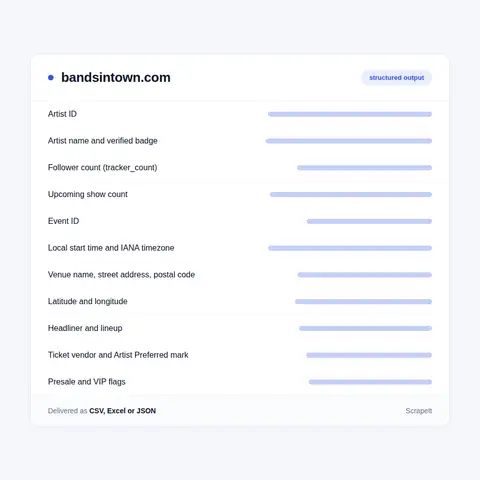
Every show is a record with its own numeric id at /e/ plus that number, and every performer has one too: the 128 in /a/128-metallica is the id the official API accepts as id_128. Bandsintown concerts in London, NYC or Chicago sit on city pages - /c/london-united-kingdom, /c/new-york-ny, /c/chicago-il - cut by date window and genre, and London, Ontario is /c/london-on. Bandsintown festivals sit under /f/, listed by month and country; a festival on Bandsintown Pro, sold from $749 per edition, gets a verified page and one event record per set on its lineup. One event record holds:

  • Timing. Start and end in the venue's local time, an IANA timezone such as America/Los_Angeles, and a display rule that tells a single night from a multi-day range. Festival sets also record when they were announced.
  • Venue and geography. The venue's id, name, street address, postal code, city, region, country, latitude and longitude, plus phone and website where the record has them.
  • Lineup. Headliner, support acts that have Bandsintown pages, an optional title, a free-text description and a label such as Concert or Comedy.
  • Ticket links by seller. One row per link naming the vendor - Ticketmaster, See Tickets, DICE, Eventim UK, AXS, Eventbrite, Tixr or the venue's own site - with Artist Preferred, presale, VIP and sold-out marks. Many rows are Bandsintown affiliate links (Ticketmaster through an affiliate network, Tixr under /af/bandsintown), like the Amazon merch and Stay22 hotel links beside them. The Bandsintown price and currency slots are usually empty, so ticket price monitoring has to follow the row to the vendor.
  • Status. Sold out, postponed, canceled and free flags, and a Notify Me button that stands in for Tickets until the on-sale. The schema.org availability can still read InStock on a sold-out night, so the row flags are the ones to trust.
  • Audience signals. The Going count, a promoted flag and the follower count of each act on the bill.

The artist card adds the verified badge, follower count, upcoming show count, genres, hometown, members, bio, streaming and social links with MusicBrainz, and a Fans Also Follow list.

Bandsintown Concerts and Festivals: Event, Venue, Lineup, Seller and Status Fields
Bandsintown Past Events, Follower Counts and Alerts as Demand Signals

Bandsintown Past Events, Follower Counts and Alerts as Demand Signals

Follower counts. Each artist page shows how many fans follow the act, rounded on screen and exact in the page data; the API calls the same figure tracker_count. Follower lists are closed to crawlers and the geographic breakdown stays in the artist dashboard, so the total is the public signal, and it is opt-in intent: following means alerts about shows near the fan. Bandsintown prices on it too - Boost placement falls back to follower tiers, from $50 below 10K followers to $500 at 500K and above, when venue capacity cannot be verified - and a claimed page turns verified at 100 followers. Venues and festivals can be followed as well, and each event shows a Going count.

Bandsintown alerts. Followers hear when a new date is published, when tickets go on sale and when a reminder they set comes due, all for one home city and radius. Pro venues add Just Announced, On Sale Now and one-month, one-week and one-day reminders; festivals add lineup, set-time and price-change alerts. Each alert type maps to a field change a feed can catch first.

Past concerts. Bandsintown past events stay on the artist page as touring history. A signed-out visitor sees the recent run, the full archive asks for a sign-in, and the API returns past dates only to the artist's own key, so a history of past concerts is best built forward from scheduled snapshots.

Where Bandsintown Data Comes From: Bandsintown for Artists, Imports and Partner Feeds

Bandsintown is a concert discovery service built on one loop: a fan follows an artist, and the artist's own team keeps the tour calendar current. Listings arrive by two roads. Teams type them into Bandsintown for Artists, the free dashboard where a manager, label or agency claims a page and adds dates one at a time, by spreadsheet upload or as scheduled posts. Bandsintown also imports dates automatically from ticketing platforms such as Ticketmaster, AXS, Eventbrite and See Tickets, and from booking agencies, promoters and venues, then publishes them on the matching artist page.

That origin shapes Bandsintown data in three ways. Coverage follows the artist, not the building: an active team lists shows sold through a venue website or with no ticket link at all, while an unclaimed page may carry imports only. Lineups run one way: adding a support act to a lineup does not put the show on that act's own page, so one night can exist as a single record or as several, one per act that listed it. Quality follows whoever typed it: genre tags are not a fixed taxonomy, and a venue name can arrive with the box office phone number glued on.

Freshness is set by the same people. A team can hold a date as a draft, schedule publication at least four hours ahead, or switch off auto-publishing and screen imports by hand; if nobody logs in for 60 days, imports go live again seven days after they land. Past shows stay on the page as touring history. The public sitemap currently lists 674,610 artist pages, 11,280 venue pages and 51,354 city pages (September 2026), and every city page has sixteen genre variants.

Get a Quote
dev_w
25

Developers

customers
500+

Customers worldwide

pages
1 500 000 000+

Pages extracted

stime
15000+

Hours saved for our clients

Plans

Airplane

€199 / one-time

setup fee - included

Data limits100,000
Frequencyone-time
Run timeup to 5 days
Data storing7 days

Helicopter

€169 / mo

setup fee €499

Data limits250,000
Frequencymonthly
Run timeup to 5 days
Data storing14 days

Glasses

€229 / mo

setup fee €499

Data limits1,000,000
Frequencyweekly
Run timeup to 5 days
Data storing30 days

DNA

€549 / mo

setup fee €799

Data limits3,000,000
Frequency3 times daily
Run timesame day
Data storing90 days

Bandsintown Events API Access for Developers: One Artist per Key

The Bandsintown REST API is read-only and deliberately narrow, and Bandsintown API documentation sits in a public reference on SwaggerHub and in the artist help center. It answers at rest.bandsintown.com with three calls: artist information by name, the same by id_ plus the numeric id, and an artist's events filtered by date - upcoming, past, all or a range, upcoming by default. Events come back with datetime, on_sale_datetime, title, description, a venue block, the lineup as plain names and offers holding only type, url and status; the artist record adds a MusicBrainz id, tracker_count and upcoming_event_count.

Access runs through an app_id created in Bandsintown for Artists and tied to a single artist unless Bandsintown authorizes more. The Data Applications terms reserve the API for artists and people acting for them, forbid selling or sharing a key and let Bandsintown cap call volume at its discretion; no fixed rate limit is published, and the usage guide warns against sweeping large artist lists. Wider Bandsintown API access for organizations runs through a partnership, on terms discussed case by case.

What no key returns: a search by city, venue, genre or date across all artists, venue or festival records, seller names, Artist Preferred marks, RSVP counts, genres or hometowns. A market-wide artist tour dates API does not exist here, which is why Bandsintown scraping of public pages is the route to city, festival and genre coverage.

Our Blog

Reads Our Latest News & Blog

Learn how to use web scraping to solve data problems for your organization

How Artificial Intelligence Is Used In Web Scraping

How Artificial Intelligence Is Used In Web Scraping

Leveraging advances in technology, the AI-powered web scraper has skyrocketed in demand and is helping to expand capabilities by automating tedious daily tasks and speeding up data collection from thousands of websites several times over.

What is Web Scraping and What is it Used For?

What is Web Scraping and What is it Used For?

Web scraping is a method of obtaining web data by extracting it from pages of web resources with the help of a program, that is, in automatic mode. It is used to syntactically convert web pages into more usable forms.

Web Scraping for Machine Learning

Web Scraping for Machine Learning

If you specialize in machine learning, you need to feed large amounts of data to the algorithms. Web scraping is the easiest and the most efficient method of collecting the data from all over the Internet.

scrapeit logo

Your Bandsintown Data Project, From Scope to Schedule

As a web scraping agency, ScrapeIt takes the whole pipeline off your hands - collection design, daily operation and repairs when pages change - so your team receives data, not tooling. A Bandsintown project usually starts from a roster of artists, a set of cities or venues, or a genre across a region, plus the counters you want tracked. Weighing Bandsintown vs Songkick, Seated or JamBase means weighing different jobs - Songkick runs its own concert listings, Seated texts fans early ticket access for artists, JamBase licenses a data API - so the right Bandsintown alternative depends on the question. Sampling is free; ongoing runs are billed by volume and frequency.

FAQ

Does Bandsintown have an API, and what does the REST API return?

Yes: the Bandsintown public API for developers is a read-only REST API at rest.bandsintown.com, built for artists who want their own dates on their own site. It looks up one artist by name or by id_ plus the numeric id and returns that artist's events - upcoming, past, all or a date range - with venue, lineup, title, description, on-sale time and ticket offers. It cannot search a city, venue, genre or date across artists, so it cannot cover a whole market; for that we collect the public city, festival, venue and artist pages and deliver the same fields in one schema.

Is Bandsintown API free, and where does an API key come from?

For its intended use, yes. An artist's manager or team creates the Bandsintown API key in Bandsintown for Artists under Settings, General, Get API Key, and it comes with the free artist account. The key is the app_id every call must carry, tied to a single artist unless Bandsintown authorizes more. Any other use needs written approval: organizations go through a partnership program whose terms are discussed case by case, and no Bandsintown API pricing is published. Without an approved key the API answers no request at all.

How does Bandsintown presale work, and does it show up in the data?

The artist's team sets the presale up with its ticketing company first, then lists it in Bandsintown for Artists with start and end times, a ticket link and an optional code - one presale per event. The event page shows a Presale button leading to a signup page, and fans who opt in get an email 30 minutes before the window opens, plus a text in the US and Canada if the team pays for SMS. In the data it appears as a presale flag on the ticket row and, at general sale, the switch from Notify Me to Tickets. Presale codes and signup lists are never collected.

How quickly do Bandsintown changes show up, and what refresh schedule makes sense?

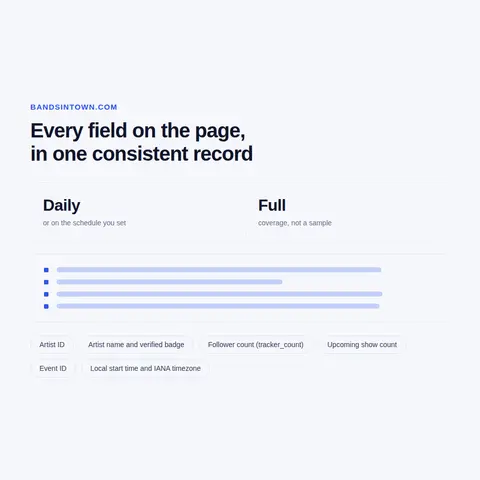
Fresher than the apps it feeds: edits reach Spotify, YouTube, Apple Maps and Shazam within 48 hours, Google within 30 and Amazon Music within 12, while an uploaded date lands on the artist page within minutes. A scheduled announcement goes live no sooner than four hours after it is set, and when tickets go on sale the Notify Me button can take two to four hours to turn into Tickets. Daily refresh suits most tour-date feeds, hourly fits a watchlist in announcement week, and weekly is enough for follower-count series. We deliver JSON, CSV or XLSX files, or load the rows into your warehouse.

Is Bandsintown scraping allowed under its terms, and which data is left out?

Bandsintown's terms forbid screen scraping and reserve the API for artists, so we keep to public pages, stay within what the site serves a signed-out visitor, pace requests gently and honour robots.txt, which closes follower lists, who-went and who's-interested pages, sign-in and the ticket redirect path. Artists, venues and festivals are public professional profiles; fan accounts, RSVP names, reviews and sign-up contacts are never collected. Rights in the listings stay with artists and the platform, so have counsel look at how you plan to use the data before the feed becomes part of a product.

How does it Work?

Step 1 - Make a Request

You share your needs, expectations, and desired timeframe. We’ll suggest the best solution based on your request and budget.

Step 2 - Configuring Custom Web Crawlers

Our specialists configure the crawlers and extract a sample dataset for your review before proceeding with the full-scale extraction.

Step 3 - Collect and Deliver

Once you approve the sample, we launch the project and start full data collection. We gather, filter, and structure the data for easy use, delivering it on time in your preferred format.

Step 4 - Maintain and Support

Our team manages ongoing processes, monitors website changes, and supports all data extraction cycles. We can also help integrate data into your systems or create dashboards to simplify analysis.

Request a Quote

Tell us more about you and your project information.
Which sites, which fields, how often. A couple of lines is enough.

We reply within 1 business day. No obligation.

scrapiet

Scrapeit Sp. z o.o.
10/208 Legionowa str., 15-099, Bialystok, Poland
NIP: 5423457175
REGON: 523384582