Meetup Scraper for Group, Event, Topic and City Data

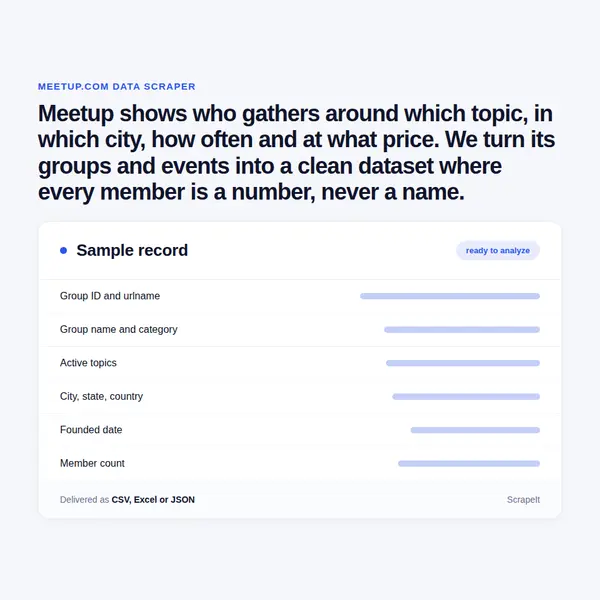
Meetup shows who gathers around which topic, in which city, how often and at what price. We turn its groups and events into a clean dataset where every member is a number, never a name.

Meetup Scraper
Solutions

Meetup Scraping and Export: How ScrapeIt Runs the Feed

ScrapeIt runs Meetup scraping as a managed service: we build the collector, run it on our own infrastructure and repair it when the platform changes - when the current API version replaced the old one, it renamed tickets to RSVPs and users to members. Anti-bot handling, proxy rotation and CAPTCHA solving are part of the service. We extract Meetup data from public group, event, topic and city pages only, with no login and no member areas, and build coverage from the published sitemaps and the clean city and topic paths rather than the parameterized search URLs that robots.txt closes. Records are deduplicated on group id and event token, and topics keep their ids so labels can be shown in any locale. A sample comes first; then we run on your schedule, from three times a day to monthly, and deliver the export as CSV, JSON or XLSX, or push it to S3, SFTP or your warehouse.

Meetup Dataset Fields: Group Profile, Event Listing and Counters

Public group and event pages embed the same GraphQL objects the API serves, so Meetup data collected from them keeps the platform's own field names.

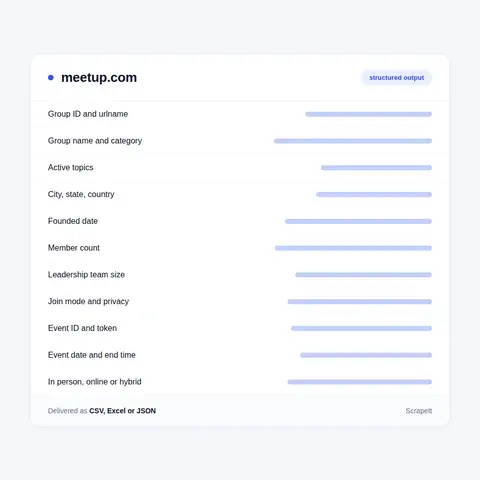
  • Group profile. Numeric id, urlname, name, description, topicCategory and activeTopics, city, state, country, IANA timezone, foundedDate, joinMode (OPEN, APPROVAL or CLOSED), the private flag and the Pro network, where there is one. Group coordinates are rounded to city level.
  • Group activity. Member count, size of the leadership team, average event rating with the number of ratings, and totals of upcoming and past events. Event frequency comes from the dated event history: events per month and the usual gap between them.
  • Event record. Every Meetup event listing carries a numeric id and stable token, title, description, dateTime and endTime with their UTC offset, createdTime, status (ACTIVE, PAST, CANCELLED and others) and topics. eventType reads PHYSICAL, ONLINE or HYBRID.
  • Place. Venue name, street address, city, state, country and exact coordinates for in-person events; a hybrid event returns two venues.
  • Attendance. Going count, waitlist count, the RSVP limit (maxTickets, zero when none is set), waitlistMode, whether guests may come and how many, and RSVP open and close times.
  • Meetup event price and fees. A free event has no fee block. A paid one carries amount, currency, whether the fee is required, the accepted method (cash or PayPal), an early bird discount with its amount and cut-off, and a promo code flag. Group dues, where a group charges them, form a separate block.
  • Series. A recurring event describes itself in plain words, such as every week on Monday until a given date.

Members are private people, so the dataset stops at numbers: we never collect member names, profiles, member lists or who signed up for an event. The organizer is recorded as a role - whether a group has one and how many people lead it - never as a person.

Meetup Dataset Fields: Group Profile, Event Listing and Counters
Local Group Events Data for Community Maps, Venues and B2B Marketing

Local Group Events Data for Community Maps, Venues and B2B Marketing

Community maps by topic and city. Member counts, event cadence and group status turn a list of groups into a map of live communities. Status is telling: PAID means an organizer with an active subscription, GRACE a lapsed one that freezes after 15 days, FROZEN no active organizer, and DEAD a group frozen for 15 days more. Topic pages per country already publish a group count and a member total for each topic, and the group-level pull shows how many of those groups still hold events - forty on paper and ten active describe two different markets.

Venue sourcing. An in-person event names its venue with an address and exact coordinates, so venues can be ranked by how many events they host each month and for which topics - a shortlist of rooms that already welcome meetups.

B2B community marketing. Pro networks such as GDG and Docker User Group bundle their chapters under one brand, with totals of groups, countries and members and a list of sponsors, which shows where a developer or product audience already meets.

Details that change counts. A recurring event can get a new id once it has seen activity while its token stays put, so we deduplicate on the token. Online events share a placeholder venue called Online event, so their city comes from the group. The same night can also be listed on Meetup and Eventbrite, the Meetup page pointing to the ticket link, so cross-platform feeds match on title, date and venue. In the group sitemaps, lastmod is the founding date rather than the latest change, so freshness is read from events.

Meetup Data Model and Statistics: Groups, Events, Topics, Cities

Meetup is where local groups run recurring events, in person and online, and it has done so for more than twenty years: the oldest group pages carry founding dates from 2002. A Meetup scraper reads it from public group pages. The platform is operated by Bending Spoons US Inc. Meetup vs Eventbrite or Luma comes down to the unit of record: those Meetup alternatives are built around the event page and its organizer or calendar, while every Meetup event belongs to a standing group with members, topics and a calendar of its own.

A group lives at meetup.com/{urlname}/ and owns everything below it. An event sits under its group, at /{urlname}/events/{numeric id}/, so the address alone names the host. A topic has a numeric id, a name and a urlkey, and belongs to one of 20 top-level categories, from Technology and Music to Games and Writing; a group carries one category plus a list of active topics.

Cities are addressed by slug: /find/us--ny--new-york/ in the United States, /find/gb--london/ elsewhere, /find/us--ny--new-york/hiking/ for one topic in one city. Above the topic tree, US city pages split into four broad Meetup interests - meet new friends, networking, sports and hobbies, outdoor activities. Locale prefixes such as /de-DE/ or /ja-JP/ translate the interface and topic names, not group names or descriptions.

Meetup statistics depend on who counts. In September 2026 the media page cited 52+ million members, 300+ thousand groups and 100+ thousand events a week across 193 countries, the app listing said over 60 million members, and the published sitemaps listed about 193,000 group pages and 172,000 event pages - the countable base any Meetup scraper starts from.

Get a Quote

dev_w
25

Developers

customers
500+

Customers worldwide

pages
1 500 000 000+

Pages extracted

stime
15000+

Hours saved for our clients

Plans

Airplane

€199 / one-time

setup fee - included

Data limits100,000
Frequencyone-time
Run timeup to 5 days
Data storing7 days

Helicopter

€169 / mo

setup fee €499

Data limits250,000
Frequencymonthly
Run timeup to 5 days
Data storing14 days

Glasses

€229 / mo

setup fee €499

Data limits1,000,000
Frequencyweekly
Run timeup to 5 days
Data storing30 days

DNA

€549 / mo

setup fee €799

Data limits3,000,000
Frequency3 times daily
Run timesame day
Data storing90 days

Meetup API Access and Meetup API Pricing: Developer Portal, Token and Meetup Pro

The official Meetup API is GraphQL. The Meetup developer portal at meetup.com/graphql/ holds the Meetup API documentation - a guide, an authentication page, a playground and the OAuth client list - and points to one endpoint, api.meetup.com/gql-ext, released as a new version in February 2025 with full schema introspection. A Meetup API token is an OAuth 2 bearer token that lasts an hour; refresh tokens work once, and the server-to-server JWT flow acts only for the member who owns the client.

Access is not open. Registering an OAuth client needs a signed-in account, the portal lists API access among the Meetup Pro features, and the license terms require a Pro subscription and a registration form, license the API for building applications around Meetup groups and events, and rule out commercial use without Meetup's written consent. The rate limit is 500 points per 60 seconds, after which requests fail with a RATE_LIMITED error until the reset time.

The shape of the API matters as much as the paperwork. groupSearch and eventSearch both require a latitude and longitude, results come back in cursor pages of 20 by default, and the Pro network queries are built for the network you administer. That suits an organization running its own chapters. A buyer who wants the whole market - every active group on a topic across twenty cities, with event history and member counts - needs Meetup scraping of public pages, which is the service we run.

Our Blog

Reads Our Latest News & Blog

Learn how to use web scraping to solve data problems for your organization

How Artificial Intelligence Is Used In Web Scraping

How Artificial Intelligence Is Used In Web Scraping

Leveraging advances in technology, the AI-powered web scraper has skyrocketed in demand and is helping to expand capabilities by automating tedious daily tasks and speeding up data collection from thousands of websites several times over.

What is Web Scraping and What is it Used For?

What is Web Scraping and What is it Used For?

Web scraping is a method of obtaining web data by extracting it from pages of web resources with the help of a program, that is, in automatic mode. It is used to syntactically convert web pages into more usable forms.

Web Scraping for Machine Learning

Web Scraping for Machine Learning

If you specialize in machine learning, you need to feed large amounts of data to the algorithms. Web scraping is the easiest and the most efficient method of collecting the data from all over the Internet.

scrapeit logo

Working With ScrapeIt on Meetup Data

ScrapeIt is a managed web scraping agency. If you have tried an Apify Meetup actor, the difference is who does the running: an actor is a tool you configure, run and monitor yourself, billed per result, while we agree cities, topics and volume with you in writing, keep the collector working when page structure moves, and hand over a finished feed. Our ScrapeIt vs Apify comparison sets out when each route is the better buy. Pricing follows volume and refresh rate.

FAQ

Is the Meetup API free, and how do you get a Meetup API key?

There is no free tier. Meetup API access comes with a Meetup Pro subscription: the license terms require Pro and a registration form, so Meetup API pricing is the price of Pro, which the public pages do not list, and the Enterprise tier is quoted after a demo. The key is an OAuth client registered in the developer portal; its client key and secret obtain an API token, a bearer token that expires after an hour. The API returns groups, events, topics and your own network's analytics within 500 points per 60 seconds. Every search is tied to a coordinate, so there is no single market-wide list, and commercial use needs Meetup's written consent.

How much does Meetup cost, and what are the Meetup pricing plans?

Signing up is free; what members pay is set by organizers - an event fee or group dues - and those Meetup fees are fields in our data. Organizers pay for the platform: a standard organizer plan runs a group, Meetup Pro adds unlimited groups, multi-group events, CRM export and API access and opens with a 30-day free trial, and Enterprise is quoted after a demo. Web prices appear only in the checkout after sign-in; the US App Store lists a Standard Organizer plan at $12.99 and member add-ons such as Meetup Plus from $4.99 (September 2026).

Which Meetup countries and cities can you cover, from London to NYC?

Any city with public groups. Meetup says it reaches communities in 193 countries, and its city directory currently has pages in 184, led by the United States, the United Kingdom, Canada, Germany and France. Meetup events in London come from /find/gb--london/ and Meetup events in NYC from /find/us--ny--new-york/, then split by category or topic. Meetup events near me, on the site, is a point plus a radius of 2 to 100 miles or any distance around the visitor; we pin the point instead, so book clubs within 25 miles of Chicago is one request. Online events are kept apart, because their city is the group's, not a venue's.

How often can Meetup data be refreshed, and how is a Meetup export delivered?

Events move faster than groups, so most projects split the schedule: upcoming events with going, waitlist and fee fields daily or weekly, group profiles and member counts weekly or monthly, and a watchlist of key events up to three times a day. Each run is stamped with its collection time, so counts can be charted week by week. The export arrives as CSV, JSON, JSON Lines or XLSX, or is pushed to S3, SFTP, cloud storage or your database. Meetup's own export tools serve organizers for the groups they run; ours covers public groups and events across the market, with no personal data.

Is it legal to scrape Meetup, and do you collect member or attendee data?

We take public group and event facts and never member data: no names, no profiles, no member lists, no record of who signed up for what, only the counts. Meetup's terms restrict automated data extraction for commercial purposes they do not permit and ask that the platform not be burdened, so we collect at a measured pace, stay out of anything behind a login and keep volumes proportionate to the project. Whether your particular use is allowed is a question for your own legal adviser, best settled before the first recurring delivery.

How does it Work?

Step 1 - Make a Request

You share your needs, expectations, and desired timeframe. We’ll suggest the best solution based on your request and budget.

Step 2 - Configuring Custom Web Crawlers

Our specialists configure the crawlers and extract a sample dataset for your review before proceeding with the full-scale extraction.

Step 3 - Collect and Deliver

Once you approve the sample, we launch the project and start full data collection. We gather, filter, and structure the data for easy use, delivering it on time in your preferred format.

Step 4 - Maintain and Support

Our team manages ongoing processes, monitors website changes, and supports all data extraction cycles. We can also help integrate data into your systems or create dashboards to simplify analysis.

Request a Quote

Tell us more about you and your project information.
Which sites, which fields, how often. A couple of lines is enough.

We reply within 1 business day. No obligation.

scrapiet

Scrapeit Sp. z o.o.
10/208 Legionowa str., 15-099, Bialystok, Poland
NIP: 5423457175
REGON: 523384582