Wolt Scraper for Venue Menus, Prices and Delivery Fees

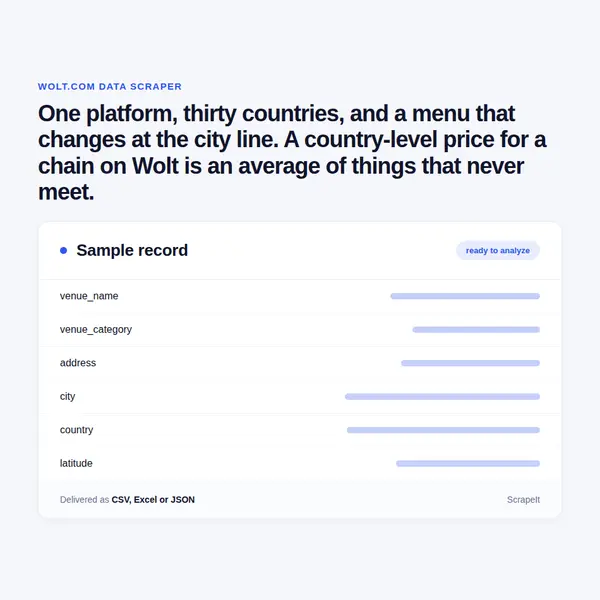
One platform, thirty countries, and a menu that changes at the city line. A country-level price for a chain on Wolt is an average of things that never meet.

Wolt Scraper
Solutions

Managed delivery data, run end to end by us

ScrapeIt runs the collector as a managed service. You name the cities and the venue categories; we build the pipeline, keep menus keyed to venues, deliver option surcharges rather than flattening them, and hand back CSV, JSON, Excel or a push into your warehouse.

Cadence is set against what you are watching. Menu structure moves slowly, prices and fees move daily, and promotions move within the day, so one schedule for all three is a compromise nobody needs.

We collect public catalogue data only: venues, menus, prices, fees and hours. No customer data, no courier data, no account access. Requests are paced within the crawl rules the site publishes. Terms restrict commercial reuse of the content, so the output is for analysis rather than republication, and your counsel should see the use case before the project starts.

Wolt fields in every export

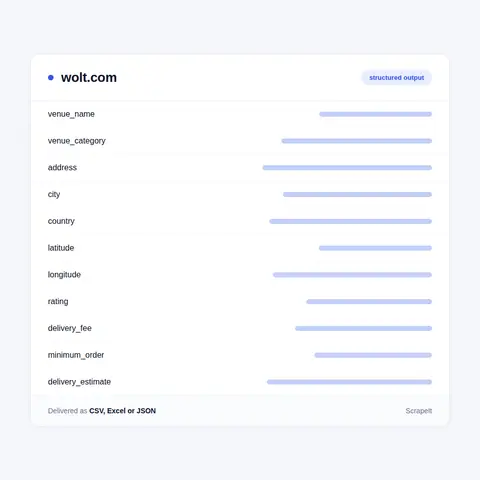
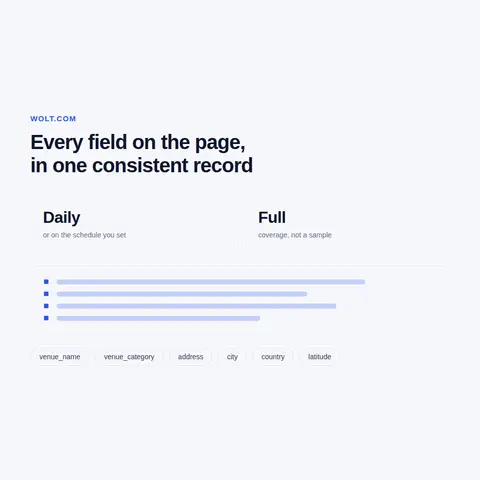
The venue record covers the venue name, category, full address, city, country, coordinates where published, rating, opening hours by day, delivery estimate, delivery fee, minimum order and current open or closed state.

The menu record is separate and keyed to the venue: section, item name, description, price, currency, and the option groups with their own surcharges. Options matter more than people expect - a base price of nine euros with a mandatory size choice that adds three is not a nine euro item, and flattening options into a single price is how a price index quietly becomes wrong.

City and country sit on every row as their own fields rather than being parsed out of an address later. That is what makes comparison across markets possible at all.

Availability is a state with a time attached. An item that is sold out at eight in the evening is not an item that was removed, and a dataset that cannot tell those apart cannot answer questions about stockouts.

Every row carries the collection timestamp and the city it was collected for, because a delivery fee without a location is not a fact about anything.

Wolt fields in every export
Promotions, coverage maps and what we leave alone

Promotions, coverage maps and what we leave alone

Promotion tracking is the most common extension and it needs repeat collection by design. A discount that ran for four hours is invisible to a daily crawl, so where promotions are the point we set the cadence against them rather than against convenience.

Coverage mapping answers where a brand is present and where it is not, city by city, which is the question behind most expansion briefs. It is a venue list problem rather than a menu problem and it is much cheaper to run.

Cross platform comparison is usually part of the brief. The same venue often lists on several delivery apps at different prices, and matching those venues across platforms is the hard part - names differ, addresses are written differently, and the match has to be done on more than a string. We build it as a resolution step with a confidence value rather than pretending it is exact.

What we leave alone is people. Courier names and locations, customer accounts and order histories are out of scope, and review text is collected only where a client has a use for it and never tied to named individuals. The venue and menu data that these projects need contains none of it.

A delivery platform that is really many local markets

Wolt is a Finnish delivery platform operating across roughly thirty countries in Europe and Asia. It carries restaurants, grocery stores, pharmacies and retail, each venue with its own menu, prices, delivery fee and opening hours.

The structural fact that shapes every project here is that the catalogue is organised by city, not by country. Discovery runs city by city, and a venue exists inside one. The same restaurant chain appears in Helsinki, Tallinn, Berlin and Tokyo as separate venues with separate menus and separate prices, because that is what it actually is.

Delivery fees and minimum orders belong to the venue and the location together, and they move with distance, time of day and demand. They are part of what a customer pays and they are not part of the menu price.

City and discovery surfaces respond directly with substantial content and crawl rules are published, so enumeration is a matter of covering the cities you care about rather than fighting the site.

Get a Quote
dev_w
25

Developers

customers
500+

Customers worldwide

pages
1 500 000 000+

Pages extracted

stime
15000+

Hours saved for our clients

Plans

Airplane

€199 / one-time

setup fee - included

Data limits100,000
Frequencyone-time
Run timeup to 5 days
Data storing7 days

Helicopter

€169 / mo

setup fee €499

Data limits250,000
Frequencymonthly
Run timeup to 5 days
Data storing14 days

Glasses

€229 / mo

setup fee €499

Data limits1,000,000
Frequencyweekly
Run timeup to 5 days
Data storing30 days

DNA

€549 / mo

setup fee €799

Data limits3,000,000
Frequency3 times daily
Run timesame day
Data storing90 days

Why the city is the unit and the country is not

The first request on this source is almost always for a country. It is the wrong shape and it produces numbers that look authoritative and describe nowhere.

Menus are set per venue, and venues price against their own local market. A chain that looks uniform in its marketing prices differently between a capital and a second city, and Wolt makes that visible because it keeps the venues separate. Averaging them across a country hides exactly the variation a pricing team is paying to see.

The second reason is the delivery fee, which is where a lot of the real economics sits. It varies by venue, by distance and by time, and it is charged on top of the menu. A competitive analysis that compares menu prices while ignoring fees compares half the bill.

The third is time. Availability, fees and promotions move during the day, and a single daily snapshot records whichever moment it happened to hit. Where a client needs promotions or stockouts, collection has to run at several points in the day and keep each observation rather than overwriting.

The fourth is coverage as its own signal. Which venues exist in a city, and which categories are thin, is a market structure question that the menu data cannot answer but the venue list can.

Our Blog

Reads Our Latest News & Blog

Learn how to use web scraping to solve data problems for your organization

How Artificial Intelligence Is Used In Web Scraping

How Artificial Intelligence Is Used In Web Scraping

Leveraging advances in technology, the AI-powered web scraper has skyrocketed in demand and is helping to expand capabilities by automating tedious daily tasks and speeding up data collection from thousands of websites several times over.

What is Web Scraping and What is it Used For?

What is Web Scraping and What is it Used For?

Web scraping is a method of obtaining web data by extracting it from pages of web resources with the help of a program, that is, in automatic mode. It is used to syntactically convert web pages into more usable forms.

Web Scraping for Machine Learning

Web Scraping for Machine Learning

If you specialize in machine learning, you need to feed large amounts of data to the algorithms. Web scraping is the easiest and the most efficient method of collecting the data from all over the Internet.

scrapeit logo

Who builds and keeps your Wolt feed

ScrapeIt is a managed extraction company, not a tool you have to learn. Our team builds the pipeline, watches it as city coverage and menu templates change, and repairs it before your price series develops a gap.

You see a sample first, in your format, over the cities you actually trade in, with option surcharges resolved and fees on the row so you can judge the comparison on real venues.

FAQ

Can I get Wolt prices for a whole country?

You can get every city in it, which is not the same thing and is more useful. Venues price against their local market, so a national average hides the variation you are paying to see. We deliver city and country as separate fields so you can aggregate deliberately rather than by accident.

Do you include delivery fees?

Yes, on the venue row with the minimum order, and that matters because fees are a real part of the bill and vary by venue, distance and time. A comparison that looks only at menu prices compares half of what the customer pays.

What happens to items with size or extras options?

Option groups and their surcharges are delivered as their own records. A nine euro base price with a mandatory size choice that adds three is not a nine euro item, and flattening options into one number is how a price index quietly becomes wrong.

How often should this run?

It depends on what you are watching, and mixing them is the usual mistake. Menu structure moves slowly, prices and fees daily, promotions within the day. If promotions are the point, a daily snapshot will miss most of them and we set the cadence accordingly.

Do you collect courier or customer information?

No. Courier names and locations, customer accounts and order histories are out of scope entirely. Venue, menu, price, fee and availability data is what these projects need and it contains none of that.

How does it Work?

Step 1 - Make a Request

You share your needs, expectations, and desired timeframe. We’ll suggest the best solution based on your request and budget.

Step 2 - Configuring Custom Web Crawlers

Our specialists configure the crawlers and extract a sample dataset for your review before proceeding with the full-scale extraction.

Step 3 - Collect and Deliver

Once you approve the sample, we launch the project and start full data collection. We gather, filter, and structure the data for easy use, delivering it on time in your preferred format.

Step 4 - Maintain and Support

Our team manages ongoing processes, monitors website changes, and supports all data extraction cycles. We can also help integrate data into your systems or create dashboards to simplify analysis.

Request a Quote

Tell us more about you and your project information.
Which sites, which fields, how often. A couple of lines is enough.

We reply within 1 business day. No obligation.

scrapiet

Scrapeit Sp. z o.o.
10/208 Legionowa str., 15-099, Bialystok, Poland
NIP: 5423457175
REGON: 523384582