Healthdirect Scraper for Australian Services and Conditions

Two datasets on one government domain: a conditions library that lives for months and a service directory that is wrong within weeks.

Healthdirect Scraper
Solutions

Managed Australian health data, run end to end by us

ScrapeIt runs the collection as a managed service. You say whether you need the service directory, the conditions library or both; we build them as separate pipelines because they are different problems, run each on a cadence that matches, and hand back CSV, JSON, Excel or a push into your warehouse with hours structured and changes as their own records.

Service records are refreshed often because their whole value is currency. Conditions content runs monthly or quarterly with the published review date as the trigger.

This is public information published for the public, and we collect it politely: crawl rules honoured, requests paced, nothing behind a login. Licence terms are checked per item before reuse rather than assumed. If your product helps people find care, that carries a duty of accuracy and we will design the cadence around it. Bring the use case to your own counsel before the project starts.

Healthdirect fields in every export

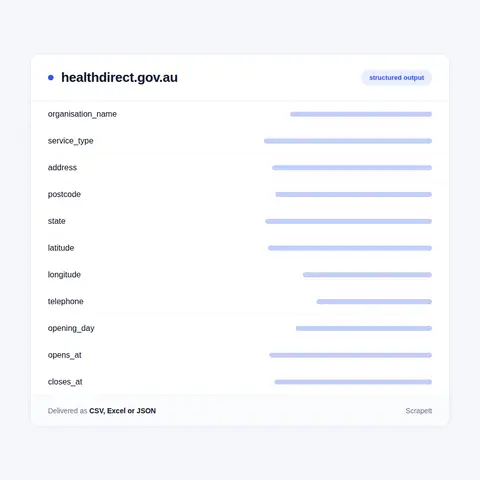
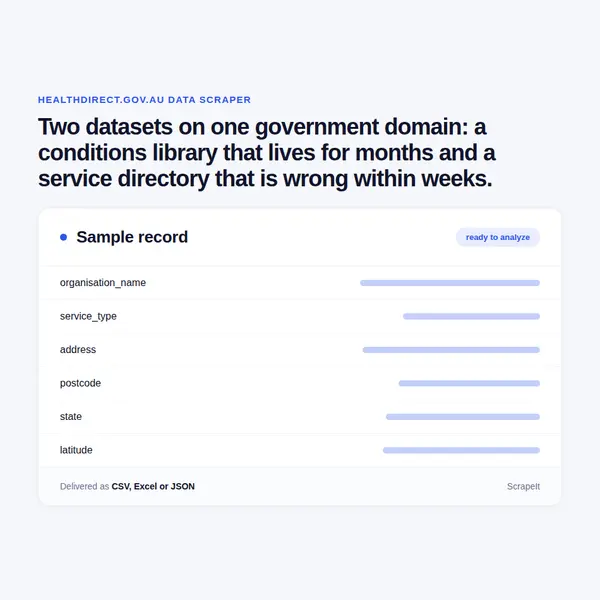
Service records carry the organisation name, service type, full address with postcode, state, coordinates where published, telephone, website, opening hours structured by day including after hours arrangements, the services offered and any access notes.

Opening hours are delivered as structured rows rather than text, which is the single most common reason a client arrives having tried this themselves. Hours as a string cannot drive an application; day, open time, close time with exception flags can.

Geography is delivered ready to join: postcode parsed, state recorded, coordinates where available, so records can be mapped against population or service coverage without another cleaning pass.

Conditions library records carry the page title, condition or medicine name, section structure, summary, symptom and treatment sections as separate fields, related topics, the last reviewed date where published and word count.

Every row carries the collection timestamp, which on the service side is what tells a downstream application whether an opening time can still be trusted.

Healthdirect fields in every export
Licensing, coverage gaps and related official sources

Licensing, coverage gaps and related official sources

Licensing needs a careful sentence rather than a confident one. Australian government information is frequently published under open licensing terms, and material on this domain often falls under such terms, but licences apply per item and carry exclusions. We check what actually applies to the material a client wants rather than assuming that everything on a government domain is free to reuse.

Coverage gap analysis is a genuine research use. Which regions have thin provision, which service types are missing where, and how availability differs between metropolitan and remote areas are questions asked by researchers, planners and anyone building a health service product, and they need the directory complete rather than sampled.

Related official sources are usually worth joining. Australian health data is spread across several national and state publications, and a directory product typically needs more than one. We scope that at the start rather than delivering a single source and letting the gaps appear later.

Change records on the service side are the operational output: this practice changed its hours, this service stopped appearing, this one began accepting patients. Downstream that becomes an alert rather than a full reload.

The national health service directory and content library

Healthdirect is the Australian government health information service. It publishes two things that people routinely conflate, and treating them as one project is how an Australian health brief goes wrong.

The first is a conditions and medicines library: pages about illnesses, symptoms, treatments and when to seek care, written for the public and maintained on review cycles. As data it behaves like reference content - slow, heavily interlinked, valuable for coverage and wording.

The second is a national service directory: general practices, pharmacies, hospitals, emergency departments and specialist services, each with an address, contact details, opening hours and the services offered. As data it behaves like infrastructure - geographic, constantly changing in small ways, and valuable entirely in the fields.

Both surfaces respond directly and crawl rules are published. The service directory in particular carries the same currency problem as any health locator: a record that is a month old can send somebody to a closed door, and here that somebody may be looking for urgent care.

Get a Quote
dev_w
25

Developers

customers
500+

Customers worldwide

pages
1 500 000 000+

Pages extracted

stime
15000+

Hours saved for our clients

Plans

Airplane

€199 / one-time

setup fee - included

Data limits100,000
Frequencyone-time
Run timeup to 5 days
Data storing7 days

Helicopter

€169 / mo

setup fee €499

Data limits250,000
Frequencymonthly
Run timeup to 5 days
Data storing14 days

Glasses

€229 / mo

setup fee €499

Data limits1,000,000
Frequencyweekly
Run timeup to 5 days
Data storing30 days

DNA

€549 / mo

setup fee €799

Data limits3,000,000
Frequency3 times daily
Run timesame day
Data storing90 days

Why the two halves need different cadences

Running both pipelines on one schedule guarantees one of two failures: either you pay repeatedly to re-read a conditions library that has not changed, or you ship service records that went stale weeks ago.

The conditions library is slow. Pages are reviewed on cycles, the review date is published, and monthly or quarterly collection with the review date as a trigger is sufficient for any content or coverage analysis.

The service directory is not. Practices change hours, close, merge and relocate without announcement anywhere a crawler would notice - the record simply changes. Frequent re-collection with change detection is what keeps it usable, and change detection matters as much as frequency: a record that moved should be flagged rather than silently overwritten, and one that vanished marked rather than dropped.

The stakes are higher than on a commercial locator. A person using an Australian health service directory may be looking for after hours or urgent care, and an address that is wrong is not a data quality complaint. Anyone building a product on this should design the refresh cadence around that rather than around a convenient interval.

The third consideration is geography, which in Australia means distance. Service availability differs enormously between metropolitan, regional and remote areas, and a national summary describes nowhere. The state and postcode fields are what let an analysis segment properly.

Our Blog

Reads Our Latest News & Blog

Learn how to use web scraping to solve data problems for your organization

How Artificial Intelligence Is Used In Web Scraping

How Artificial Intelligence Is Used In Web Scraping

Leveraging advances in technology, the AI-powered web scraper has skyrocketed in demand and is helping to expand capabilities by automating tedious daily tasks and speeding up data collection from thousands of websites several times over.

What is Web Scraping and What is it Used For?

What is Web Scraping and What is it Used For?

Web scraping is a method of obtaining web data by extracting it from pages of web resources with the help of a program, that is, in automatic mode. It is used to syntactically convert web pages into more usable forms.

Web Scraping for Machine Learning

Web Scraping for Machine Learning

If you specialize in machine learning, you need to feed large amounts of data to the algorithms. Web scraping is the easiest and the most efficient method of collecting the data from all over the Internet.

scrapeit logo

Who builds and keeps your Healthdirect feed

ScrapeIt is a managed extraction company, not a tool you have to learn. Our team builds both pipelines, watches them as the site changes, and repairs them before your directory starts sending people to the wrong address.

You see a sample first, in your format, over the service types and regions you actually cover, with hours structured and change records populated from a real observation window.

FAQ

Why build two pipelines instead of one?

Because the halves age at completely different speeds. Conditions content moves on review cycles; service records go stale in weeks. One schedule means either paying to re-read static content or shipping opening hours that are wrong, and both are avoidable by scoping them separately.

How current can the service directory be?

As current as the refresh you buy, and this is the source where it matters most. Practices change hours, close, merge and relocate with no announcement anywhere a crawler would see. We re-collect frequently and deliver changes as records, so a moved service is flagged rather than silently overwritten and a vanished one marked rather than dropped.

Do you deliver opening hours as usable data?

Yes, structured by day with open and close times plus flags for exceptions and after hours arrangements. Hours as a text string cannot drive an application, and this is the most common reason clients arrive having tried the collection themselves.

Can I reuse the content in my own product?

Sometimes, and the answer is per item rather than blanket. Australian government information is frequently published under open licensing, but licences apply to specific material and carry exclusions. We check what actually applies to what you want and tell you what it permits, rather than assuming a government domain means free reuse.

Is any of this patient data?

No. The directory is organisational information about services, and the library is published guidance for the public. There is no patient information on these surfaces and we collect none. We work only on public pages and pace requests.

How does it Work?

Step 1 - Make a Request

You share your needs, expectations, and desired timeframe. We’ll suggest the best solution based on your request and budget.

Step 2 - Configuring Custom Web Crawlers

Our specialists configure the crawlers and extract a sample dataset for your review before proceeding with the full-scale extraction.

Step 3 - Collect and Deliver

Once you approve the sample, we launch the project and start full data collection. We gather, filter, and structure the data for easy use, delivering it on time in your preferred format.

Step 4 - Maintain and Support

Our team manages ongoing processes, monitors website changes, and supports all data extraction cycles. We can also help integrate data into your systems or create dashboards to simplify analysis.

Request a Quote

Tell us more about you and your project information.
Which sites, which fields, how often. A couple of lines is enough.

We reply within 1 business day. No obligation.

scrapiet

Scrapeit Sp. z o.o.
10/208 Legionowa str., 15-099, Bialystok, Poland
NIP: 5423457175
REGON: 523384582