karriere.at Scraper for Austrian Job Postings and Salaries

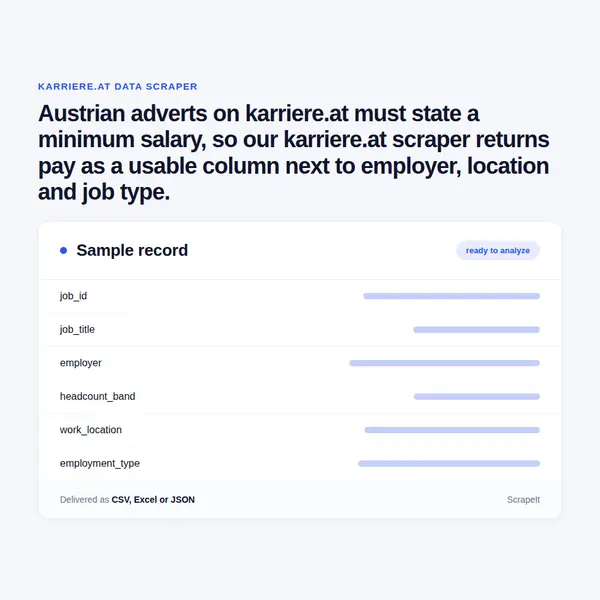
Austrian adverts on karriere.at must state a minimum salary, so our karriere.at scraper returns pay as a usable column next to employer, location and job type.

Plans from €169 a month · Free project assessment · Reply within 1 business day

CSV · Excel · JSON · XML · FTP · SFTP · Amazon S3 · Google Cloud

karriere.at
karriere.at Scraper for Austrian Job Postings and Salaries
karriere.atwhat you get
Typical fields for job boards
job_titlecompanylocationsalaryemployment_typeposted_at
Delivery

API, JSON feed or CSV, XLSX and JSON files

Schedule

One-time, monthly, weekly, daily or 3 times a day

Scrape karriere.at as a Managed Service

  1. You send

    karriere.at pages, filters, fields and a schedule

  2. We run the scrapers

    Built, monitored and repaired by our team

  3. You receive the data

    API, JSON feed or CSV, XLSX and JSON files

You tell us which slice of the Austrian market matters - a Bundesland, a set of Berufsfelder, a salary band, a list of employers - and we build the karriere.at crawler around it, run it and repair it when the site changes. Search pages, job pages and the /f/ company profiles are read as a visitor sees them, the German labels are mapped to English column names, and the salary text is split into amount, period and the over-pay wording. Anti-bot handling - pacing, proxy rotation, CAPTCHA handling, rendering - is part of the service. Runs are one-off or on the schedule you set, daily or weekly, with field documentation in every delivery. The project assessment is free, and a sample can be ordered before the first run.

karriere.at Data: Fields From Each Job Posting

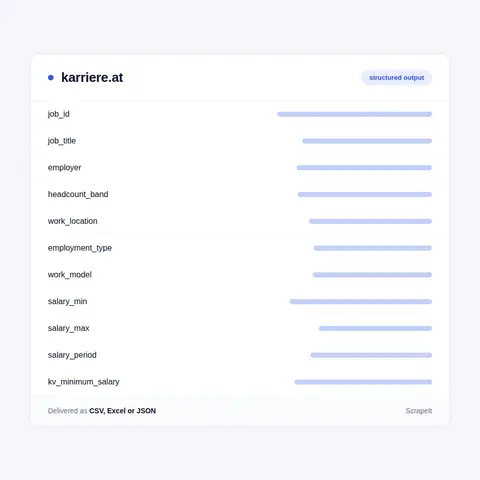
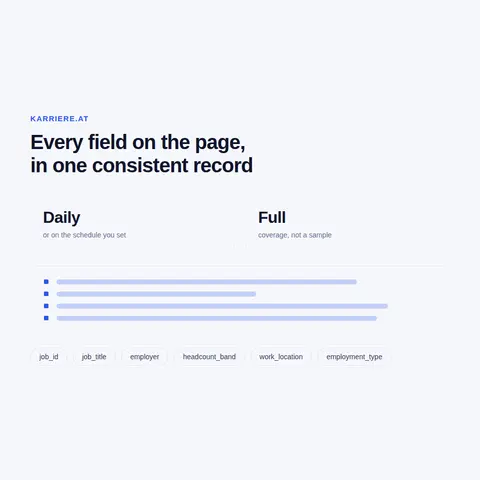
Each job posting on karriere.at lives at /jobs/ followed by a numeric job id, and that id keeps a row stable from one run to the next. The site is German only, so we deliver its labels as English columns and keep the original value beside each one. A row covers:

  • Identityjob id, URL, job title with the gender tag Austrian adverts carry (m/w/d), the ad type such as Stelleninserat, and the posting date, which cards show as an age from Heute veröffentlicht (published today) to vor 6 Tagen veröffentlicht.
  • EmployerArbeitgeber (employer) name with its company profile link, Mitarbeiter*innenanzahl (headcount band) and Standorte (company locations).
  • Place and typeDienstort (work location, sometimes several), Anstellungsart (employment type: Vollzeit, Teilzeit, Praktika, with Festanstellung marking a permanent post), Arbeitsmodell (work model, such as On-site or Hybrid) and the Homeoffice badge.
  • Salarythe Gehalt line as shown, for example ab 33.000 € jährlich or a monthly range, split into minimum, maximum, currency and period; the KV Mindestgehalt (collective agreement minimum) and the Überzahlung wording when the employer is willing to pay above it.
  • ClassificationBerufsfelder (job fields), Positionsebene (position level) and Offene Stellen, the number of openings for the role.
  • Requirementsfrom the block Detaillierte Angaben zur Stelle: Erforderliche Kenntnisse (required skills), Nice-To-Have Kenntnisse, required and nice-to-have languages, and education.
  • Descriptionthe Über den Job text with its tasks and profile sections, and the Über das Unternehmen paragraph.
  • Card badgesSmart Bewerben (one-click applying), Einblicke (employer insights), Videos and the Gesponsert (sponsored) label on paid placements.

Salary is the column that sets karriere.at apart. Because the minimum pay is part of the advert by law rather than an optional extra, the salary field can be analysed instead of merely counted.

karriere.at Data: Fields From Each Job Posting
karriere.at Job Listings Beyond the Single Advert

karriere.at Job Listings Beyond the Single Advert

One advert answers one question; karriere.at job listings become useful through coverage and repetition.

  • Search coverageresults are cut by Bundesland and city pages such as /jobs/wien or /jobs/innsbruck, by Umkreis (radius), Berufsfelder, Anstellungsart, Positionsebene, Brutto-Monatsgehalt (gross monthly salary) and the Homeoffice möglich switch, so a full Austrian pull is assembled from slices that do not overlap.
  • Company profileseach /f/ page lists Unternehmensgröße (company size), Branchen (industries), Gründungsjahr (founding year), Standorte, the Unsere Benefits block grouped into food, health, workplace, work-life balance and perks, Gesuchte Positionen und Kenntnisse, and the count of open jobs. The Firmen directory adds benefit filters such as Kantine or Flexible Arbeitszeiten.
  • Historya posting is taken down once the employer closes it, so scheduled runs keep the first and last date each job id was seen and the salary on every pass, which gives time-to-fill and salary drift.
  • Hiring activityopen jobs per employer and the Gesuchte Mitarbeiter*innen/Jahr figure (hires per year, as the employer states it), tracked week by week.

The Ansprechperson block on company profiles names a person, so contact names and photos stay out by default.

About karriere.at and the Austrian Job Market

Source
karriere.at
Category
job boards
Delivery
API, JSON feed, CSV, XLSX
Plans
From €169 a month
Get a quote

karriere.at is an Austrian job platform run by karriere.at GmbH from offices in Linz and Vienna, and it describes itself as the market leader among Austrian job portals. It is written for Austria alone: German throughout, salaries in euro, locations organised by Bundesland (federal state) - Wien, Niederösterreich, Oberösterreich, Steiermark, Tirol, Salzburg, Kärnten, Vorarlberg, Burgenland - and down to the districts of Vienna.

Three sections matter for data. Jobs holds the adverts and their filters. Firmen holds employer profiles that companies fill in themselves, with benefits, values and Einblicke, the photo and video look behind the scenes that also shows as a badge on job cards. A salary comparison, the Gehaltsvergleich, and the karriere.blog sit beside them. Candidate features - Lebenslauf (CV), Bewerbungen (applications), Merkliste (saved jobs), Job-Alarm - belong to job seekers and are never part of a dataset.

What makes Austrian adverts different is the pay line. Austrian equal treatment law requires a job ad to state the minimum salary under the relevant Kollektivvertrag (collective agreement) and whether more is possible, which is why karriere.at postings print KV Mindestgehalt next to phrases about Überzahlung. For anyone studying wages, that turns a job board into a salary source.

25Developers
500+Customers
1.5BPages extracted
15,000+Hours saved for our clients

karriere.at scraping plans and pricing

Airplane

€199one-time

Setup fee included

100,000
One-time
Up to 5 days
7 days

Helicopter

€169/ mo

Setup fee €499

250,000
Monthly
Up to 5 days
14 days

Glasses

€229/ mo

Setup fee €499

1,000,000
Weekly
Up to 5 days
30 days

Microscope popular

€349/ mo

Setup fee €499

2,000,000
Daily
Same day
60 days

DNA

€549/ mo

Setup fee €799

3,000,000
3 times daily
Same day
90 days

Delivery: CSV, JSON or XLSX files, our API or a JSON feed. MCP server on request.

Full plan details

Why Scrape karriere.at

karriere.at carries a salary figure that job boards in most other countries rarely get, attached to a field, a level and a region. Typical uses:

  • Salary benchmarkingminimum salaries by Berufsfeld, Positionsebene and Bundesland, with the over-pay flag showing which employers compete above the collective agreement.
  • Labour demand by regionopen jobs per city and per job field over time, for staffing agencies, regional development bodies and investors in Austrian companies.
  • Skills trackingrequired and nice-to-have skills and languages from each advert, counted by month, show which tools and languages Austrian employers ask for.
  • Competitor hiringa rival's open jobs, the roles it seeks and how long its postings stay up.
  • Home office sharethe Homeoffice badge and Arbeitsmodell by field and by employer size.
  • Employer branding researchwhich benefits companies list on their profiles, by industry and headcount band.

About ScrapeIt

ScrapeIt is a managed web scraping service: we build, run and repair the crawlers and deliver the data, so your team works with tables rather than parsers. Job boards are a regular part of our work, and on German-language sites like karriere.at we map the original labels to documented English fields while keeping the source values. Personal data is handled under GDPR, and we do not collect CVs or build profiles of people. Plans start from EUR 169 a month, or EUR 199 for a one-time extract.

FAQ

Still unsure? Write to info@scrapeit.io

Do you offer a karriere.at API for job and salary data?

Yes. The ScrapeIt karriere.at API returns job id, title, employer, Dienstort, Anstellungsart and the parsed salary with its KV minimum as JSON from an endpoint we host, refreshed on the schedule you set. The same data also comes as CSV or Excel files, a JSON feed, or a load into your database.

Is it legal to scrape karriere.at?

Yes. Job adverts, salaries and company profiles on karriere.at are shown to any visitor without an account. We collect only publicly available data - everything a visitor can see on karriere.at - and we collect it legally. Contact persons named on adverts and profiles are left out by default.

How does the karriere.at dataset handle salary text?

We keep the Gehalt line exactly as published and split it into minimum, maximum, period (jährlich or monatlich) and currency. Where the advert names the KV Mindestgehalt and mentions Überzahlung, both go into separate columns, so a legal minimum is never mistaken for the actual offer.

Can you scrape karriere.at for one Bundesland or job field only?

Yes. Searches can be narrowed by location pages such as Wien or Tirol, by Umkreis around a town, and by Berufsfelder, Anstellungsart and Positionsebene. We crawl only the slices you need, which keeps a regional or single-field dataset quick to refresh.

How often should karriere.at data be refreshed?

Adverts go up and come down every day, and cards count a posting's age in days, so most projects run daily or weekly. Repeated runs record when each job id first appeared and when it went offline, which a single extract cannot show.

How it works

  1. 1

    Make a request

    You share your needs, expectations, and desired timeframe. We'll suggest the best solution based on your request and budget.

  2. 2

    We configure the crawlers

    Our specialists configure the crawlers and extract a sample dataset for your review before proceeding with the full-scale extraction.

  3. 3

    Collect and deliver

    Once you approve the sample, we launch the project and start full data collection. We gather, filter, and structure the data for easy use, delivering it on time in your preferred format.

  4. 4

    Maintain and support

    Our team manages ongoing processes, monitors website changes, and supports all data extraction cycles. We can also help integrate data into your systems or create dashboards to simplify analysis.

Request a quote

Tell us which sites, which fields and how often. A couple of lines is enough to start.

  • We reply within 1 business day
  • A sample dataset before the full run
  • We sign an NDA on request
  • Delivery by API, JSON feed or files
Which sites, which fields, how often. A couple of lines is enough.

This form is protected by Google reCAPTCHA, which loads when you start filling it in; the Google Privacy Policy and Terms of Service apply. If you prefer not to use it, email us at info@scrapeit.io. Privacy & Cookie Policy

We reply within 1 business day. No obligation.

karriere.at data from €169/month. Free project assessment, reply within 1 business day.