Totaljobs Scraper for UK Job Ads and Salary Data

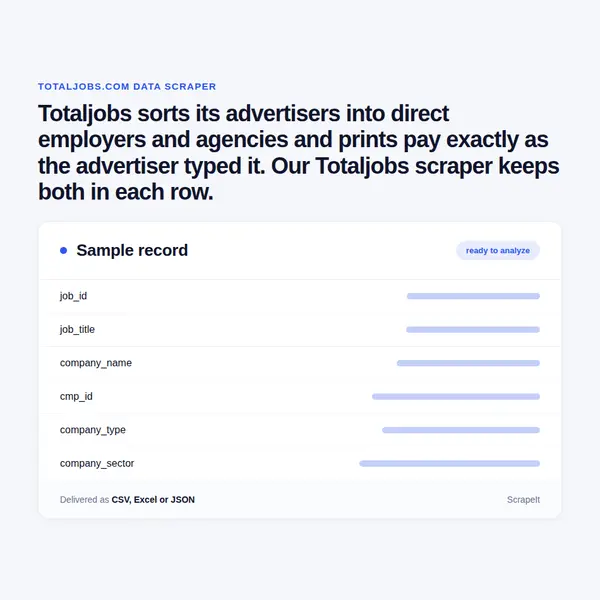
Totaljobs sorts its advertisers into direct employers and agencies and prints pay exactly as the advertiser typed it. Our Totaljobs scraper keeps both in each row.

Plans from €169/month · Free project assessment · Reply within 1 business day

Totaljobs Scraper
Solutions

Totaljobs scraping, run for you

You choose the scope: job titles, sectors, towns with a radius, a list of companies, or a sweep of the whole UK board. We build the crawler for totaljobs.com, schedule it and repair it when the site ships a new layout. Rendering, pacing, proxy rotation and CAPTCHA handling are included in the service.

Pay arrives the way advertisers write it - per annum, per day, per hour, Negotiable, a bare figure followed by Annual, or a range followed by a list of perks - so we keep the original line and add parsed minimum, maximum, currency and period columns. A free project assessment comes first, and a sample shows the columns before any plan.

Fields our Totaljobs data scraper returns

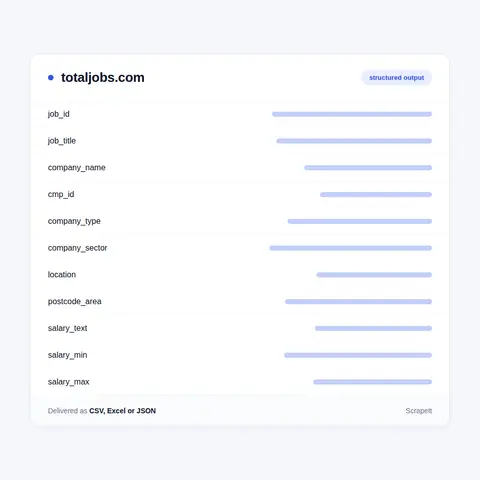
A Totaljobs ad address ends in the word job and a nine-digit number, and the company link carries its own cmpId. Those two ids anchor the dataset; everything else comes from the results card and the ad page:

  • Ad identity - job id, URL, title, and the NEW, FEATURED or PREMIUM label a card may carry.
  • Advertiser - company name, logo and cmpId, the sector and live job count on its company card, and whether Totaljobs files it as a Direct Employer or an Agency.
  • Location - town or district with the postcode area in brackets, as in East London (E1), and a full postcode where the advertiser gives one.
  • Pay - the salary line as printed, from annual ranges to day rates and hourly rates, with parsed figures and period.
  • Contract and work model - contract type such as Permanent, Contract, Temporary or Part Time, and the work model in the ad header, for example On-site.
  • Timing - the Published age on the card and ad, converted to a publication date.
  • Classification - the industry and sub-sector an ad is filed under in the page data, such as Logistics with Warehouse beneath it.
  • Text - the full description, and the short snippet that search results carry for each ad.

Recruitment agencies post many of the ads, so the advertiser is often not the company that will employ the hire. Agency names are business data and stay in; consultants' own names and direct numbers inside ad text are personal data and are dropped by default.

Fields our Totaljobs data scraper returns
Building a Totaljobs dataset: searches, salary panels, history

Building a Totaljobs dataset: searches, salary panels, history

Totaljobs organises listings by job title, sector and place, and its addresses follow suit - data analyst jobs in London, warehouse operative jobs in Manchester, one page per sector from Accountancy to Utilities. A search narrows by date posted, work from home options, job type, type of company, skills, and commute time by walking, cycling, car or public transport, and sorts by published date, relevance, salary or distance. We build the slice plan from those filters and merge on the job id.

The foot of a title-and-place search carries a panel worth keeping: the average salary per year for that role in that place with its range, the number of matching jobs, similar titles, the skills Totaljobs rates useful, the industry the role belongs to, and how many of the jobs are temporary or part-time. Captured on every run, it becomes a pay benchmark series per title and town.

Repeated runs add the rest of the history: first appearance, how long an ad stayed live, and when the same role was posted again. Agencies sometimes list one vacancy several times with identical title, postcode and pay, so we mark duplicates instead of counting them as separate jobs.

About Totaljobs

Totaljobs describes itself as one of the UK's largest online recruitment platforms. The site is operated by The Stepstone Group UK Limited and has offices in Glasgow, London, Manchester and Portsmouth. It covers every sector, from warehouse shifts paid by the hour to day-rate contracts in the City. The brand is one word, though many people type it as two; a total jobs scraper and a Totaljobs scraper are the same project here.

An ad page opens with the title, advertiser, location, a line such as Permanent Contract; On-site, the Published age and the salary line, then the description. Below it sits a company card with the advertiser's sector and its count of live jobs, followed by similar jobs popular with other job seekers and links to related titles and sectors in the same town.

Search comes in two forms: Classic search with a job title and a location, and Search in your words, which takes a plain-language description. Location pages run from Aberdeen to Yorkshire, and a Salary Planner and career advice sit beside the listings.

Get a Quote
dev_w
25

Developers

customers
500+

Customers worldwide

pages
1 500 000 000+

Pages extracted

stime
15000+

Hours saved for our clients

Plans

Totaljobs Scraping Plans and Pricing

Airplane

€199 / one-time

setup fee - included

Data limits100,000
Frequencyone-time
Run timeup to 5 days
Data storing7 days

Helicopter

€169 / mo

setup fee €499

Data limits250,000
Frequencymonthly
Run timeup to 5 days
Data storing14 days

Glasses

€229 / mo

setup fee €499

Data limits1,000,000
Frequencyweekly
Run timeup to 5 days
Data storing30 days

DNA

€549 / mo

setup fee €799

Data limits3,000,000
Frequency3 times daily
Run timesame day
Data storing90 days

Delivery: CSV, JSON or XLSX files, our API or a JSON feed. MCP server on request.

Full plan details →

Why scrape Totaljobs

Totaljobs shows a salary line on many ads and separates direct employers from agencies, two things a UK labour-market analyst otherwise rebuilds by hand. Scrape Totaljobs salaries by title and town and the result is a pay distribution, not an anecdote.

  • Pay benchmarking - annual, daily and hourly rates by title, town and contract type, set against the average-salary panel Totaljobs publishes for the same search.
  • Agency share - which recruitment agencies post in which sectors and towns, and how much of a category runs through agencies at all.
  • Contractor rates - day rates on contract ads, tracked per skill, show where the contract market is moving.
  • Hiring demand - new ads per sector and region from publication dates, with reposts removed.
  • Skills demand - the skills filter and description text, counted per title, show which tools employers name most.
  • Prospecting - direct employers with many live jobs are companies in hiring mode, worth knowing for staffing firms and HR software vendors.

Our Blog

Reads Our Latest News & Blog

Learn how to use web scraping to solve data problems for your organization

How Artificial Intelligence Is Used In Web Scraping

How Artificial Intelligence Is Used In Web Scraping

Leveraging advances in technology, the AI-powered web scraper has skyrocketed in demand and is helping to expand capabilities by automating tedious daily tasks and speeding up data collection from thousands of websites several times over.

What is Web Scraping and What is it Used For?

What is Web Scraping and What is it Used For?

Web scraping is a method of obtaining web data by extracting it from pages of web resources with the help of a program, that is, in automatic mode. It is used to syntactically convert web pages into more usable forms.

Web Scraping for Machine Learning

Web Scraping for Machine Learning

If you specialize in machine learning, you need to feed large amounts of data to the algorithms. Web scraping is the easiest and the most efficient method of collecting the data from all over the Internet.

scrapeit logo

About ScrapeIt

ScrapeIt builds and runs data collection for teams that would rather not maintain crawlers. On UK job boards that means sorting out pay written in many formats, agency reposts and postcode areas in brackets before the file reaches you. Deliveries follow the schedule you set - daily for demand tracking, weekly for benchmarks - as CSV, Excel or JSON, through our API or into Amazon S3, with field documentation included and personal data handled under GDPR.

FAQ

Do you offer a Totaljobs API for job and salary data?

Yes. The ScrapeIt Totaljobs API returns job id, title, company, the Direct Employer or Agency type, location with postcode area, salary as printed with parsed figures, and publication date as JSON from an endpoint we host, refreshed on the schedule you set. The same data also comes as CSV or XLSX files, as a JSON feed, or dropped into Amazon S3 or your own database.

Is it legal to scrape Totaljobs?

Yes. Result cards, full ad pages, company job lists and the salary panels on search pages are open to anyone without an account. We collect only publicly available data - everything a visitor can see on Totaljobs - and we collect it legally.

Can you separate agency ads from direct employer ads?

Yes. Totaljobs files each advertiser as a Direct Employer or an Agency, and its type of company filter exposes that split. We store it as a column, so you can drop agency ads, study them alone or compare pay between the two groups.

How do you scrape Totaljobs salaries when every ad words pay differently?

We keep the original salary line and parse it into minimum, maximum, currency and period - per annum, per day or per hour. Lines such as Negotiable stay as text with empty figures, and allowances or perks written after the figure go into a separate column.

How fresh is Totaljobs data, and how often should it run?

Searches can narrow to the last 24 hours, and cards show ages from hours to weeks. Daily runs pick up new ads on their first day; weekly runs are enough for salary panels and employer tables. Each run is timestamped, so expired ads drop out cleanly.

How does it Work?

Step 1 - Make a Request

You share your needs, expectations, and desired timeframe. We’ll suggest the best solution based on your request and budget.

Step 2 - Configuring Custom Web Crawlers

Our specialists configure the crawlers and extract a sample dataset for your review before proceeding with the full-scale extraction.

Step 3 - Collect and Deliver

Once you approve the sample, we launch the project and start full data collection. We gather, filter, and structure the data for easy use, delivering it on time in your preferred format.

Step 4 - Maintain and Support

Our team manages ongoing processes, monitors website changes, and supports all data extraction cycles. We can also help integrate data into your systems or create dashboards to simplify analysis.

Request a Quote

Tell us more about you and your project information.
Which sites, which fields, how often. A couple of lines is enough.

This form is protected by Google reCAPTCHA, which loads when you start filling it in. If you prefer not to use it, email us at info@scrapeit.io. Privacy & Cookie Policy

We reply within 1 business day. No obligation.

Totaljobs data from €169/month. Free project assessment, reply within 1 business day.

scrapiet

Scrapeit Sp. z o.o.
10/208 Legionowa str., 15-099, Bialystok, Poland
NIP: 5423457175
REGON: 523384582