stellenanzeigen.de Scraper for Job Ads, Salaries and Benefits

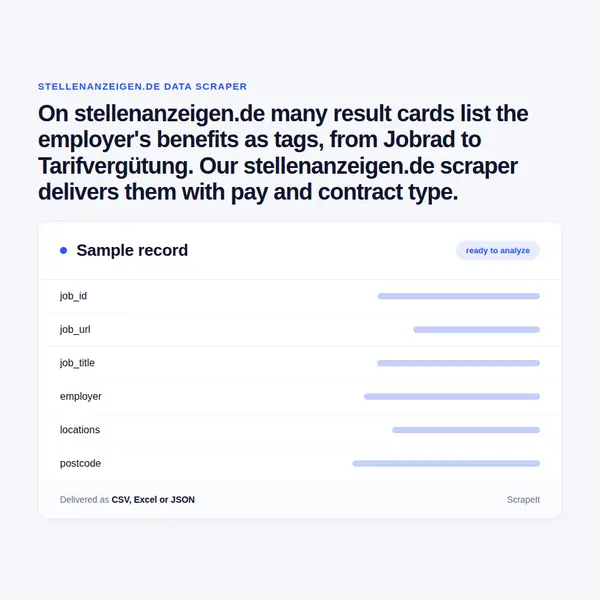
On stellenanzeigen.de many result cards list the employer's benefits as tags, from Jobrad to Tarifvergütung. Our stellenanzeigen.de scraper delivers them with pay and contract type.

Plans from €169/month · Free project assessment · Reply within 1 business day

stellenanzeigen.de Scraper
Solutions

stellenanzeigen.de scraping as a managed service

Describe the scope - keywords, job titles, cities and radius, Vertragsart, industries or a list of employers - and the cadence. We build the crawler, keep it running and repair it after front-end changes. The anti-bot work - pacing, proxy rotation, rendering, CAPTCHA handling - is included, not something you arrange.

Before the first run you get a free assessment of the scope and a sample file. Runs then go out once, daily, weekly or on demand with field documentation, as CSV, XLSX or JSON, through a JSON feed, into Google Cloud Storage or Dropbox, or loaded into your database.

stellenanzeigen.de data in each job ad

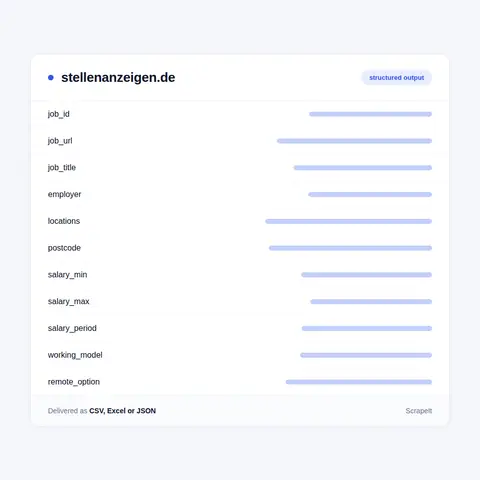
Each ad on stellenanzeigen.de has a job id made of a source prefix and a number - SDE-, JIM-, YF- and REG- among them - and the same id closes the ad address after /job/ and the title slug. Rows are keyed on it. Fields per ad:

  • Identity - the prefixed id, the ad link, the title with its gender tag, employer name and logo, and the employer profile where one exists.
  • Location - one or several cities as the card lists them, with postcode and region from the structured job data of the ad where the employer gave them.
  • Pay - salary as printed on the card, a range in euros per year or per month, split into minimum, maximum, currency and period.
  • Working model - Vollzeit and Teilzeit tags for full-time and part-time, Teilweise Remote or 100% Home Office, and the Schnellbewerbung badge.
  • Benefit tags - each tag as its own value, such as Gesundheitsangebote, Flexible Arbeitszeiten, Gute Verkehrsanbindung, Weiterbildungsangebote, Jobrad, Tarifvergütung, Urlaubsgeld, Kantine or Jobticket, plus the counter printed after the tags.
  • Classification - industry tags, employment type and, where stated, the required experience in months, all from the structured data on the ad page.
  • Dates - the posting date and the end date the ad is scheduled to run to.
  • Text - the teaser under the card and the full ad, read from the employer's layout or its barrierefreie Version.

Employers design their own ads, so headings differ - Deine Aufgaben, Dein Profil and Deine Benefits on one, other words on the next. We keep the full text next to the structured fields, and contact names printed in an ad are left out by default.

stellenanzeigen.de data in each job ad
Salary comparison, employer profiles and history

Salary comparison, employer profiles and history

The Gehaltsvergleich section adds a salary layer of its own. Each occupation page gives a Mindestgehalt, a Durchschnitt and a Maximalgehalt for Germany, then a table by city with average, range and a link to that city's open jobs. Collected alongside the ads, the salary comparison lets you set what employers print against the board's own survey figures for the same title and city.

Employer profiles under /arbeitgeberprofil/ list an employer's open positions; the Arbeitgeber von A-Z directory and the index by town let a run start from a list of companies instead of a keyword. Landing pages under /jobs/ for job titles, cities and industries - Pflege, Logistik, Öffentlicher Dienst, Erneuerbare Energien and many more - give ready slices for sector monitoring.

Scheduled passes that revisit each SDE- or JIM- id show what one snapshot cannot: how long an ad stayed up against its scheduled end date, whether a salary or benefit was added later, and which employers post the same role again.

About stellenanzeigen.de and its regional reach

stellenanzeigen.de is a German job board run by stellenanzeigen.de GmbH & Co. KG from Munich and founded in 1995. Its own fact page calls it a generalist board for skilled staff and managers and lists media partnerships with regional news portals, Süddeutsche Zeitung and Münchner Merkur/tz among them, plus specialist portals that ads are distributed to.

For job seekers the site is built around a Was? and Wo? search with radius options from 10 km, landing pages per job title, city and industry, an Arbeitgeber von A-Z directory, a Gehaltsvergleich glossary of occupations and the careeasy magazine. A result list shows its count, and once exact matches run out it continues with a block of similar jobs - worth knowing, because the tail of a list is no longer your query.

The filters are the board's vocabulary: Arbeitszeitmodell, Home Office (100% Home-Office or Home-Office möglich), Leitungsebene for management level, Datum and Vertragsart. Vertragsart reaches past employment contracts to Freiberufler for freelance work, Werkstudent for working student jobs, Ausbildung for an apprenticeship, Praktikum for an internship, Ehrenamt for volunteer roles, Abschlussarbeit for a thesis and Doktorand for doctoral posts.

Get a Quote
dev_w
25

Developers

customers
500+

Customers worldwide

pages
1 500 000 000+

Pages extracted

stime
15000+

Hours saved for our clients

Plans

stellenanzeigen.de Scraping Plans and Pricing

Airplane

€199 / one-time

setup fee - included

Data limits100,000
Frequencyone-time
Run timeup to 5 days
Data storing7 days

Helicopter

€169 / mo

setup fee €499

Data limits250,000
Frequencymonthly
Run timeup to 5 days
Data storing14 days

Glasses

€229 / mo

setup fee €499

Data limits1,000,000
Frequencyweekly
Run timeup to 5 days
Data storing30 days

DNA

€549 / mo

setup fee €799

Data limits3,000,000
Frequency3 times daily
Run timesame day
Data storing90 days

Delivery: CSV, JSON or XLSX files, our API or a JSON feed. MCP server on request.

Full plan details →

What a stellenanzeigen.de dataset is good for

Data from stellenanzeigen.de answers what employers offer, not only whom they are looking for.

  • Benefits benchmarking. Count how often employers in a region or industry offer Jobrad, Jobticket, Urlaubsgeld or Tarifvergütung, and how that moves over a year.
  • Pay transparency. Printed salary ranges per job title and city, set against the Gehaltsvergleich averages for the same occupation.
  • Flexible work tracking. Shares of Teilweise Remote, fully remote and Teilzeit ads per industry and city.
  • Local demand maps. Postcode-level locations turn ads into vacancy maps by district and commuting zone.
  • Early talent pipeline. Werkstudent, Praktikum, Abschlussarbeit and Doktorand ads show which employers recruit students and graduates before they finish.
  • Sales intelligence. HR service providers, recruiters and benefit vendors find employers that are hiring - and see which benefits they do not list yet.

Our Blog

Reads Our Latest News & Blog

Learn how to use web scraping to solve data problems for your organization

How Artificial Intelligence Is Used In Web Scraping

How Artificial Intelligence Is Used In Web Scraping

Leveraging advances in technology, the AI-powered web scraper has skyrocketed in demand and is helping to expand capabilities by automating tedious daily tasks and speeding up data collection from thousands of websites several times over.

What is Web Scraping and What is it Used For?

What is Web Scraping and What is it Used For?

Web scraping is a method of obtaining web data by extracting it from pages of web resources with the help of a program, that is, in automatic mode. It is used to syntactically convert web pages into more usable forms.

Web Scraping for Machine Learning

Web Scraping for Machine Learning

If you specialize in machine learning, you need to feed large amounts of data to the algorithms. Web scraping is the easiest and the most efficient method of collecting the data from all over the Internet.

scrapeit logo

About ScrapeIt

ScrapeIt collects website data for companies that would rather not maintain scrapers themselves. With job boards, what we add is consistency: the same columns for every ad, benefits split into values you can count, salaries normalised to minimum, maximum and period, and a history built from scheduled runs. Personal data is handled under GDPR and we do not build profiles of people. Plans start from EUR 169 a month, or EUR 199 for a one-time extract.

FAQ

Do you offer a stellenanzeigen.de API for job ads?

Yes. The ScrapeIt stellenanzeigen.de API returns the prefixed job id, ad title, employer, salary range, Vertragsart and benefit tags as JSON from an endpoint we host, refreshed on the schedule you set. The same data also comes as CSV or XLSX files, a JSON feed or straight into your database.

Is it legal to scrape stellenanzeigen.de?

Yes. Search results, ad pages, employer profiles and the salary comparison pages on stellenanzeigen.de open without an account. We collect only publicly available data - everything a visitor can see on stellenanzeigen.de - and we collect it legally.

Can you split the data by contract type, such as Werkstudent or Freiberufler?

Yes. Vertragsart offers Festanstellung, Freiberufler, Befristeter Vertrag, Ausbildung, Trainee, Duales Studium, Minijob, Praktikum, Ehrenamt, Werkstudent, Abschlussarbeit and Doktorand, and we run one slice per value so every ad carries its type. Leitungsebene adds a leading or non-leading position flag the same way.

How often are stellenanzeigen.de jobs updated?

New ads arrive every day, and the Datum filter offers seit gestern, seit 7 Tagen and seit 30 Tagen, so a run on the seit gestern slice each day picks up new ads within a day. Every ad states its posting date and end date in its structured data, and a weekly full pass shows which job ids went offline early.

Do you capture the benefit tags and salary on every card?

Where the card shows them. Tags such as Flexible Arbeitszeiten, Nachhaltiger Arbeitgeber or Jobticket appear on many cards, while a salary appears only when the employer gives one, as a range per year or per month. We store each benefit as its own value and leave salary empty when none is printed.

How does it Work?

Step 1 - Make a Request

You share your needs, expectations, and desired timeframe. We’ll suggest the best solution based on your request and budget.

Step 2 - Configuring Custom Web Crawlers

Our specialists configure the crawlers and extract a sample dataset for your review before proceeding with the full-scale extraction.

Step 3 - Collect and Deliver

Once you approve the sample, we launch the project and start full data collection. We gather, filter, and structure the data for easy use, delivering it on time in your preferred format.

Step 4 - Maintain and Support

Our team manages ongoing processes, monitors website changes, and supports all data extraction cycles. We can also help integrate data into your systems or create dashboards to simplify analysis.

Request a Quote

Tell us more about you and your project information.
Which sites, which fields, how often. A couple of lines is enough.

This form is protected by Google reCAPTCHA, which loads when you start filling it in. If you prefer not to use it, email us at info@scrapeit.io. Privacy & Cookie Policy

We reply within 1 business day. No obligation.

stellenanzeigen.de data from €169/month. Free project assessment, reply within 1 business day.

scrapiet

Scrapeit Sp. z o.o.
10/208 Legionowa str., 15-099, Bialystok, Poland
NIP: 5423457175
REGON: 523384582