Australia Post Data for Tracking, Rates and Remote Delivery

Comparing a Sydney lane with a Kimberley lane on the same chart is not a comparison. On this carrier, distance is the variable that explains almost everything.

Australia Post Scraper
Solutions

Managed Australia Post data, run end to end by us

ScrapeIt builds and runs the pipeline as a managed service. You tell us the lanes and services; we build the collection, classify destinations by remoteness, normalise statuses across every carrier you use, and hand back CSV, JSON, Excel or a push into your warehouse.

Where the operator's business interfaces are the right route and you can obtain credentials, we recommend and support that rather than routing around it. Public collection stays on open surfaces, honours published crawl rules and is paced deliberately.

We collect no recipient names and no address detail beyond the postcode, which is what lane and regional analysis actually needs. Bring the use case to your own counsel before the project starts.

Australia Post fields in every export

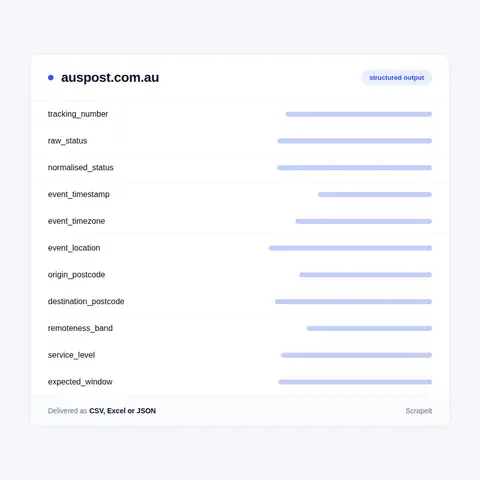
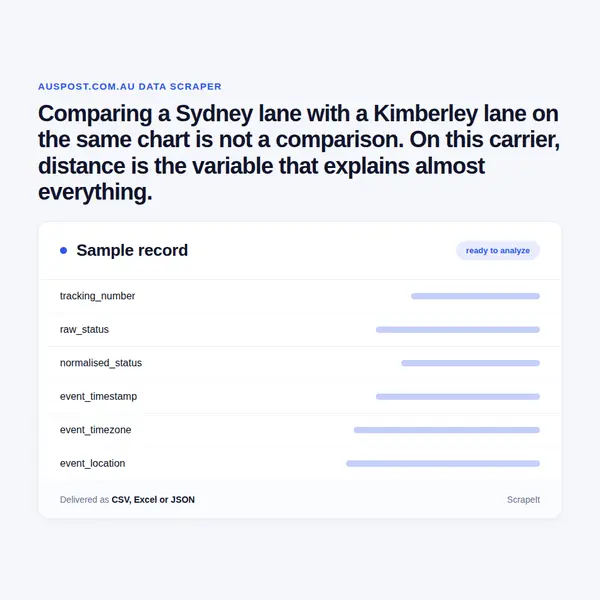
Tracking output carries the tracking number, the raw status text as published, the normalised status, the event timestamp with time zone, the event location and the facility identifier where given.

Time zones need naming rather than assuming. The country spans several, some observing daylight saving and some not, which means a naive timestamp produces delivery duration analyses that are wrong by hours for a large share of shipments and wrong inconsistently across the year. We store the zone explicitly and compute durations in UTC.

Shipment fields cover origin and destination postcode, the destination classified as metropolitan, regional or remote, service level, expected delivery window where published, actual delivery, attempt count, delivery outcome including collection point holds, and the exception reason.

Rate records carry service level, origin and destination zone, weight band, dimensional limits, base price, surcharges where published and the effective date of the price table.

Location records carry the outlet or locker name, type, address, postcode, coordinates where published, opening hours structured by day and the services offered.

Australia Post fields in every export
Collection points, seasonality and multi-carrier comparison

Collection points, seasonality and multi-carrier comparison

The outlet and locker estate is a slower dataset with a real refresh need: hours change, sites open and close, and a checkout locator showing a closed post office is worse than showing none. Monthly collection with change records keeps it honest, and change records mean a client sees what moved rather than reloading everything.

Seasonality is pronounced here and worth modelling separately. Volume and transit times move sharply around the end of year peak, and a year on year comparison that ignores the peak window reports noise as trend.

Multi carrier comparison is where most clients end up, and this carrier is usually the baseline because of its reach. The comparison only means anything with remoteness segmentation and consistent outcome classification, both of which have to be designed before the second carrier is added rather than after.

Rate history is retained rather than overwritten, because a procurement review always asks what a shipping profile would have cost under the previous table.

A national operator across an unusually large country

Australia Post is the national postal operator and, across most of the continent, the only carrier that reaches the address at all. Private networks concentrate on the eastern seaboard cities; everything else falls to the post. Any Australian ecommerce analysis that treats carriers as interchangeable is wrong about most of the map.

Geography dominates the data more than on any other carrier we work with. Transit expectations, surcharges and delivery outcomes vary enormously between metropolitan, regional and remote destinations, and a national average across those is a number that describes nowhere.

Tracking, rate lookup and location search are available through the public site, and the operator runs a developer programme with documented interfaces for business integrations. Where a client can obtain credentials, that is the route we recommend and support.

Alongside delivery to the door the operator runs a large estate of post offices, parcel lockers and collection points, which is what powers pickup options in Australian checkouts and is its own dataset with its own refresh cadence.

Get a Quote
dev_w
25

Developers

customers
500+

Customers worldwide

pages
1 500 000 000+

Pages extracted

stime
15000+

Hours saved for our clients

Plans

Airplane

€199 / one-time

setup fee - included

Data limits100,000
Frequencyone-time
Run timeup to 5 days
Data storing7 days

Helicopter

€169 / mo

setup fee €499

Data limits250,000
Frequencymonthly
Run timeup to 5 days
Data storing14 days

Glasses

€229 / mo

setup fee €499

Data limits1,000,000
Frequencyweekly
Run timeup to 5 days
Data storing30 days

DNA

€549 / mo

setup fee €799

Data limits3,000,000
Frequency3 times daily
Run timesame day
Data storing90 days

Why remoteness classification is the whole analysis

The default carrier performance report compares average transit times and declares a winner. On this carrier that report is meaningless, because the average is dominated by where the parcels were going rather than by how well anyone performed.

A metropolitan lane and a remote lane differ by days, not hours, and they differ for reasons nobody can fix. Comparing the national operator against a private network without segmenting by remoteness makes the operator look slow when it is simply serving addresses the other one does not attempt.

So the classification is not a nice-to-have field, it is the precondition for the analysis being honest. We classify every destination and report performance within each band, which is the only version a logistics team can act on.

The second issue is the delivery outcome. A large share of Australian parcels complete at a collection point rather than at the door, and that is a legitimate completion rather than a failure. Tooling that treats anything other than a doorstep handover as an exception generates false alarms at national scale.

The third is rates, which are zone based across enormous distances with surcharges layered on. The published price is a calculation rather than a lookup, and reproducing it needs the full table with its effective date.

Our Blog

Reads Our Latest News & Blog

Learn how to use web scraping to solve data problems for your organization

How Artificial Intelligence Is Used In Web Scraping

How Artificial Intelligence Is Used In Web Scraping

Leveraging advances in technology, the AI-powered web scraper has skyrocketed in demand and is helping to expand capabilities by automating tedious daily tasks and speeding up data collection from thousands of websites several times over.

What is Web Scraping and What is it Used For?

What is Web Scraping and What is it Used For?

Web scraping is a method of obtaining web data by extracting it from pages of web resources with the help of a program, that is, in automatic mode. It is used to syntactically convert web pages into more usable forms.

Web Scraping for Machine Learning

Web Scraping for Machine Learning

If you specialize in machine learning, you need to feed large amounts of data to the algorithms. Web scraping is the easiest and the most efficient method of collecting the data from all over the Internet.

scrapeit logo

Who builds and keeps your Australia Post feed

ScrapeIt is a managed extraction company, not a tool you have to learn. Our team builds the pipeline, watches it as interfaces and status wording change, and repairs it before your peak season reporting goes quiet.

You see a sample first, in your format, on your own lanes including remote destinations, with the remoteness classification applied so you can see how much of your average it was hiding.

FAQ

Why classify destinations by remoteness?

Because without it the performance report is meaningless. Metropolitan and remote lanes differ by days for reasons nobody can fix, so a national average describes where the parcels went rather than how anyone performed. Comparing the national operator with a private network without segmenting makes it look slow when it is serving addresses the other one does not attempt.

Are collection point deliveries treated as failures?

Not by us. A large share of Australian parcels complete at a post office or locker, and that is a legitimate completion. We classify the outcome rather than flagging it, because tooling that treats anything other than a doorstep handover as an exception generates false alarms at national scale.

Do time zones really cause problems here?

Yes, and inconsistently, which is worse. The country spans several zones and some observe daylight saving while others do not, so a naive timestamp produces delivery durations that are wrong by hours for many shipments and wrong differently across the year. We store the zone explicitly and compute in UTC.

Can you collect the post office and locker network?

Yes, with addresses, coordinates, opening hours structured by day and services offered. It changes slowly but it does change, and a checkout locator showing a closed outlet is worse than showing none, so we refresh monthly with change records.

Should I use the official developer interfaces instead?

Where you can obtain credentials, yes, and we will help you get there rather than routing around it. What we add is everything after retrieval: remoteness classification, cross carrier normalisation, silence detection and delivery into your warehouse.

How does it Work?

Step 1 - Make a Request

You share your needs, expectations, and desired timeframe. We’ll suggest the best solution based on your request and budget.

Step 2 - Configuring Custom Web Crawlers

Our specialists configure the crawlers and extract a sample dataset for your review before proceeding with the full-scale extraction.

Step 3 - Collect and Deliver

Once you approve the sample, we launch the project and start full data collection. We gather, filter, and structure the data for easy use, delivering it on time in your preferred format.

Step 4 - Maintain and Support

Our team manages ongoing processes, monitors website changes, and supports all data extraction cycles. We can also help integrate data into your systems or create dashboards to simplify analysis.

Request a Quote

Tell us more about you and your project information.
Which sites, which fields, how often. A couple of lines is enough.

We reply within 1 business day. No obligation.

scrapiet

Scrapeit Sp. z o.o.
10/208 Legionowa str., 15-099, Bialystok, Poland
NIP: 5423457175
REGON: 523384582