Poczta Polska Data for Tracking, Customs and Delivery

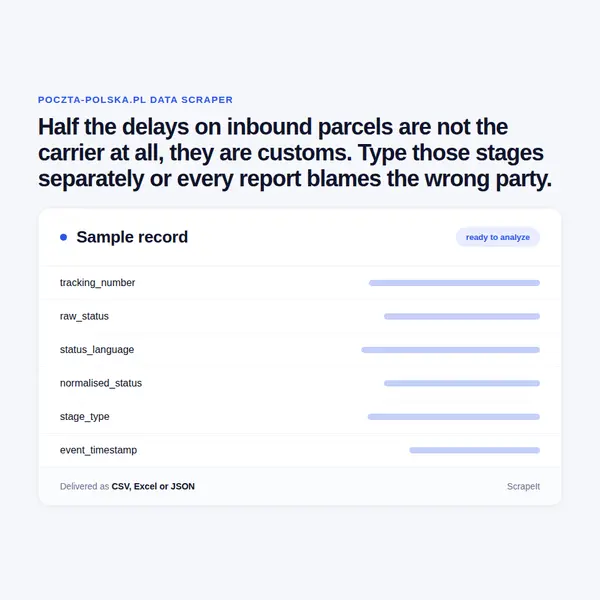
Half the delays on inbound parcels are not the carrier at all, they are customs. Type those stages separately or every report blames the wrong party.

Poczta Polska Scraper
Solutions

Managed Poczta Polska data, run end to end by us

ScrapeIt builds and runs the pipeline as a managed service. You tell us the lanes; we build the collection with a Polish language status map, type customs stages separately, normalise everything into your cross carrier model and hand back CSV, JSON, Excel or a push into your warehouse.

Requests are paced deliberately. A carrier tracking surface hammered by one client becomes harder for everyone, and on a national operator that matters more than usual.

We collect no recipient names and no address detail beyond the postcode. Duty and VAT values attach to shipments rather than to people. Bring the use case to your own counsel before the project starts.

Poczta Polska fields in every export

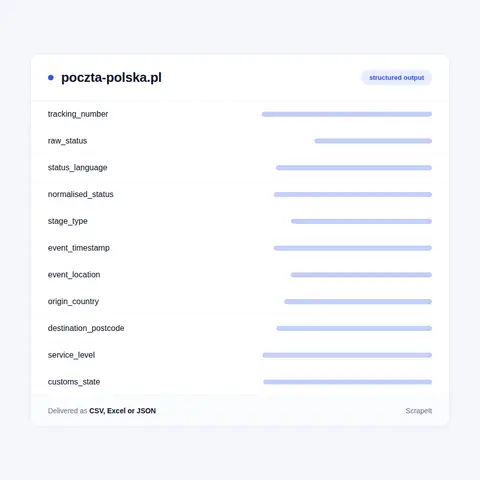
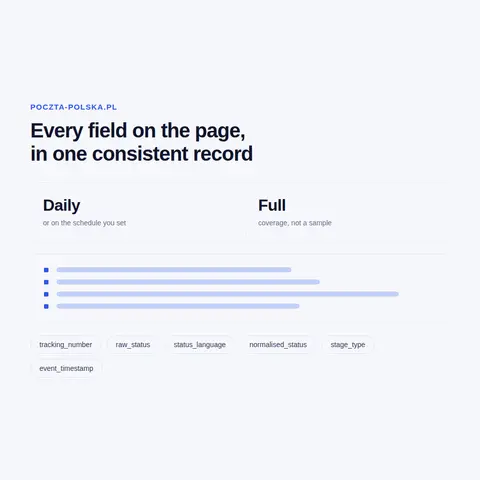
Tracking output carries the tracking number, the raw status text in its original language with the language recorded, the normalised status, the event timestamp with time zone, the event location and the facility where given.

Stage type is the field that makes this source worth collecting properly: transport, delivery attempt, customs presentation, customs hold, customs release, duty assessment and collection point hold are typed separately rather than flattened into a status string. That single distinction turns an inbound exception report from noise into something actionable.

Where duty or VAT amounts appear in the stream they are captured as their own fields, because for a cross border seller the charge is frequently the reason the parcel stalled and the customer complained.

Shipment fields cover origin and destination postcode, origin country for inbound items, service level, expected delivery where published, actual delivery, attempt count, delivery outcome and the exception reason.

Location records carry the branch name, address, postcode, coordinates where published, opening hours structured by day and the services offered.

Poczta Polska fields in every export
Duty data, branches and cross-border analysis

Duty data, branches and cross-border analysis

Duty and VAT capture is worth setting up deliberately where a client ships into Poland at volume. The charge is what the recipient sees, and the correlation between charge value and refusal rate is one of the more useful numbers a cross border seller can have.

Branch and collection point data is the slower second dataset: hours, services and locations, refreshed monthly with change records. It powers pickup options in a Polish checkout, where out of home delivery has an unusually high share.

Cross border analysis usually means collecting the sending side too. A parcel's history starts with the origin operator and continues with Poczta Polska, and joining the two gives an end to end timeline instead of two fragments. We match on the tracking number where the format carries through and on timing and route where it does not.

Historical backfill depends on retention, which is limited on carrier tracking surfaces generally. A tracking dataset is built going forward, and we say so rather than promising a year of history that was never retained.

The national operator and the customs stage

Poczta Polska is the Polish national postal operator. It handles domestic mail and parcels, and it is the receiving operator for a large share of international post entering the country, which is where the interesting part of its data sits.

Inbound international parcels pass through customs clearance, and those stages appear in the tracking stream alongside ordinary transport events. They look similar and they are not: a parcel held for customs assessment is not a parcel the carrier lost, and the resolution path is completely different. Any exception report that does not type them separately blames the operator for delays it does not control.

The tracking surface is public and responds with substantial content. Status wording is Polish, with English available in places, which brings the same bilingual parsing requirement as any non English carrier: build the status map in the source language or half the events fall into an unknown bucket.

Alongside delivery the operator runs a large network of post offices and collection points, with their own hours and services, which is the usual second dataset with its own slower cadence.

Get a Quote
dev_w
25

Developers

customers
500+

Customers worldwide

pages
1 500 000 000+

Pages extracted

stime
15000+

Hours saved for our clients

Plans

Airplane

€199 / one-time

setup fee - included

Data limits100,000
Frequencyone-time
Run timeup to 5 days
Data storing7 days

Helicopter

€169 / mo

setup fee €499

Data limits250,000
Frequencymonthly
Run timeup to 5 days
Data storing14 days

Glasses

€229 / mo

setup fee €499

Data limits1,000,000
Frequencyweekly
Run timeup to 5 days
Data storing30 days

DNA

€549 / mo

setup fee €799

Data limits3,000,000
Frequency3 times daily
Run timesame day
Data storing90 days

Why customs stages have to be typed separately

A cross border seller shipping into Poland sees a stalled parcel and opens a ticket against the carrier. Often the carrier has done nothing wrong: the item is sitting in customs awaiting assessment or awaiting payment from the recipient, and no amount of chasing the operator will move it.

Typed data fixes the conversation. Once customs stages are their own type, an exception dashboard can separate we are waiting on the carrier from we are waiting on customs from we are waiting on the recipient to pay, and each routes to a different action. Untyped, all three look identical and the support team works the wrong queue.

The second reason is that the customs pattern is itself a dataset. How long assessment typically takes, which origin countries stall most often, how frequently duty is charged at what values - all of that falls out of typed stages collected over time, and it feeds directly into landed cost estimates and delivery promises that hold up.

The third is the language. Status wording is Polish, and a status map built in English will drop a large share of events into unknown. Worse, it drops them silently, so the dataset looks complete while a class of event is missing.

The fourth is the same as on any national operator: it reaches addresses private networks do not, so comparing it with them on an unadjusted average understates it.

Our Blog

Reads Our Latest News & Blog

Learn how to use web scraping to solve data problems for your organization

How Artificial Intelligence Is Used In Web Scraping

How Artificial Intelligence Is Used In Web Scraping

Leveraging advances in technology, the AI-powered web scraper has skyrocketed in demand and is helping to expand capabilities by automating tedious daily tasks and speeding up data collection from thousands of websites several times over.

What is Web Scraping and What is it Used For?

What is Web Scraping and What is it Used For?

Web scraping is a method of obtaining web data by extracting it from pages of web resources with the help of a program, that is, in automatic mode. It is used to syntactically convert web pages into more usable forms.

Web Scraping for Machine Learning

Web Scraping for Machine Learning

If you specialize in machine learning, you need to feed large amounts of data to the algorithms. Web scraping is the easiest and the most efficient method of collecting the data from all over the Internet.

scrapeit logo

Who builds and keeps your Poczta Polska feed

ScrapeIt is a managed extraction company, not a tool you have to learn. Our team builds the pipeline, maintains the Polish status map as wording changes, and repairs the collector before a class of event quietly disappears into unknown.

You see a sample first, in your format, on your own lanes including inbound international, with customs stages typed so you can see how much of your delay was never the carrier.

FAQ

Why separate customs stages from transport events?

Because they require different actions and blaming the wrong party wastes everyone's time. A parcel held for assessment is not a parcel the carrier lost, and chasing the operator will not move it. Typed apart, a dashboard can distinguish waiting on the carrier, waiting on customs and waiting on the recipient to pay - three different queues.

Do you capture duty and VAT amounts?

Where they appear in the tracking stream, yes, as their own fields. For a cross border seller the charge is frequently the reason the parcel stalled and the customer complained, and the correlation between charge value and refusal rate is one of the more useful numbers available.

Does the Polish status wording cause problems?

For pipelines not built for it, yes, and silently. A status map built in English drops a large share of events into unknown, and the dataset still looks complete. We build the map in the source language, keep the raw text with its language on every row and treat an unmapped status as an alert.

Can you cover the whole journey for inbound parcels?

Usually, by collecting the sending operator as well and joining the two into one timeline. The tracking number often carries through; where it does not we match on timing and route. Two fragments become an end to end history, which is what a cross border seller actually needs.

How far back does tracking history go?

Not far. Carrier tracking surfaces retain limited history generally, so a tracking dataset is built going forward rather than backfilled. We say that at scoping rather than promising a year of history that was never retained.

How does it Work?

Step 1 - Make a Request

You share your needs, expectations, and desired timeframe. We’ll suggest the best solution based on your request and budget.

Step 2 - Configuring Custom Web Crawlers

Our specialists configure the crawlers and extract a sample dataset for your review before proceeding with the full-scale extraction.

Step 3 - Collect and Deliver

Once you approve the sample, we launch the project and start full data collection. We gather, filter, and structure the data for easy use, delivering it on time in your preferred format.

Step 4 - Maintain and Support

Our team manages ongoing processes, monitors website changes, and supports all data extraction cycles. We can also help integrate data into your systems or create dashboards to simplify analysis.

Request a Quote

Tell us more about you and your project information.
Which sites, which fields, how often. A couple of lines is enough.

We reply within 1 business day. No obligation.

scrapiet

Scrapeit Sp. z o.o.
10/208 Legionowa str., 15-099, Bialystok, Poland
NIP: 5423457175
REGON: 523384582