DPD Scraper for Parcel Tracking Across European Networks

DPD is a network of national companies rather than one carrier. Statuses, tracking formats and even the domains differ by country, and a single integration will not do.

DPD Scraper
Solutions

Managed DPD data collection, run end to end by us

ScrapeIt builds and runs the pipeline as a managed service. You name the country networks and whether you need tracking, pickup points or both; we build the integrations per market, match cross border parcels into one stream, and hand back CSV, JSON, Excel or a push into your warehouse with statuses normalised and original wording retained.

Where a national operation offers a supported interface and you can obtain credentials, that is the route we recommend and help you set up. Public collection is confined to open surfaces, we honour published crawl rules and we pace requests, because a carrier tracking endpoint hammered by one client tends to become unavailable to everyone.

Tracking data describes shipments with recipients at the end of them. We collect no recipient names and no address detail beyond the postcode level needed for lane analysis. Bring the use case to your own counsel before the project starts.

DPD fields in every export

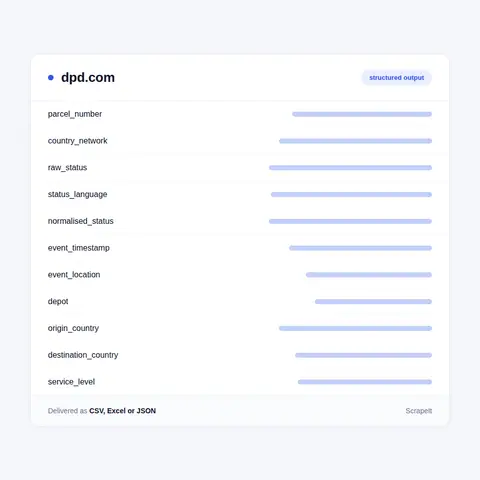
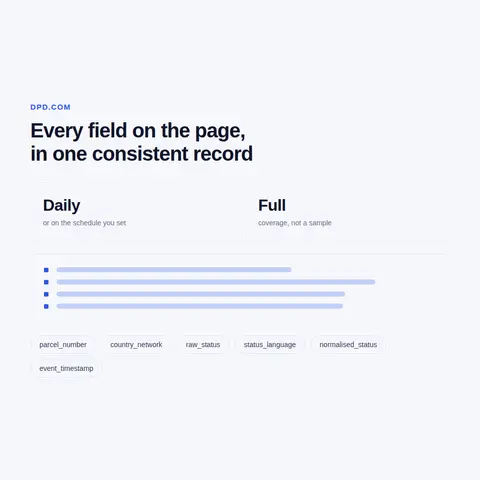
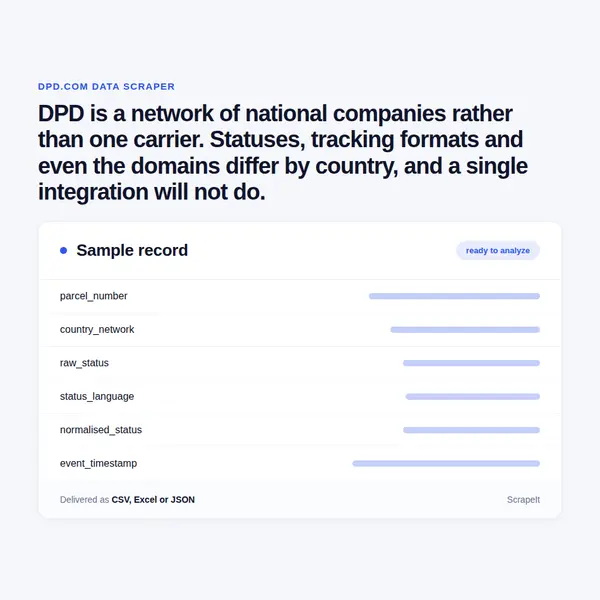
Tracking output carries the parcel number, the country network the event came from, the raw status text in its original language, an English normalised status, the event timestamp with time zone, the event location and the depot where it is identified.

Original language status text is kept rather than discarded. A German status and a Polish status mapped to the same normalised value are the same fact, but when somebody disputes an outcome the original wording is the evidence, and translating it away loses that.

Shipment fields cover origin and destination country and postcode, service level, promised delivery window where published, actual delivery time, delivery attempt count, the delivery outcome including neighbour and safe place deliveries where recorded, and the exception reason.

Pickup point records carry the point identifier, name, full address, country, coordinates where published, opening hours structured by day, the services offered such as drop off, collection and returns, and capacity or size limits where stated.

Every row carries the country network and the collection timestamp, because on this carrier a status without the network it came from cannot be interpreted reliably.

DPD fields in every export
Cross-border matching, pickup estate and refresh design

Cross-border matching, pickup estate and refresh design

Cross border matching is the piece that separates a usable dataset from a pile of events. We match parcels across national systems on reference numbers, timing and route, then present one ordered stream with the source network recorded per event. Where a parcel is visible in two systems with different detail, the richer record is preferred and the difference is retained rather than discarded.

The pickup point estate needs its own cadence. Locations change more slowly than parcels move but faster than anybody expects: shops close, hours change seasonally, and lockers are added continuously. A monthly refresh with change records keeps a checkout locator honest, and change records mean a client sees what moved rather than reloading everything.

Language handling runs throughout. Status text arrives in the national language, and pickup point names and addresses carry local characters. We keep the original text, store the language and provide normalised English values alongside rather than in place of it.

Multi carrier design applies here exactly as it does elsewhere: one status model, one lane definition and one exception taxonomy across every carrier a client uses, defined before the second carrier is added rather than after.

One brand, many national networks

DPD is one of the largest parcel networks in Europe, and it is structurally a group of national operations rather than a single company with one system. That distinction is invisible from the outside and decisive for anybody integrating it.

Country operations run their own sites, frequently on their own domains, with their own tracking interfaces, their own status wording and, in some markets, their own reference number formats. A parcel handed over in one country and delivered in another may be visible through more than one of those systems, showing different levels of detail.

The group site carries a parcel tracking entry point and general information, and it responds normally, as do the national sites for the markets we have checked. The practical consequence is that scoping an integration means naming the countries, not naming the carrier, and expecting the effort to scale with the number of markets rather than being fixed.

Pickup points are the other substantial dataset here. The network runs a large estate of parcel shops and lockers, each with an address, opening hours and service capabilities, and that data powers checkout delivery options for a great many European retailers.

Get a Quote
dev_w
25

Developers

customers
500+

Customers worldwide

pages
1 500 000 000+

Pages extracted

stime
15000+

Hours saved for our clients

Plans

Airplane

€199 / one-time

setup fee - included

Data limits100,000
Frequencyone-time
Run timeup to 5 days
Data storing7 days

Helicopter

€169 / mo

setup fee €499

Data limits250,000
Frequencymonthly
Run timeup to 5 days
Data storing14 days

Glasses

€229 / mo

setup fee €499

Data limits1,000,000
Frequencyweekly
Run timeup to 5 days
Data storing30 days

DNA

€549 / mo

setup fee €799

Data limits3,000,000
Frequency3 times daily
Run timesame day
Data storing90 days

Why a European network is several integrations wearing one name

The usual brief is add DPD, as though it were one thing. It is not, and the cost of discovering that late is a rebuild.

Each national operation words its statuses differently, in its own language, at its own level of granularity. One network reports a depot scan that another does not expose at all. One publishes a delivery time window before the day of delivery, another only afterwards. A status model built from one country's vocabulary breaks the moment a second country is added, which is why the model has to be designed for the group from the start.

Cross border parcels compound this. A shipment moving between two national operations produces events in both, and without joining them the same parcel looks like two incomplete journeys. Matching them, and presenting a single ordered event stream, is a substantial part of the work on this carrier and it is why cross border retailers come to us for it.

The second reason to collect here is pickup points. Out of home delivery is a large and growing share of European ecommerce, and a checkout that shows a nearby parcel shop with correct opening hours converts better than one that does not. That dataset ages, since shops open, close and change hours, so it needs refreshing rather than importing once.

The third is delivery outcome detail. European networks record safe place and neighbour deliveries in ways that matter for claims and for customer service, and those outcomes are frequently flattened into delivered by generic tooling.

Our Blog

Reads Our Latest News & Blog

Learn how to use web scraping to solve data problems for your organization

How Artificial Intelligence Is Used In Web Scraping

How Artificial Intelligence Is Used In Web Scraping

Leveraging advances in technology, the AI-powered web scraper has skyrocketed in demand and is helping to expand capabilities by automating tedious daily tasks and speeding up data collection from thousands of websites several times over.

What is Web Scraping and What is it Used For?

What is Web Scraping and What is it Used For?

Web scraping is a method of obtaining web data by extracting it from pages of web resources with the help of a program, that is, in automatic mode. It is used to syntactically convert web pages into more usable forms.

Web Scraping for Machine Learning

Web Scraping for Machine Learning

If you specialize in machine learning, you need to feed large amounts of data to the algorithms. Web scraping is the easiest and the most efficient method of collecting the data from all over the Internet.

scrapeit logo

Who builds and keeps your DPD feed

ScrapeIt is a managed extraction company, not a tool you have to learn. Our team builds and maintains the per market integrations, watches them as national systems change independently of each other, and repairs them before your exception alerts go quiet.

You see a sample first, in your format, on your own lanes across the markets you actually ship to, including a cross border parcel so you can judge the matching on a real journey.

FAQ

Is one integration enough for all of Europe?

No, and assuming so is the most expensive mistake on this carrier. The network is a group of national operations with their own sites, their own status wording and sometimes their own reference formats. Scope by country rather than by carrier, and expect the effort to scale with the number of markets.

What happens with a parcel that crosses a border?

It produces events in more than one national system, at different levels of detail. We match those records on reference numbers, timing and route and present a single ordered event stream with the source network recorded per event. Without that step one parcel looks like two incomplete journeys.

Do you keep the status text in the original language?

Yes, alongside the normalised English value rather than instead of it. Two statuses in different languages can map to the same normalised state, but when an outcome is disputed the original wording is the evidence. Translating it away at collection time loses something you cannot recover.

Can you collect the pickup point and locker network?

Yes, with addresses, coordinates, opening hours structured by day and the services each point offers. It is a slower dataset than tracking but it does age: shops close, hours change seasonally and lockers appear. A monthly refresh with change records keeps a checkout locator honest.

How fast can tracking events arrive?

As fast as the networks publish them, which varies by market, and at a request rate that stays polite. We would rather quote a cadence we can hold indefinitely than a fast one that gets an endpoint closed. Delivery is CSV, Excel, JSON, JSONLines or XML over FTP, SFTP, Amazon S3, Google Cloud Storage, Dropbox, Google Drive or email, or written straight into your database.

How does it Work?

Step 1 - Make a Request

You share your needs, expectations, and desired timeframe. We’ll suggest the best solution based on your request and budget.

Step 2 - Configuring Custom Web Crawlers

Our specialists configure the crawlers and extract a sample dataset for your review before proceeding with the full-scale extraction.

Step 3 - Collect and Deliver

Once you approve the sample, we launch the project and start full data collection. We gather, filter, and structure the data for easy use, delivering it on time in your preferred format.

Step 4 - Maintain and Support

Our team manages ongoing processes, monitors website changes, and supports all data extraction cycles. We can also help integrate data into your systems or create dashboards to simplify analysis.

Request a Quote

Tell us more about you and your project information.
Which sites, which fields, how often. A couple of lines is enough.

We reply within 1 business day. No obligation.

scrapiet

Scrapeit Sp. z o.o.
10/208 Legionowa str., 15-099, Bialystok, Poland
NIP: 5423457175
REGON: 523384582