Evri Scraper for UK Tracking, Safe Place and ParcelShops

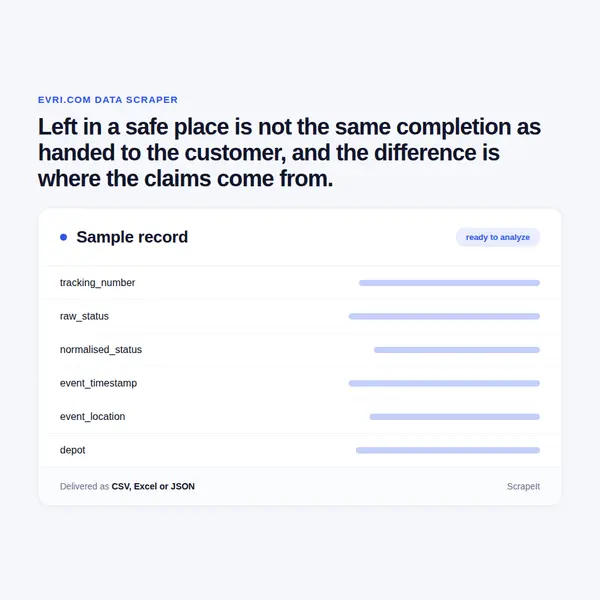
Left in a safe place is not the same completion as handed to the customer, and the difference is where the claims come from.

Evri Scraper
Solutions

Managed Evri data collection, run end to end by us

ScrapeIt builds and runs the pipeline as a managed service. You tell us the lanes and whether you need tracking, ParcelShops or both; we build the collection with delivery outcomes typed, normalise into your cross carrier model and hand back CSV, JSON, Excel or a push into your warehouse.

We honour the crawl rules the site publishes and pace requests. Carrier tracking surfaces are easy to overload and hard to get back once access is withdrawn.

We collect no recipient names, no address detail beyond the postcode and no delivery photographs. Bring the use case to your own counsel before the project starts.

Evri fields in every export

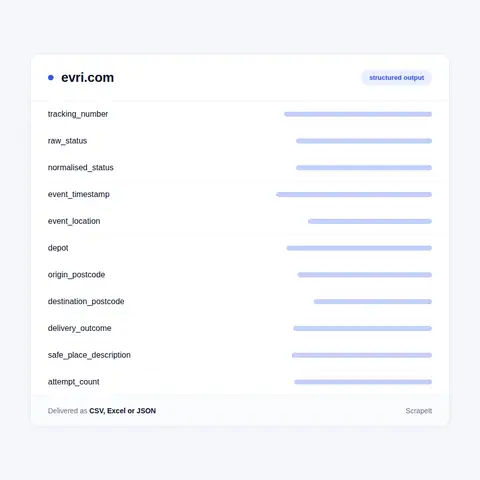
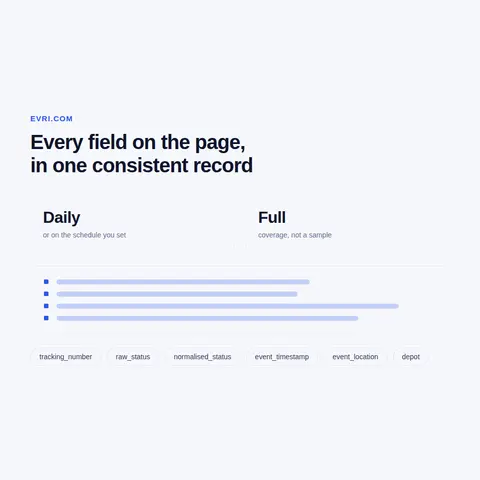
Tracking output carries the tracking number, the raw status text as published, the normalised status, the event timestamp with time zone, the event location and the depot or courier round identifier where given.

Delivery outcome is a first class field with the four completions kept apart: handed to customer, left with neighbour, left in safe place, collected from ParcelShop. Each carries the detail the carrier publishes, such as the safe place description, without the evidence image itself.

We do not collect the delivery photograph. A doorstep photo frequently shows a front door, a house number and sometimes a person, which makes it personal data about the recipient and occasionally about a passer by. The outcome and its description are what the analysis needs; the image is a liability with no analytical value, and we say so rather than collecting it because it is there.

Shipment fields cover origin and destination postcode, service level, promised delivery window where published, actual delivery, attempt count and exception reason.

ParcelShop records carry the shop identifier, name, full address, postcode, coordinates where published, opening hours structured by day, services offered and any size or weight limits stated.

Evri fields in every export
ParcelShops, evidence handling and multi-carrier design

ParcelShops, evidence handling and multi-carrier design

The ParcelShop estate needs a genuinely frequent refresh by the standards of location data. These are independent businesses rather than owned branches, and churn is material. Monthly with change records is the minimum we would recommend for anything customer facing.

Evidence handling deserves repeating because clients do ask for it. We collect the outcome and its description and not the photograph. If a brief insists on images we will explain the exposure: doorstep photos are personal data about the recipient, often about the property, and occasionally about somebody who never consented to anything. That is not a dataset we will assemble.

Multi carrier design matters here more than usual because the outcome taxonomy is the part that differs most between carriers. A common model has to be rich enough to hold safe place and neighbour completions, and if it is designed around a postal carrier first it will not be. We define it before the second carrier is added.

Historical backfill is limited by retention, as on any carrier tracking surface. The dataset is built going forward.

A courier network built around out-of-home and safe place

Evri is one of the largest parcel networks in the United Kingdom, built on a courier model rather than a traditional postal one. Its delivery patterns reflect that: a large share of parcels complete at a ParcelShop, with a neighbour, or in a safe place chosen at the door.

Those outcomes are the distinguishing feature of this carrier's data and the part generic tooling handles worst. Delivered is not one state here. Handed to the customer, left with a named neighbour, left in a safe place and collected from a ParcelShop are four different completions with four different risk profiles, and the last two are where claims and disputes concentrate.

The tracking surface is public and responds, and crawl rules are published. The ParcelShop estate is large and its locations, hours and services are the second dataset, powering out of home options in UK checkouts where their share is high and rising.

Delivery evidence, typically a photograph, is presented on the tracking page for safe place deliveries. That is worth thinking about carefully before collecting, and we do.

Get a Quote
dev_w
25

Developers

customers
500+

Customers worldwide

pages
1 500 000 000+

Pages extracted

stime
15000+

Hours saved for our clients

Plans

Airplane

€199 / one-time

setup fee - included

Data limits100,000
Frequencyone-time
Run timeup to 5 days
Data storing7 days

Helicopter

€169 / mo

setup fee €499

Data limits250,000
Frequencymonthly
Run timeup to 5 days
Data storing14 days

Glasses

€229 / mo

setup fee €499

Data limits1,000,000
Frequencyweekly
Run timeup to 5 days
Data storing30 days

DNA

€549 / mo

setup fee €799

Data limits3,000,000
Frequency3 times daily
Run timesame day
Data storing90 days

Why delivery outcome is the field that predicts claims

A retailer looking at a carrier report sees a delivery rate and is reassured. The rate hides the thing that actually costs money, which is that some of those completions will turn into claims.

Safe place and neighbour deliveries are the ones that do. The parcel is recorded as delivered, the customer says it never arrived, and the dispute goes to the retailer rather than the carrier. Tracking the outcome mix by lane, by depot and over time gives a retailer the one number that predicts claim volume before the claims arrive.

That analysis is impossible if the four completions are flattened into delivered, which is exactly what generic multi carrier tooling does. Keeping them apart costs nothing at collection time and cannot be recovered afterwards.

The second reason is the out of home share. A large and growing proportion of parcels complete at a ParcelShop, and for a retailer that changes both cost and customer experience. Measuring the share by area, and its trend, informs whether to promote the option at checkout.

The third is the estate itself. ParcelShops are independent businesses, so they open, close and change hours far more often than a postal branch network, and a locator built on a stale export starts sending customers to closed shops within weeks.

Our Blog

Reads Our Latest News & Blog

Learn how to use web scraping to solve data problems for your organization

How Artificial Intelligence Is Used In Web Scraping

How Artificial Intelligence Is Used In Web Scraping

Leveraging advances in technology, the AI-powered web scraper has skyrocketed in demand and is helping to expand capabilities by automating tedious daily tasks and speeding up data collection from thousands of websites several times over.

What is Web Scraping and What is it Used For?

What is Web Scraping and What is it Used For?

Web scraping is a method of obtaining web data by extracting it from pages of web resources with the help of a program, that is, in automatic mode. It is used to syntactically convert web pages into more usable forms.

Web Scraping for Machine Learning

Web Scraping for Machine Learning

If you specialize in machine learning, you need to feed large amounts of data to the algorithms. Web scraping is the easiest and the most efficient method of collecting the data from all over the Internet.

scrapeit logo

Who builds and keeps your Evri feed

ScrapeIt is a managed extraction company, not a tool you have to learn. Our team builds the pipeline, watches it as status wording and the ParcelShop estate change, and repairs it before your locator starts sending customers to closed shops.

You see a sample first, in your format, on your own lanes, with the four completion types separated so you can see your safe place share before committing.

FAQ

Why split delivered into four outcomes?

Because they carry different risk. Handed to the customer, left with a neighbour, left in a safe place and collected from a ParcelShop are four completions, and the middle two are where claims concentrate: the parcel is recorded as delivered, the customer says it never arrived, and the dispute lands with the retailer. Flattened into delivered, that signal is gone and cannot be recovered.

Do you collect the delivery photograph?

No. A doorstep photo shows a front door, a house number and sometimes a person, which makes it personal data about the recipient and occasionally about a passer by. The outcome and its description are what the analysis needs; the image is a liability with no analytical value, and we decline briefs that ask for it.

How often does the ParcelShop network change?

Far more often than a postal branch network, because ParcelShops are independent businesses. Churn is material, and a locator built on a stale export starts sending customers to closed shops within weeks. Monthly refresh with change records is the minimum for anything customer facing.

Can this be combined with other UK carriers?

Yes, and the outcome taxonomy is the part that needs designing first. A common status model built around a postal carrier will not be rich enough to hold safe place and neighbour completions, so it has to be defined before the second carrier is added rather than retrofitted.

How far back can you go?

Not far. Carrier tracking surfaces retain limited history, so this dataset is built going forward rather than backfilled. Delivery is CSV, Excel, JSON, JSONLines or XML over FTP, SFTP, Amazon S3, Google Cloud Storage, Dropbox, Google Drive or email, or written straight into your database.

How does it Work?

Step 1 - Make a Request

You share your needs, expectations, and desired timeframe. We’ll suggest the best solution based on your request and budget.

Step 2 - Configuring Custom Web Crawlers

Our specialists configure the crawlers and extract a sample dataset for your review before proceeding with the full-scale extraction.

Step 3 - Collect and Deliver

Once you approve the sample, we launch the project and start full data collection. We gather, filter, and structure the data for easy use, delivering it on time in your preferred format.

Step 4 - Maintain and Support

Our team manages ongoing processes, monitors website changes, and supports all data extraction cycles. We can also help integrate data into your systems or create dashboards to simplify analysis.

Request a Quote

Tell us more about you and your project information.
Which sites, which fields, how often. A couple of lines is enough.

We reply within 1 business day. No obligation.

scrapiet

Scrapeit Sp. z o.o.
10/208 Legionowa str., 15-099, Bialystok, Poland
NIP: 5423457175
REGON: 523384582