GLS Scraper for Shipping Rates, ParcelShops and Tracking

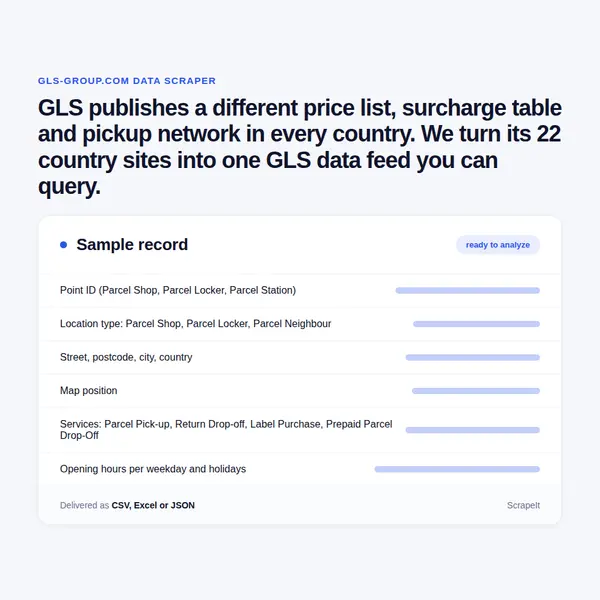
GLS publishes a different price list, surcharge table and pickup network in every country. We turn its 22 country sites into one GLS data feed you can query.

Plans from €169/month · Free project assessment · Reply within 1 business day

GLS Scraper
Solutions

Managed GLS scraping, from price PDFs to GLS tracking feeds

We run the whole pipeline. The German site puts a browser check in front of automated visitors, the locator loads points by map area, and several price lists are PDFs. Our answer is anti-bot handling, proxy rotation and CAPTCHA solving, per-country parsers and PDF table extraction; then we extract GLS data into one schema for size classes, zones and currencies. For tracking, you send your own parcel numbers to our GLS tracking API and get status events on schedule. Every run is compared with the last one, so a changed surcharge, a new price list or a closed ParcelShop arrives as a change record.

GLS locations and the fields behind every ParcelShop record

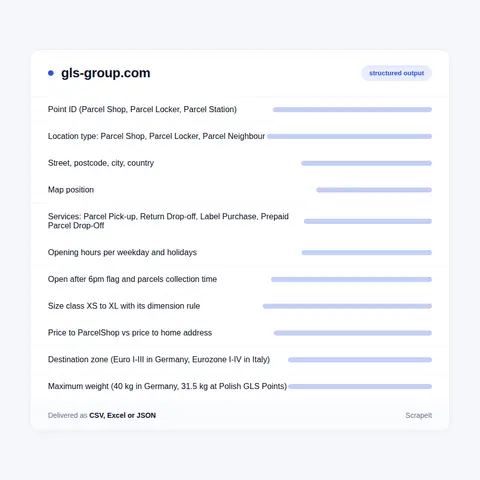
The GLS Points locator is the richest structured source on the group site. It covers three location types - Parcel Shop, Parcel Locker and Parcel Neighbour - and filters them by service and opening hours. For each point we collect:

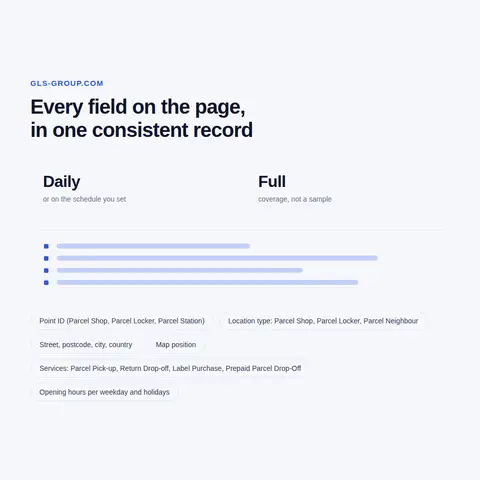
  • Identity: point ID, location type, name, street, postcode, city, country and map position. German Parcel Stations are listed as "Paketstation #" entries.
  • Services: Parcel Pick-up, Return Drop-off, Label Purchase and Prepaid Parcel Drop-Off flags.
  • Opening hours: hours per weekday, the live status line such as "Open until 20:00", holidays, the "Open after 6pm" flag, parcels collection time, and maintenance notices for lockers that run 00:00 to 24:00.
  • GLS depot and branch addresses where a country lists them: Italian Sede offices, Polish branches, the collaborating agencies of GLS Spain.

Price rows come from each published price list: size class, the dimension rule behind it, maximum weight, destination country or zone, and separate prices for delivery to a GLS ParcelShop and to a home address. Surcharge rows add the percentage, the index it follows and the month or week it applies to. For your own shipments, tracking returns the parcel number or Track ID and each status step with date, time and location, including the ParcelShop where a parcel waits. Tracking forms differ by country: Germany and the Netherlands ask for a postcode next to the parcel number, Italy searches by national or international reference, parcel ID or delivery note, France by parcel or notice-card number. Parcel Neighbour points are private people, so we keep them as counts per postcode, not names.

GLS locations and the fields behind every ParcelShop record
GLS shipping rates, surcharges and delivery times by country

GLS shipping rates, surcharges and delivery times by country

Each national company prices in its own format:

  • GLS Germany sizes parcels by longest plus shortest side, from XS at EUR 3.29 to a Parcel Shop or Parcel Station (EUR 4.59 to an address), with three Euro zones abroad, a transit time per country and an island surcharge for Sylt or Helgoland. Its energy surcharge, set monthly from federal price indexes, was 31.50% for invoices from 11 September 2026.
  • GLS Poland lists every destination in zloty, point versus address, with box sizes and a 31.5 kg limit.
  • GLS Italy ties size classes to weight bands and adds fees for Sicily, Sardinia and minor islands.
  • GLS US publishes Ground and Priority rate cards, accessorial fees with three-letter billing codes and a weekly fuel surcharge matrix; GLS Canada adds a Quebec fuel premium.
  • GLS France posts a monthly diesel surcharge, the Netherlands an energy surcharge that blends fuel and electricity.

Whether GLS will ship on weekends depends on the country: GLS US serves Monday to Friday with Saturday delivery in selected areas, while German national prices assume Monday to Friday transit. We also collect the GLS holiday schedule and the GLS international shipping prices each site quotes by zone.

How GLS data is split across country sites and partners

A GLS scraper has to start from the map, because General Logistics Systems is a group of national parcel companies rather than one website. The holding, General Logistics Systems B.V., is registered in Amsterdam and belongs to International Distribution Services, the owner of Royal Mail. Its country selector leads to 22 own-country sites and to partner pages for the rest of the network.

Most country sites sit on gls-group.com under a country and language path such as /PL/pl/, /IT/it/, /FR/fr/ or /US/en/. GLS Germany is the exception and runs gls-pakete.de, with its own shop for parcel labels. Monaco is served by GLS France, San Marino and Vatican City by GLS Italy, Andorra by GLS Spain. Where GLS has no subsidiary, the partner page names the carrier that delivers: Parcelforce Worldwide in the United Kingdom, Swiss Post GLS in Switzerland, Posten Norge in Norway, DSV Road in Sweden, SmartPosti in Latvia and Lithuania.

The group reports 977 million parcels in fiscal year 2025/26, 63% of them B2C. International parcels go up to 40 kg, domestic delivery usually takes under 24 hours and delivery across Europe 24 to 96 hours. Each country site has its own tracking form, GLS Points search, service pages and prices, so every market needs its own parser.

Get a Quote

dev_w
25

Developers

customers
500+

Customers worldwide

pages
1 500 000 000+

Pages extracted

stime
15000+

Hours saved for our clients

Plans

GLS Scraping Plans and Pricing

Airplane

€199 / one-time

setup fee - included

Data limits100,000
Frequencyone-time
Run timeup to 5 days
Data storing7 days

Helicopter

€169 / mo

setup fee €499

Data limits250,000
Frequencymonthly
Run timeup to 5 days
Data storing14 days

Glasses

€229 / mo

setup fee €499

Data limits1,000,000
Frequencyweekly
Run timeup to 5 days
Data storing30 days

DNA

€549 / mo

setup fee €799

Data limits3,000,000
Frequency3 times daily
Run timesame day
Data storing90 days

Why teams scrape GLS data country by country

Prices, pickup coverage and surcharges differ from one GLS company to the next, and that gap is why GLS data scraping pays off.

  • Rate benchmarking. Put GLS parcel rates for Germany, Poland and Italy on one grid with DPD, InPost or the national post, per size class and destination.
  • Out-of-home coverage. Count GLS Points and Parcel Lockers per postcode before switching on ShopDeliveryService. In Poland the points include Zabka stores and lockers shared with ORLEN Paczka; in France the Relais Colis network now belongs to GLS.
  • Surcharge monitoring. Fuel and energy percentages move every week or month and touch every invoice line.
  • Delivery performance. Timestamps from your own GLS tracking numbers give real transit days per lane, to hold against the published GLS delivery times.
  • Checkout pickers. A clean GLS database of point IDs, hours and services feeds store locators and pickup selectors.

Retailers, marketplaces, logistics analysts and consultancies reuse the same GLS dataset for tenders and network planning.

Our Blog

Reads Our Latest News & Blog

Learn how to use web scraping to solve data problems for your organization

How Artificial Intelligence Is Used In Web Scraping

How Artificial Intelligence Is Used In Web Scraping

Leveraging advances in technology, the AI-powered web scraper has skyrocketed in demand and is helping to expand capabilities by automating tedious daily tasks and speeding up data collection from thousands of websites several times over.

What is Web Scraping and What is it Used For?

What is Web Scraping and What is it Used For?

Web scraping is a method of obtaining web data by extracting it from pages of web resources with the help of a program, that is, in automatic mode. It is used to syntactically convert web pages into more usable forms.

Web Scraping for Machine Learning

Web Scraping for Machine Learning

If you specialize in machine learning, you need to feed large amounts of data to the algorithms. Web scraping is the easiest and the most efficient method of collecting the data from all over the Internet.

scrapeit logo

ScrapeIt, a managed team for carrier and parcel network data

ScrapeIt is a managed web scraping agency. You tell us which GLS countries, which records and how often; we build the crawlers, keep them running when a country site changes and deliver clean files or a live feed as JSON, CSV, XLSX, Google Sheets or a push to your database or storage bucket. A sample comes first, so you check the fields on real GLS records before committing to a schedule.

FAQ

Do you offer a GLS API?

Yes. The ScrapeIt GLS API returns ParcelShop, Parcel Locker and depot records with hours and services, price-list rows by country and size class, current surcharge percentages and, for parcel numbers you send us, tracking events. Responses are JSON on the schedule you choose - hourly for tracking, daily or weekly for locations and prices - and the same data ships as CSV and XLSX files.

Is it legal to scrape GLS?

We collect only publicly available data - everything a visitor can see on GLS - and we collect it legally. That covers price lists, surcharge tables, service pages, the GLS Points locator and tracking results for parcel numbers you own. No logins, no paywalls. Under GDPR we leave personal data out: recipient names, addresses and signatures from tracking, and the names of private Parcel Neighbours.

Can you turn each GLS price list into one comparable table?

Yes. We map every country's size classes, dimension rules, weight limits, zones and currencies onto one schema, keep the original label next to the normalised value and store the effective date of each list. Germany's XS by longest plus shortest side, Poland's XS by box size and Italy's XS with its 3 kg cap then sit side by side, with surcharges in separate columns, so you compare GLS prices like for like.

How often do you refresh GLS ParcelShop and locker data?

Weekly suits most network studies; daily suits checkout pickers that must hide closed points. Each run records new, moved and removed points, changes to opening hours and services, holiday closures and maintenance notices, so you get a history rather than a snapshot. Country pages round their network counts differently, and a full crawl gives the real number of GLS Points per country, city and postcode.

Can you pull GLS tracking for our own parcels?

Yes, for parcel numbers or Track IDs that belong to your shipments. GLS tracking shows each step - data entered, in transit, at the destination parcel centre, out for delivery, delivered, or delivered to a ParcelShop - and we return it as timestamped events with the location and the pickup point. We do not look up parcels that are not yours, and recipient details stay out of the feed.

How does it Work?

Step 1 - Make a Request

You share your needs, expectations, and desired timeframe. We’ll suggest the best solution based on your request and budget.

Step 2 - Configuring Custom Web Crawlers

Our specialists configure the crawlers and extract a sample dataset for your review before proceeding with the full-scale extraction.

Step 3 - Collect and Deliver

Once you approve the sample, we launch the project and start full data collection. We gather, filter, and structure the data for easy use, delivering it on time in your preferred format.

Step 4 - Maintain and Support

Our team manages ongoing processes, monitors website changes, and supports all data extraction cycles. We can also help integrate data into your systems or create dashboards to simplify analysis.

Request a Quote

Tell us more about you and your project information.
Which sites, which fields, how often. A couple of lines is enough.

We reply within 1 business day. No obligation.

scrapiet

Scrapeit Sp. z o.o.
10/208 Legionowa str., 15-099, Bialystok, Poland
NIP: 5423457175
REGON: 523384582