Canada Post Data Collection for Tracking and Postal Rates

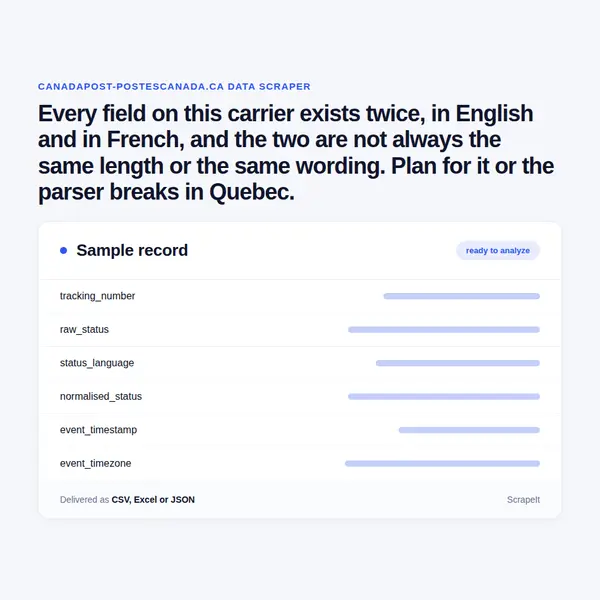
Every field on this carrier exists twice, in English and in French, and the two are not always the same length or the same wording. Plan for it or the parser breaks in Quebec.

Canada Post Scraper
Solutions

Managed Canada Post data, run end to end by us

ScrapeIt builds and runs the pipeline as a managed service. You tell us the lanes, services and whether you need tracking, rates, outlets or all three; we build the collection bilingually, normalise statuses across every carrier you use, segment lanes by remoteness, and hand back CSV, JSON, Excel or a push into your warehouse.

Where the operator's business interfaces are the right route and you can obtain credentials, we recommend and support that. Public collection stays on open surfaces, honours the paths the robots file closes and is paced deliberately.

We collect no recipient names and no address detail beyond the postal code and its forward sortation area, which is what regional analysis actually needs. Bring the use case to your own counsel before the project starts.

Canada Post fields in every export

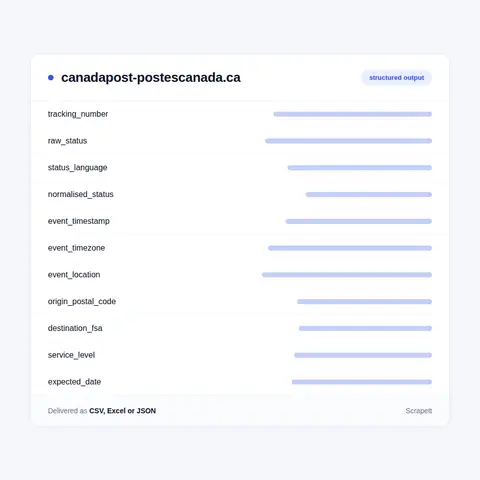
Tracking output carries the tracking number, the raw status text with the language it was collected in, the normalised status, the event timestamp with time zone, the event location and the retail or depot identifier where given.

Time zones deserve specific attention on this carrier. The country spans six of them, and a timestamp without a zone produces delivery time analyses that are wrong by several hours for a large share of shipments. We store the zone explicitly on every event and compute durations in UTC.

Shipment fields cover origin and destination postal code, the forward sortation area parsed out for regional analysis, service level, expected delivery date where published, actual delivery, attempt count, delivery outcome including community mailbox and post office pickup, and the exception reason.

Rate records carry service level, origin and destination zone, weight band, dimensional limits, base price, fuel and remote area surcharges where published, and the effective date of the price table.

Outlet records carry name, type, full address, postal code, coordinates where published, opening hours structured by day, and the services offered. Every row carries the language it was collected in and the collection timestamp.

Canada Post fields in every export
Postal geography, outlets and multi-carrier comparison

Postal geography, outlets and multi-carrier comparison

Postal geography is unusually useful here. The forward sortation area, the first half of a postal code, is a stable regional unit that supports aggregation without exposing anything about individual recipients. We parse it on every shipment, which gives clients regional performance analysis with no personal data anywhere in the pipeline.

The outlet estate covers corporate offices, franchise counters inside retail stores and parcel lockers, each with different hours and services. It changes slowly, suits a monthly refresh with change records, and is what powers a pickup option in a Canadian checkout.

Multi carrier comparison is where most clients end up, and this carrier is usually the baseline because of its rural reach. The comparison only means anything if lanes are segmented by remoteness and delivery outcomes are classified consistently, both of which have to be designed before the second carrier is added.

Rate history is retained rather than overwritten. Price tables change on announced dates and a procurement review inevitably asks what a shipping profile would have cost under the previous table, which is unanswerable if the old prices were replaced.

A bilingual national carrier with rural reach

Canada Post is the national postal operator and, for a great deal of the country, the only carrier that reaches the address at all. Private networks concentrate on populated corridors; rural and northern delivery falls to the post. Any Canadian ecommerce analysis that treats carriers as interchangeable will be wrong about most of the map.

The service publishes in English and French throughout, as it is required to, and this is not cosmetic for a data pipeline. Status wording, service names, outlet information and rate descriptions all exist in two versions, with different lengths and occasionally different levels of detail. A parser built against one language will encounter the other and produce nulls that look like missing events.

Tracking, rate lookup and outlet finding are all available through the public site, and the operator also runs a developer programme for business integrations. Its robots file closes several paths including business sections, and we work inside those rules rather than around them.

Geography shapes the rate structure more here than in most markets. Prices are zone based across an enormous country, and remote area surcharges apply to a large number of postal codes, which makes the rate dataset genuinely complex rather than a simple table.

Get a Quote
dev_w
25

Developers

customers
500+

Customers worldwide

pages
1 500 000 000+

Pages extracted

stime
15000+

Hours saved for our clients

Plans

Airplane

€199 / one-time

setup fee - included

Data limits100,000
Frequencyone-time
Run timeup to 5 days
Data storing7 days

Helicopter

€169 / mo

setup fee €499

Data limits250,000
Frequencymonthly
Run timeup to 5 days
Data storing14 days

Glasses

€229 / mo

setup fee €499

Data limits1,000,000
Frequencyweekly
Run timeup to 5 days
Data storing30 days

DNA

€549 / mo

setup fee €799

Data limits3,000,000
Frequency3 times daily
Run timesame day
Data storing90 days

Why bilingual and remote delivery change the analysis

The bilingual requirement is the first thing that breaks naive pipelines and it breaks them quietly. A collector built and tested in English runs into French statuses, fails to match them against its status map, and emits unknown for a subset of shipments that correlates almost perfectly with one province. The resulting performance report shows Quebec as a data quality problem rather than what it is: a parser that was only ever half built.

We build the status map bilingually from the start, keep the language on every row, and treat an unmapped status as an alert rather than a silent null. That is the difference between a pipeline that degrades visibly and one that misleads.

Remote delivery is the second structural fact. A very large share of Canadian postal codes carry remote area handling, longer transit expectations and surcharges, and comparing carrier performance without accounting for that makes the national operator look slow when it is simply serving addresses nobody else will. Lane analysis has to segment by remoteness or it is not analysis.

The third is community delivery outcomes. Parcels are frequently delivered to a community mailbox or held at a post office for collection rather than handed over at the door, and both are legitimate completions. Tooling that treats anything other than a doorstep delivery as an exception generates false alarms at scale.

The fourth is rates. Zone based pricing across a country this size, with surcharges layered on top, means the published rate is a calculation rather than a lookup, and it needs the full table with its effective date to be reproducible.

Our Blog

Reads Our Latest News & Blog

Learn how to use web scraping to solve data problems for your organization

How Artificial Intelligence Is Used In Web Scraping

How Artificial Intelligence Is Used In Web Scraping

Leveraging advances in technology, the AI-powered web scraper has skyrocketed in demand and is helping to expand capabilities by automating tedious daily tasks and speeding up data collection from thousands of websites several times over.

What is Web Scraping and What is it Used For?

What is Web Scraping and What is it Used For?

Web scraping is a method of obtaining web data by extracting it from pages of web resources with the help of a program, that is, in automatic mode. It is used to syntactically convert web pages into more usable forms.

Web Scraping for Machine Learning

Web Scraping for Machine Learning

If you specialize in machine learning, you need to feed large amounts of data to the algorithms. Web scraping is the easiest and the most efficient method of collecting the data from all over the Internet.

scrapeit logo

Who builds and keeps your Canada Post feed

ScrapeIt is a managed extraction company, not a tool you have to learn. Our team builds the pipeline, watches it in both languages as status wording changes, and repairs it before a province quietly disappears from your reporting.

You see a sample first, in your format, on your own lanes including remote destinations, with French and English statuses mapped so you can confirm nothing is being dropped.

FAQ

Does the bilingual site cause problems for collection?

It does for pipelines that were not designed for it, and the failure is quiet. A collector built in English meets French statuses, fails to map them and emits unknown for a set of shipments that correlates with one province, which then looks like a regional performance problem. We build the status map bilingually, keep the language on every row and treat an unmapped status as an alert rather than a null.

Why does remote delivery matter to the analysis?

Because a large share of Canadian postal codes carry remote handling, longer transit expectations and surcharges. Comparing this carrier with a private network without segmenting by remoteness makes it look slow when it is serving addresses the others do not reach at all. Lane analysis has to account for it to mean anything.

Are community mailbox deliveries treated as exceptions?

Not by us. Delivery to a community mailbox or a post office hold for collection are legitimate completions and we classify them as such, with the outcome recorded. Generic tooling that treats anything other than a doorstep handover as an exception generates false alarms across a large fraction of Canadian volume.

Can you collect postal rates including surcharges?

Yes, with the caveat that pricing here is a calculation rather than a lookup: zone based across a very large country with fuel and remote area surcharges layered on. We collect the full table with its effective date and retain previous tables, because a procurement review always asks what last year's prices would have produced.

Do you collect anything about recipients?

No names, no street addresses. We keep the postal code and parse out the forward sortation area, which is a stable regional unit that supports aggregation without exposing anything about an individual. That is what regional performance analysis actually needs.

How does it Work?

Step 1 - Make a Request

You share your needs, expectations, and desired timeframe. We’ll suggest the best solution based on your request and budget.

Step 2 - Configuring Custom Web Crawlers

Our specialists configure the crawlers and extract a sample dataset for your review before proceeding with the full-scale extraction.

Step 3 - Collect and Deliver

Once you approve the sample, we launch the project and start full data collection. We gather, filter, and structure the data for easy use, delivering it on time in your preferred format.

Step 4 - Maintain and Support

Our team manages ongoing processes, monitors website changes, and supports all data extraction cycles. We can also help integrate data into your systems or create dashboards to simplify analysis.

Request a Quote

Tell us more about you and your project information.
Which sites, which fields, how often. A couple of lines is enough.

We reply within 1 business day. No obligation.

scrapiet

Scrapeit Sp. z o.o.
10/208 Legionowa str., 15-099, Bialystok, Poland
NIP: 5423457175
REGON: 523384582