CMA CGM Scraper for Schedules, Local Charges and Surcharge Tariffs

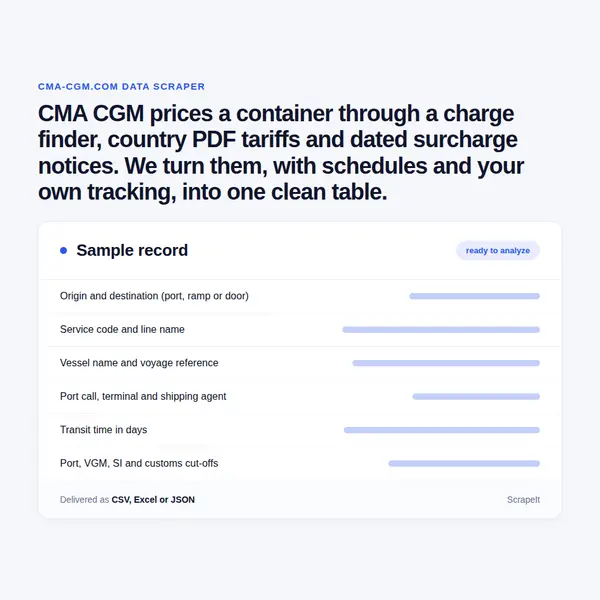
CMA CGM prices a container through a charge finder, country PDF tariffs and dated surcharge notices. We turn them, with schedules and your own tracking, into one clean table.

Plans from €169/month · Free project assessment · Reply within 1 business day

CMA CGM Scraper
Solutions

CMA CGM Surcharges and Schedules as a Managed Service

We run CMA CGM collection as a managed service. The site sits behind commercial bot protection that turns away plain automated clients, so anti-bot handling, proxy rotation and CAPTCHA solving are part of the job, not an extra. Schedules and line pages come from the finders on a daily or weekly pass. Tariff PDFs are parsed into rows keyed by country, charge, equipment and validity, and re-read whenever an effective date changes. Charge names are normalised across CMA CGM, APL, ANL and CNC, so one column always means one charge. You get JSON, CSV or XLSX in S3, a database or email, and when a layout moves, we repair the extractor and backfill the gap.

CMA CGM Schedule, Line and Vessel Fields We Extract

A CMA CGM vessel schedule only pays off when rows are keyed the way the carrier keys them: UN/LOCODE port codes such as CNSHA or FRLEH, a service code, a voyage reference like 12S0KS1MA and a vessel name. Weekly passes then line up without fuzzy matching.

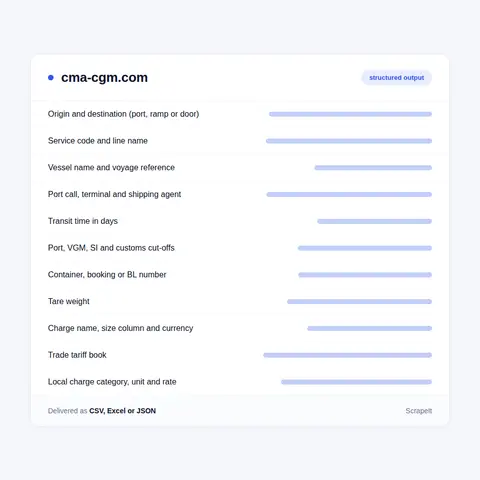
  • CMA CGM routing finder: origin and destination as port, ramp or door, a departure or arrival basis, a start date and a period of up to ten weeks, equipment from 20' Dry Standard to 40' Reefer High Cube and a hazardous flag. Each solution is direct or via transhipment, with vessel, first voyage reference, dates, standard and special booking acceptance and the CMA CGM cut-off set: port, VGM, SI and customs.
  • CMA CGM port schedule: vessels calling a port or a whole country, on departure or arrival, within a day window.
  • CMA CGM voyage finder: by voyage reference or vessel name, the calls, terminals, berthing and departure dates of one voyage.
  • CMA CGM shipping lines: each line page gives frequency, fleet size, ports of call, loop duration in days and alliance, such as Ocean Alliance on the French Asia Line, the rotation as day offsets westbound and eastbound, and the port terminal and shipping agent at every call. A PDF flyer adds a transit time matrix between call pairs, marked non contractual.
  • Operated vessels: name, operator, type, geared or not, nominal capacity, commercial capacity at 14 t, reefer plugs, deadweight, year built, flag and speed.
  • Local advisories: per voyage and terminal, ETA and ETB, gate opening for dry and reefer units, shipping bill cut-off, port gate cut-off and SI cut-off.
  • CMA CGM container tracking: equipment moves such as loaded, discharged and transhipped, with date and place, plus planned departure and arrival of each vessel leg, for references from your own bookings.
  • Tare and terminals: CMA CGM tare weight for a comma separated list of container numbers, and terminal pages with address and opening hours by weekday.

CMA CGM Schedule, Line and Vessel Fields We Extract
CMA CGM Demurrage, Detention and Local Charges Country by Country

CMA CGM Demurrage, Detention and Local Charges Country by Country

The CMA CGM detention tariff files split demurrage inside the terminal from detention outside it. Each side has its own CMA CGM free time in calendar days, then day slabs priced per 20', 40' and 45'. Separate grids cover standard, NOR (a reefer used unplugged), reefer, special (open top, flat rack), hazardous and tank equipment, import differs from export, and single ports can carry their own grid, as Montoir and Dunkerque do in France.

Each CMA CGM local charges file is a table with the same columns: category, service description, export or import, location, unit, container type where the rate is per box, currency, rate, additional information and validity, grouped into systematic, spot and value-added services. The France file lists the documentation fee at origin, OTHC and DTHC, the advanced manifest declaration fee, bill of lading amendment, booking cancellation, late SI submission and a fee for idle containers left on terminal. CMA CGM THC charges therefore appear twice, per port pair in the charge finder and per country here, and a clean extract reconciles them.

The Pick up / Drop off files add merchant haulage fees for empty boxes per depot, with depot code, address and a price per 20', 40' and HC, valid quarter by quarter.

CMA CGM Data Scraping Across Finders, Tariff Files and Local Pages

A CMA CGM scraper has to read a French ocean carrier that publishes in three layers. The first is a set of finders: the Routing Finder for point to point searches, Port Schedules, the Voyage finder, Shipping Lines, Shipment Tracking and a Tare Finder. The second is a General Tariffs hub that branches into public prices, a carrier charge finder, local charges, demurrage and detention conditions and inland prices. The third is news: a global newsroom with a Prices & Surcharges category, and a page per country where each agency posts its own advisories.

The tariff layer is mostly PDF, not HTML. Local charges are filed by region and country as Local Services, Pick up / Drop off, Storage & Monitoring and Other documents, each labelled with an effective date. Demurrage and detention tariffs follow the same pattern, one file per country plus a transhipment tariff per region. At the end of September 2026 the local charges library alone held close to four hundred files. That is where CMA CGM data scraping pays off: every file is open to any visitor, but layouts differ from country to country, and a new version simply replaces the old link.

The same eBusiness platform also serves APL, ANL and CNC, so one extractor covers the group brands, each with its own routes, surcharge notices and charge lists.

Get a Quote
dev_w
25

Developers

customers
500+

Customers worldwide

pages
1 500 000 000+

Pages extracted

stime
15000+

Hours saved for our clients

Plans

CMA CGM Scraping Plans and Pricing

Airplane

€199 / one-time

setup fee - included

Data limits100,000
Frequencyone-time
Run timeup to 5 days
Data storing7 days

Helicopter

€169 / mo

setup fee €499

Data limits250,000
Frequencymonthly
Run timeup to 5 days
Data storing14 days

Glasses

€229 / mo

setup fee €499

Data limits1,000,000
Frequencyweekly
Run timeup to 5 days
Data storing30 days

DNA

€549 / mo

setup fee €799

Data limits3,000,000
Frequency3 times daily
Run timesame day
Data storing90 days

Why Forwarders and Shippers Scrape CMA CGM Data

Forwarders and NVOCCs scrape CMA CGM data to price a lane the way the carrier does. The CMA CGM charge finder answers per port pair and date: pick a POL, a POD, an equipment type (Dry, Reefer, NOR or Special) and flags for hazardous or out-of-gauge cargo, and it lists charges payable as per freight, at export and at import, by 20ST, 40ST, 40HC, 45HC or per BL, with the currency and the trade tariff book behind them. A Shanghai to Le Havre dry search brings Bunker Adjustment Factor, Emergency Fuel Surcharge, Energy Transition Surcharge and ISPS vessel security, then origin THC in CNY and destination THC in EUR. Run it weekly and the CMA CGM BAF becomes a time series.

Market analysts read the Prices & Surcharges newsroom instead. Every CMA CGM rate announcement, CMA CGM PSS notice, CMA CGM FAK rates table and CMA CGM emergency fuel surcharge update is a dated article that states the effective loading date, the trade scope, the cargo covered and an amount per TEU or per container. Pair them with the CMA CGM public prices finder and you get basic ocean freight plus the add-ons, which is what CMA CGM freight rates really are.

Shippers and planners watch the network instead: transit times per call pair, omitted calls and delays posted by local agencies, and vessels joining or leaving a line. Finance teams check D&D invoices against the free time and day slabs published for each country.

Our Blog

Reads Our Latest News & Blog

Learn how to use web scraping to solve data problems for your organization

How Artificial Intelligence Is Used In Web Scraping

How Artificial Intelligence Is Used In Web Scraping

Leveraging advances in technology, the AI-powered web scraper has skyrocketed in demand and is helping to expand capabilities by automating tedious daily tasks and speeding up data collection from thousands of websites several times over.

What is Web Scraping and What is it Used For?

What is Web Scraping and What is it Used For?

Web scraping is a method of obtaining web data by extracting it from pages of web resources with the help of a program, that is, in automatic mode. It is used to syntactically convert web pages into more usable forms.

Web Scraping for Machine Learning

Web Scraping for Machine Learning

If you specialize in machine learning, you need to feed large amounts of data to the algorithms. Web scraping is the easiest and the most efficient method of collecting the data from all over the Internet.

scrapeit logo

Why Logistics Teams Hand CMA CGM Collection to ScrapeIt

ScrapeIt is a managed web scraping agency. We build and run collection pipelines for carriers, ports, marketplaces and travel platforms, with monitoring, retries and a person reviewing schema drift. For an ocean carrier that means a named engineer, an agreed list of port pairs, lines and countries, and a refresh window written into the plan. A sample comes first, so you check the columns before committing.

FAQ

Do you offer a CMA CGM API?

Yes. The ScrapeIt CMA CGM API returns routing finder solutions with cut-offs, port and voyage schedules, line rotations with operated vessels, carrier charges by port pair, local charges and D&D slabs by country, and each price announcement split into fields. Responses are JSON, refreshed on the schedule you choose, usually daily for schedules and weekly for tariffs, and the same data ships as CSV and XLSX. The CMA CGM schedule API and the CMA CGM tracking API share one set of field names, so a single integration covers both.

How do you scrape CMA CGM local charges, D&D files and schedules?

In two passes. The first walks the finders for the port pairs, ports, lines and voyages you name and stores every solution, call and cut-off. The second reads the General Tariffs files, the local charges, D&D and pick up / drop off PDFs, turns each table into rows and records the effective date, so a new version shows up as a change. Price announcements are split into range, cargo scope and amount. That is how we extract CMA CGM data at one charge per row.

Does CMA CGM tracking work for our own containers and bills of lading?

Yes. We track CMA CGM containers by container number, booking reference or bill of lading, so CMA CGM tracking by BL number, by booking or by box returns the same row format: the move, its date and place, and the planned departure and arrival of the vessel leg. We run it only on references from your own bookings, not on other companies' cargo. References shipped with APL, ANL or CNC go through the same flow.

Which brands does CMA CGM own, and can you cover them too?

The group lists APL in Singapore, ANL in Oceania and CNC in the intra-Asia market as carrier brands, next to Comanav in North Africa, Mercosul in South America and CEVA Logistics. APL, ANL and CNC keep their own sites with tracking, schedule and price tabs, so APL tracking, ANL tracking and CNC tracking, plus their surcharge notices and charge finders, come out in the same columns. CNC, for example, posts a quarterly BAF for long-term contracts and a monthly BRAF.

Is it legal to scrape CMA CGM?

We collect only publicly available data - everything a visitor can see on CMA CGM - and we collect it legally. No logins, no paywalls: schedules, line pages, tariff files, the charge finder and the newsroom are open pages, while SpotOn quotes, contract rates and inland prices sit behind a customer account and stay out. Names and contacts of shippers and consignees are personal data under GDPR, so they never enter an extract.

How does it Work?

Step 1 - Make a Request

You share your needs, expectations, and desired timeframe. We’ll suggest the best solution based on your request and budget.

Step 2 - Configuring Custom Web Crawlers

Our specialists configure the crawlers and extract a sample dataset for your review before proceeding with the full-scale extraction.

Step 3 - Collect and Deliver

Once you approve the sample, we launch the project and start full data collection. We gather, filter, and structure the data for easy use, delivering it on time in your preferred format.

Step 4 - Maintain and Support

Our team manages ongoing processes, monitors website changes, and supports all data extraction cycles. We can also help integrate data into your systems or create dashboards to simplify analysis.

Request a Quote

Tell us more about you and your project information.
Which sites, which fields, how often. A couple of lines is enough.

We reply within 1 business day. No obligation.

scrapiet

Scrapeit Sp. z o.o.
10/208 Legionowa str., 15-099, Bialystok, Poland
NIP: 5423457175
REGON: 523384582