Hapag-Lloyd Scraper for Tariffs, Local Charges, Sailing Schedules and the Fleet List

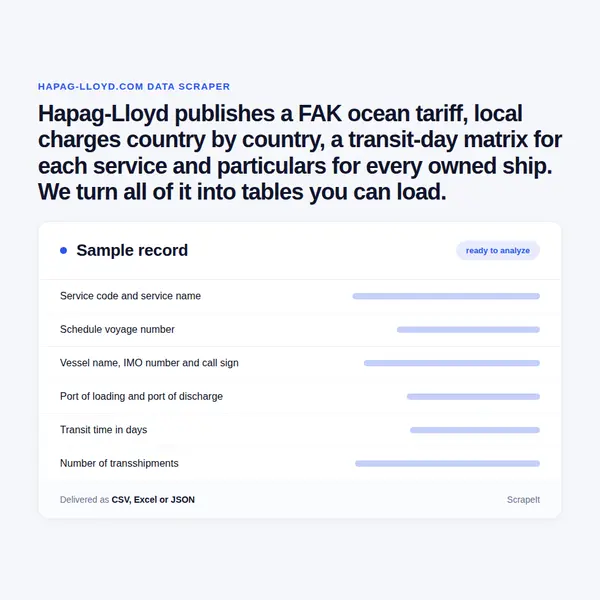
Hapag-Lloyd publishes a FAK ocean tariff, local charges country by country, a transit-day matrix for each service and particulars for every owned ship. We turn all of it into tables you can load.

Plans from €169/month · Free project assessment · Reply within 1 business day

Hapag-Lloyd Scraper
Solutions

Hapag-Lloyd Container Tracking and Tariff Collection as a Managed Service

We run it as a managed service. You name the port pairs, services, ships, countries and container numbers; we collect, parse and deliver the same columns on every run as CSV, JSON or XLSX, to S3, SFTP or your warehouse, or through the ScrapeIt Hapag-Lloyd container tracking API we host. Hapag-Lloyd serves its schedule, tracking and tariff tools behind a bot challenge that stops automated clients, so anti-bot handling, proxy rotation and CAPTCHA solving are part of the service. Surcharge, local charge and detention tables come as PDF documents; we turn them into rows keyed by charge code, country and effective date. We log in nowhere, so quotes, bookings and invoices stay out.

Hapag-Lloyd Vessel Schedule, Service Finder and Fleet Fields

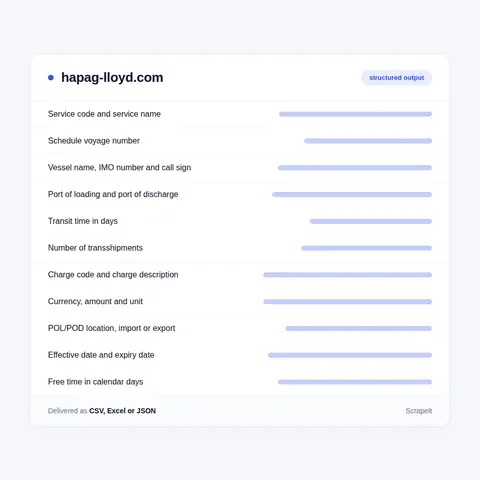
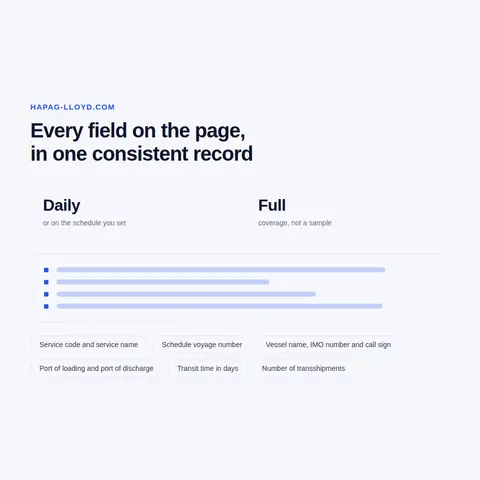
Every row carries the identifiers the carrier prints itself: service code and name, schedule voyage number, vessel name, IMO number and call sign, and UN/LOCODE for ports and inland points.

  • Point to point routings: start and end location, port of loading and port of discharge with planned dates, number of transshipments, vessels, voyages and services, and total transit time in days. Each routing splits into sections with location, arrival and departure, voyage, service code and mode of transport - vessel, truck, rail, waterway, combined rail or combined waterway, with Vessel TBA where no ship is fixed yet. Carrier's haulage or merchant haulage, via ports and the reefer filter change the answer, so they are stored with it.
  • Service Finder: per loop, the service name and code, such as West Africa Express (WAX), its direction and frequency, the port rotation with arrival weekday, and a from-to matrix of transit days between every pair of calls.
  • Vessel Tracker: the Hapag-Lloyd vessel schedule by vessel name, for mainline and feeder ships including partner tonnage: ports of call, arrival and departure dates, transit time, the service and the terminal behind each call.
  • Hapag-Lloyd fleet list: ships grouped by class and capacity band, and per ship the nominal intake in TEU, reefer plugs, deadweight, gross tonnage, length, breadth, speed, maximum power, year built, port of registry, flag, IMO number and call sign, with ISM and ISSC certificates. Chartered ships come with safety management and ship security certificates.
  • Container tracking: Hapag-Lloyd tracking by booking, container or BL number returns each move with its status and place of activity, the transport (vessel name, truck or rail), voyage number and ISO type, with actual moves kept apart from planned ones.
  • Equipment: inside dimensions, door opening, capacity in cbm and cbft, ISO type group and ISO size type for each container type.

Tracking runs only on the container, booking and BL numbers you send us; other companies' shipments are not collected.

Hapag-Lloyd Vessel Schedule, Service Finder and Fleet Fields
Hapag-Lloyd Local Charges, Detention Tariff and Inland Rates by Country

Hapag-Lloyd Local Charges, Detention Tariff and Inland Rates by Country

Local charges are published per country and move in a quarterly change table. Each line carries country, POL/POD location, import or export, charge code, charge description, currency, amount and unit - per container, per TEU, per BL or per invoice. India shows the depth: a destination documentation fee (DDF) and a manifest amendment fee (MFD) per BL, an equipment maintenance fee (EMF) split into dry, reefer or hazardous, and special equipment, import service fees, dock de-stuffing (STR) and off-dock charges per port, each line with an effective date, an expiry date and, where one applies, its tariff entry.

The Hapag-Lloyd detention tariff comes per country and direction. The India import detention table, for example, gives free time in calendar days, then the amounts for a first period, a second period and thereafter, split into 20' dry, 40' dry and high cube, and temperature-controlled and special equipment.

The Hapag-Lloyd inland tariff lists from and to points, container type, dangerous or non-dangerous cargo, lower and upper gross weight, effective date and publishing date; German ports add quarterly ramp rate indications and rail capacity updates. The Hapag-Lloyd tariff rules sit in a section of their own and explain each charge. Rates of exchange are shown per port and schedule voyage from a week before departure or arrival.

Hapag-Lloyd Data Scraping: What the Hamburg Carrier Publishes

Hapag-Lloyd is a container line run from Hamburg, and a Hapag-Lloyd scraper earns its keep on the price side of the site as much as on the sailing side. At the end of June 2026 its fleet counted 300 container ships, and much of its network runs in the Gemini Cooperation with Maersk, a hub-and-spoke system of mainliners, shuttles and feeders, so schedules and ship lists mix the tonnage of both partners.

The open surface falls into four layers. Schedules: point to point routings from an interactive schedule that needs no registration, a Service Finder with the rotation and transit days of each loop, and a Vessel Tracker with the current schedule of every mainline and feeder ship. Prices: an ocean tariff of FAK rates searchable by base date, trade surcharge tables, local charges and service fees country by country, detention and demurrage tariffs, an inland tariff and rates of exchange per port. News: CustomerNEWS notices on GRIs, peak season surcharges and price announcements, plus weekly operational updates per region. Fleet: each ship it owns with full particulars, and certificates for the chartered ones.

The Quick Quotes pages are open to anyone - container types from dry and reefer to flatrack and hardtop, port or door routing, the dangerous goods classes it leaves out - but the rate itself appears only after sign-in, like bookings, shipping instructions, invoices and the detention calculator. Those stay out of scope. Everything else is keyed by identifiers the carrier uses itself - service code, voyage number, IMO number, charge code, UN/LOCODE - so repeated passes line up row by row.

Get a Quote
dev_w
25

Developers

customers
500+

Customers worldwide

pages
1 500 000 000+

Pages extracted

stime
15000+

Hours saved for our clients

Plans

Hapag-Lloyd Scraping Plans and Pricing

Airplane

€199 / one-time

setup fee - included

Data limits100,000
Frequencyone-time
Run timeup to 5 days
Data storing7 days

Helicopter

€169 / mo

setup fee €499

Data limits250,000
Frequencymonthly
Run timeup to 5 days
Data storing14 days

Glasses

€229 / mo

setup fee €499

Data limits1,000,000
Frequencyweekly
Run timeup to 5 days
Data storing30 days

DNA

€549 / mo

setup fee €799

Data limits3,000,000
Frequency3 times daily
Run timesame day
Data storing90 days

Hapag-Lloyd Freight Rates and Surcharges as a Time Series

Forwarders and NVOCCs benchmark their contracts against Hapag-Lloyd ocean freight rates in the public FAK tariff. The tariff can be read at a chosen base date, so a daily pass records each level as it stood, and every Hapag-Lloyd price announcement or GRI notice can be matched to the tariffing date it names. Notices go out weeks ahead, so a table of them shows a Hapag-Lloyd rate increase long before it reaches an invoice.

Procurement teams model landed cost, and sea freight is only part of it. Marine Fuel Recovery is set per quarter, terminal handling charges and security charges come per region, and Hapag-Lloyd export local charges and import fees differ by country and port. A Hapag-Lloyd shipping guarantee fee or an additional free time fee adds to the bill for anyone buying those services.

Operations and risk teams read the weekly operational updates: yard utilization bands per terminal, reefer utilization, omitted port calls, strike notices and no-sailing positions with vessel, voyage and dates. Inland planners follow the Rhine low water surcharge, graded by the Kaub gauge with separate amounts for 20' and 40' boxes.

Analysts compare Hapag-Lloyd shipping rates with other carriers' published levels, and finance teams pull the Hapag-Lloyd rates of exchange that apply per port and voyage.

Our Blog

Reads Our Latest News & Blog

Learn how to use web scraping to solve data problems for your organization

How Artificial Intelligence Is Used In Web Scraping

How Artificial Intelligence Is Used In Web Scraping

Leveraging advances in technology, the AI-powered web scraper has skyrocketed in demand and is helping to expand capabilities by automating tedious daily tasks and speeding up data collection from thousands of websites several times over.

What is Web Scraping and What is it Used For?

What is Web Scraping and What is it Used For?

Web scraping is a method of obtaining web data by extracting it from pages of web resources with the help of a program, that is, in automatic mode. It is used to syntactically convert web pages into more usable forms.

Web Scraping for Machine Learning

Web Scraping for Machine Learning

If you specialize in machine learning, you need to feed large amounts of data to the algorithms. Web scraping is the easiest and the most efficient method of collecting the data from all over the Internet.

scrapeit logo

Scrape Hapag-Lloyd Data Without Building the Pipeline

ScrapeIt is a managed web scraping agency. We extract Hapag-Lloyd data the way a freight desk reads it and keep the pipeline running: monitoring, retries and a person who checks the schema when a page changes. You get an agreed field list, an agreed refresh window and a Hapag-Lloyd dataset that loads without cleaning - schedules, tariffs, local charges and fleet in one model, joined on service code, UN/LOCODE and IMO number. A sample comes first, and you check it before committing.

FAQ

Do you offer a Hapag-Lloyd API?

Yes. The ScrapeIt Hapag-Lloyd API returns JSON records for the jobs you order: point to point routings with vessel, voyage, service and transit days, Service Finder rotations, vessel schedules, tariff and local charge lines with code, currency, amount, unit and effective date, fleet particulars, and tracking events for your own container, booking and BL numbers. Schedules and tracking refresh daily or faster, tariffs and local charges weekly or on each notice, and every run is also delivered as CSV and XLSX.

Which Hapag-Lloyd tariff and local charges fields can you deliver?

From the ocean tariff: tariff code, routing by port or country with inland points, container type, commodity, charge type, amount, validity, mode of transport, publishing date and FMC amendment code, at the base date you choose. From the surcharge tables: Marine Fuel Recovery by quarter, terminal handling and security charges by region, and fees for Shipping Guarantee, Additional Freetime, Ship Green and Live Position. From local charges and detention tariffs: every line described above. Hapag-Lloyd spot rates from Quick Quotes Spot appear only after login, so they stay out.

How do you scrape Hapag-Lloyd schedules and container tracking?

We run the searches a planner runs by hand: each port pair through point to point routings, each loop through the Service Finder, each ship through the Vessel Tracker, on a daily cycle, so the Hapag-Lloyd sailing schedule becomes a table instead of a screen. We track Hapag-Lloyd containers by BL number, booking number or container number and store each move with its status, place and transport, as often as your planners need.

How often does Hapag-Lloyd change its tariff, local charges and schedules?

Often, and on a rhythm you can plan for. FAK levels move with each price announcement and GRI, and every notice names the tariffing date it applies from. Marine Fuel Recovery is set per quarter, local charges move in a quarterly change table, and detention tables are reissued country by country. The Hapag-Lloyd schedule shifts with omitted calls, no-sailing positions and service changes, announced in CustomerNEWS and the weekly operational updates. We refresh schedules and tracking daily, surcharges and local charges weekly or on each notice, and the fleet list monthly.

Is it legal to scrape Hapag-Lloyd?

We collect only publicly available data - everything a visitor can see on Hapag-Lloyd - and we collect it legally. That covers schedules, the Service Finder, the Vessel Tracker, tariff and surcharge tables, local charges, operational updates and the fleet pages. No logins, no paywalls: quotes, bookings and invoices in the customer account are left alone. Office pages name individual staff; we keep the Hapag-Lloyd offices as company data - address and opening hours - and skip personal names and direct contacts, in line with GDPR.

How does it Work?

Step 1 - Make a Request

You share your needs, expectations, and desired timeframe. We’ll suggest the best solution based on your request and budget.

Step 2 - Configuring Custom Web Crawlers

Our specialists configure the crawlers and extract a sample dataset for your review before proceeding with the full-scale extraction.

Step 3 - Collect and Deliver

Once you approve the sample, we launch the project and start full data collection. We gather, filter, and structure the data for easy use, delivering it on time in your preferred format.

Step 4 - Maintain and Support

Our team manages ongoing processes, monitors website changes, and supports all data extraction cycles. We can also help integrate data into your systems or create dashboards to simplify analysis.

Request a Quote

Tell us more about you and your project information.
Which sites, which fields, how often. A couple of lines is enough.

We reply within 1 business day. No obligation.

scrapiet

Scrapeit Sp. z o.o.
10/208 Legionowa str., 15-099, Bialystok, Poland
NIP: 5423457175
REGON: 523384582