Maersk Scraper for Sailing Schedules, Port Calls and Container Tracking

Maersk is an ocean carrier, so its data is vessels, voyages and port rotations, not parcels. We extract Maersk schedules, tracking milestones and published surcharge tariffs on the cadence you set.

Maersk Scraper
Solutions

Managed Maersk Scraping: Rotation, Tracking and Tariff Feeds

We run this as a managed service, not a tool you babysit. You name the port pairs, the services and the trades you care about; we run the passes, hold the schema steady and deliver the same columns every time in CSV, JSON, Excel or straight into your warehouse or S3 bucket.

The public pages are served behind commercial bot protection, and interactive lookups do not open for a plain automated client. That is our job, not yours: anti-bot handling, proxy rotation and CAPTCHA solving are part of the service, together with request pacing that stays polite to the origin. We authenticate nowhere and log in nowhere, so nothing behind a customer account is in scope.

Change is handled as a matter of course. Service codes get renamed, loops get re-lettered and surcharge notices change shape; we patch the extractor and backfill so your series does not develop a hole.

Vessel, Voyage and Port Call Fields a Maersk Scraper Collects

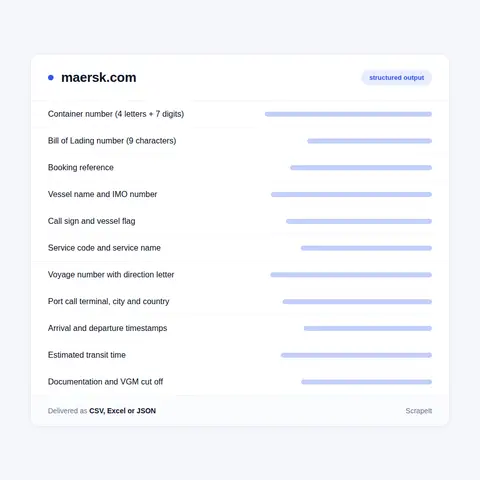
Every row is keyed by an identifier the carrier itself uses, so passes stack instead of drifting. A container number is 4 letters of owner prefix plus 7 digits, printed on the top right of the door. A Bill of Lading number is 9 characters. A vessel is identified by IMO number and call sign as well as by name, and a sailing is identified by service code plus voyage number.

  • Point to point: origin and destination, a departure or an arrival window, estimated transit time, and the legs of the transport plan with load and discharge terminals. Container Yard and Store Door are separate service modes; Ocean and LCL are separate schedule types and return different plans.
  • Vessel and voyage: vessel name, IMO number, call sign, vessel flag, the carrier's own vessel code, and the voyage number with its direction letter, where 611W is a westbound sailing and 613E an eastbound one.
  • Port call: terminal, city and country, arrival and departure timestamps, the service the call belongs to, and the deadlines attached to that call, including documentation and the VGM cut off.
  • Service rotation: the weekly timetable per loop, written as port call, transit time in days, arrival day and departure day, so a feeder rotation reads Day 1 through Day 8 and then repeats.
  • Tracking milestones: container type and size, every stop in the journey including load and discharge, and the estimated date and time at each milestone.
  • Equipment: maximum payload, tare weight and maximum gross weight in kilograms, per type: 20 ft and 40 ft standard steel, 40 ft high cube, 45 ft high, reefer standard, magnum, StarCare and super freezer, open top and collapsible flat rack.
  • Tariff lines: surcharge code, scope, direction and the amount per equipment size, with the effective date stated.

What the carrier keeps private we do not touch. Contract rates, allocations, invoices and booking documents sit behind a customer login and stay out of scope. Shipping papers name shippers and consignees; we do not collect them, and work with schedules, rotations, milestones and tariffs instead.

Vessel, Voyage and Port Call Fields a Maersk Scraper Collects
Surcharge Tariffs, Dangerous Cargo Rules and Container Specifications

Surcharge Tariffs, Dangerous Cargo Rules and Container Specifications

The rate announcement feed is a dataset in its own right. Each notice carries a surcharge code, a scope, a direction and an effective date, and the amounts are broken out by equipment. A bunker notice, for example, quotes 20DRY, 40DRY, 40HDRY and 45HDRY separately from 20REEF and 40REEF, and splits All Long Hauls headhaul from backhaul and from intra trades. The recurring codes are worth learning: PSS for peak season, EBS for emergency bunker, ECS for emergency contingency, LSS for low sulphur, EMS and ESS for emissions, HWS for heavy load, LWC for low water, DPS and DPI for dry port, IPE and IPI for inland peak, PAE and PAI for port additionals, ODC and DDC for dangerous cargo handling, plus terminal handling and the demurrage and detention revisions published country by country.

Dangerous cargo runs on the IMDG Code and the published restrictions are explicit rather than generic. Classes 1.5, 1.6 and 6.2 are not accepted; nor is tantalum or tantalite outside IMDG class 7, nor thiourea dioxide from China. A short list of class 5.1 chlorinated isocyanurates is accepted on deck only. Dangerous goods in flexitanks are refused outright, and misdeclaration carries a stated administrative fee per bill of lading, higher per container for China.

Alongside that sit the equipment tables, where every container type publishes maximum payload, tare weight and maximum gross weight in kilograms, and the per country pages that list depots with their gate hours and cut off times.

What an Ocean Carrier Publishes, and Why Maersk Data Is Not Courier Data

A.P. Moller - Maersk runs liner shipping, and that single fact decides how a Maersk scraper has to be built. Nothing here moves as a parcel through a sorting hub. A box moves on a named service, aboard a vessel that calls a fixed rotation of ports, on a loop that repeats every week. The carrier publishes that rotation, the transit time between calls, and the documentation deadlines that decide whether a container makes the sailing at all.

The open surface splits into four layers. Schedules come in three shapes: point to point between two locations, vessel schedules by ship, and port calls by terminal. Tracking takes a container number or a Bill of Lading number and returns the journey behind it. News carries every rate announcement and advisory as a dated article. Local information holds a page per country with office and port addresses, container depots and their gate hours, import and export guidance and cut off times.

Above all of that sits the network. The East-West Network is published in two routings, Trans Suez and Cape of Good Hope, each built from mainliner loops plus a shuttle layer that feeds them, and operated jointly with Hapag-Lloyd under the Gemini Cooperation. Regional and feeder loops get a page each, keyed by service code: Z05 Turkey-Bulgaria Feeder, L74 Black Sea Link 2, Z98 Unifeeder G16, IOI, MESAWA. Those pages are plain weekly timetables, and they are where Maersk scraping is cheapest and most durable.

Get a Quote
dev_w
25

Developers

customers
500+

Customers worldwide

pages
1 500 000 000+

Pages extracted

stime
15000+

Hours saved for our clients

Plans

Airplane

€199 / one-time

setup fee - included

Data limits100,000
Frequencyone-time
Run timeup to 5 days
Data storing7 days

Helicopter

€169 / mo

setup fee €499

Data limits250,000
Frequencymonthly
Run timeup to 5 days
Data storing14 days

Glasses

€229 / mo

setup fee €499

Data limits1,000,000
Frequencyweekly
Run timeup to 5 days
Data storing30 days

DNA

€549 / mo

setup fee €799

Data limits3,000,000
Frequency3 times daily
Run timesame day
Data storing90 days

Who Buys Maersk Schedule Data and What the Time Series Answers

Forwarders and NVOCCs scrape Maersk schedules because a quote is only as good as the sailing behind it. A single pass tells you which loop connects two ports and how long it claims to take. A daily pass against the same port pair tells you something better: how the promise moves. Published transit time on a lane is a number that drifts, and the drift is the signal.

Shippers and cargo owners watch the rotation rather than the lane. When a service drops a call, adds a shuttle leg or reroutes between Suez and the Cape, the inventory plan behind it changes weeks before anyone writes a press release. Voyage level advisories make that legible: a voyage marked void, a vessel given a new position after reset, a whole service sliding one week at a single port.

Terminals, port authorities and inland hauliers read port calls to see what is coming and when berth demand stacks up. Rail and barge operators join arrival timestamps to their own slots.

Market analysts track the advisory feed because every Maersk price move is published there first, dated and scoped. Peak season surcharges, emergency bunker charges and demurrage revisions arrive as separate notices per trade, and stitching them into one table is exactly the kind of work a scraper should do rather than a person.

Our Blog

Reads Our Latest News & Blog

Learn how to use web scraping to solve data problems for your organization

How Artificial Intelligence Is Used In Web Scraping

How Artificial Intelligence Is Used In Web Scraping

Leveraging advances in technology, the AI-powered web scraper has skyrocketed in demand and is helping to expand capabilities by automating tedious daily tasks and speeding up data collection from thousands of websites several times over.

What is Web Scraping and What is it Used For?

What is Web Scraping and What is it Used For?

Web scraping is a method of obtaining web data by extracting it from pages of web resources with the help of a program, that is, in automatic mode. It is used to syntactically convert web pages into more usable forms.

Web Scraping for Machine Learning

Web Scraping for Machine Learning

If you specialize in machine learning, you need to feed large amounts of data to the algorithms. Web scraping is the easiest and the most efficient method of collecting the data from all over the Internet.

scrapeit logo

Why Teams Hand Ocean Freight Collection to ScrapeIt

ScrapeIt is a managed web scraping agency. We have been building and running collection pipelines for marketplaces, carriers, travel and logistics platforms since long before anyone called it an AI data problem, and we operate them as production systems with monitoring, retries and human review of schema drift.

You get a named engineer, an agreed field list, an agreed refresh window and a delivery format that matches your stack. If a source changes overnight, fixing it is our problem. If a field cannot be collected honestly, we say so before you sign rather than after.

FAQ

Does Maersk have a public API for schedules and container tracking?

Maersk runs a developer portal with an API catalogue covering schedules, tracking, booking and finance, and the products are aligned to Digital Container Shipping Association standards. It is not open, though. You register an account, create an app and receive consumer keys, and every call is checked against them; unauthenticated requests to the API host are refused for a missing or invalid key, and even the catalogue listing behind the portal needs one. There is no anonymous public feed of Maersk schedules or tracking events, which is why most buyers come to us for a normalised extract instead.

Which Maersk fields can you deliver, and what stays out of scope?

We deliver what the site publishes openly: point to point results with transit time and transport plan legs, vessel schedules with IMO number, call sign and voyage number, port calls with arrival and departure timestamps and cut off deadlines, service rotations as weekly timetables, tracking milestones by container or Bill of Lading number, container specifications, and the full rate announcement feed. Contract rates, allocations, invoices and anything behind a customer login stay out. Shipper and consignee details on cargo documents are personal data and we do not collect them.

How often do Maersk schedules change and how often should we refresh?

Constantly, and for reasons that have nothing to do with the website. Weather closes a terminal, a berth window slips, a port is omitted, a voyage is voided and the vessel takes a new position after reset, or a whole service slides a week at one call. Blank sailings around Chinese New Year and Golden Week are planned months ahead and still move. For a working operational picture we usually run daily passes on your port pairs and services, with an extra sweep of the advisory feed; weekly is enough only if you are building a long baseline rather than reacting.

Can you cover every trade lane, region and language version of the site?

Yes. The network is published by region and by loop, so coverage is a matter of enumerating services rather than guessing: East-West mainliners plus shuttles, intra-regional loops and feeder services for Europe, Asia Pacific, IMEA, Latin America and North America. Local information exists per country, and the site is published in twelve languages plus a separate mainland China property. We normally take one language as the canonical source and add others only where the local page carries facts the English one does not, such as country specific tariffs.

Is it legal to scrape Maersk data, and how do you stay on the right side?

We collect only pages that are published openly to any visitor: schedules, service rotations, port calls, tracking results, container specifications and the news and tariff feed. We do not create accounts, we do not authenticate, and we do not touch anything behind a customer login. We do not collect personal data from cargo documents. Output is factual reference material, not a copy of the site, and clients use it inside their own systems. If your legal team wants the collection scope written down before a pilot, we put it in the contract.

How does it Work?

Step 1 - Make a Request

You share your needs, expectations, and desired timeframe. We’ll suggest the best solution based on your request and budget.

Step 2 - Configuring Custom Web Crawlers

Our specialists configure the crawlers and extract a sample dataset for your review before proceeding with the full-scale extraction.

Step 3 - Collect and Deliver

Once you approve the sample, we launch the project and start full data collection. We gather, filter, and structure the data for easy use, delivering it on time in your preferred format.

Step 4 - Maintain and Support

Our team manages ongoing processes, monitors website changes, and supports all data extraction cycles. We can also help integrate data into your systems or create dashboards to simplify analysis.

Request a Quote

Tell us more about you and your project information.
Which sites, which fields, how often. A couple of lines is enough.

We reply within 1 business day. No obligation.

scrapiet

Scrapeit Sp. z o.o.
10/208 Legionowa str., 15-099, Bialystok, Poland
NIP: 5423457175
REGON: 523384582