Port of Antwerp-Bruges Scraper for Two Merged Ports

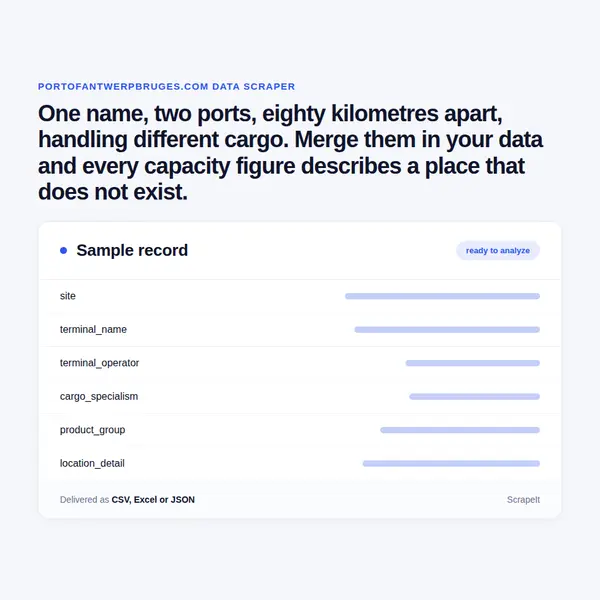
One name, two ports, eighty kilometres apart, handling different cargo. Merge them in your data and every capacity figure describes a place that does not exist.

Port of Antwerp-Bruges Scraper
Solutions

Managed port data, run end to end by us

ScrapeIt runs the collection as a managed service. You name the sites, cargo types or terminals; we build the pipeline with site mandatory on every row, specialism vocabulary preserved and connections as a network, and hand back CSV, JSON, Excel or a push into your warehouse.

Published infrastructure data changes slowly, so periodic collection with change records fits better than a continuous feed and is what we quote.

We collect published information only, honour the crawl rules and pace requests. This is a public authority's publication about infrastructure and contains no commercial or personal data.

Port of Antwerp-Bruges fields in every export

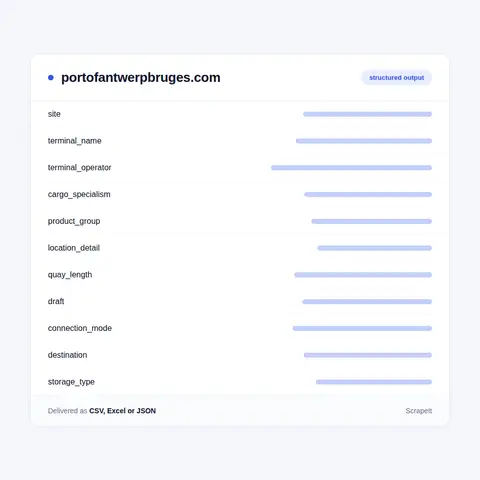
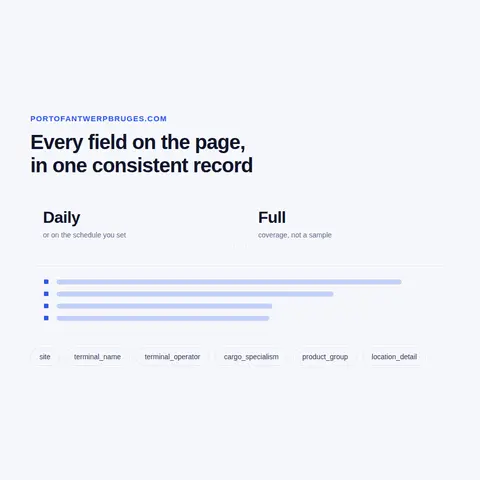
Records carry the site - Antwerp or Zeebrugge - alongside terminal name, operator, cargo specialism, location detail and the services described.

Site is mandatory and never inferred from context. The two locations have different depths, different hinterland connections and different cargo mixes, and an aggregate across them is a number for nowhere.

Cargo specialism is kept in the source's own vocabulary, which distinguishes containers, liquid bulk, chemicals, breakbulk, ro-ro and vehicles. Chemicals in particular are a distinct category here rather than a subset of liquid bulk, and flattening them loses what makes Antwerp what it is.

Hinterland connections are collected as rows by mode, as on any port source, because cargo leaving the quay is the question a supply chain model actually asks.

Every row carries the collection timestamp and the source address.

Port of Antwerp-Bruges fields in every export
Chemical cluster, ro-ro capacity and limits

Chemical cluster, ro-ro capacity and limits

Chemical cluster mapping is the distinctive output: which terminals handle which product groups, how they connect by pipeline, and what storage exists. For chemicals logistics it is a rare structured view of an industry that is otherwise opaque.

Ro-ro and vehicle handling capacity at the coastal site answers a question that container-centric port data cannot, and it matters to automotive supply chains in particular.

Comparative analysis between the two sites is only possible because they are recorded separately, and it is often the most interesting output - how a merged authority balances investment between two locations with different futures.

Limits: published information, not operations. No berth occupancy, no shipper volumes, no commercial terms. Promotional capacity claims are labelled as claims rather than folded in as measurements.

A merged authority over two distinct ports

Port of Antwerp-Bruges is the authority formed by the merger of the ports of Antwerp and Zeebrugge. It is one organisation publishing under one name, and it operates two physically separate ports with substantially different profiles.

Antwerp is a deep inland port on the Scheldt, dominant in containers and the largest integrated chemical cluster in Europe. Zeebrugge is a coastal port strong in roll-on roll-off traffic, vehicles and liquefied natural gas. They are eighty kilometres apart and they do different things.

A dataset that takes the merged brand at face value and records a single port produces figures that describe neither location. Site has to be a field from the first row, and it is the most common error made with this source since the merger.

Port sections respond directly with substantial content. Crawl rules are published, allow the site broadly, disallow one technical path and parameterised addresses, and reference the sitemaps.

Get a Quote
dev_w
25

Developers

customers
500+

Customers worldwide

pages
1 500 000 000+

Pages extracted

stime
15000+

Hours saved for our clients

Plans

Airplane

€199 / one-time

setup fee - included

Data limits100,000
Frequencyone-time
Run timeup to 5 days
Data storing7 days

Helicopter

€169 / mo

setup fee €499

Data limits250,000
Frequencymonthly
Run timeup to 5 days
Data storing14 days

Glasses

€229 / mo

setup fee €499

Data limits1,000,000
Frequencyweekly
Run timeup to 5 days
Data storing30 days

DNA

€549 / mo

setup fee €799

Data limits3,000,000
Frequency3 times daily
Run timesame day
Data storing90 days

Why a merger is a data modelling problem

Corporate mergers create quiet data errors, because the brand consolidates faster than the physical reality it describes.

Here the two ports remain two ports. Their depths differ, so the vessels that can call differ. Their hinterland connections differ. Their cargo mixes barely overlap. Any analysis of capacity, congestion or routing that treats them as one facility will be wrong in ways that look plausible, because the merged figure sits between two real numbers and resembles both.

The second reason this source matters is the chemical cluster. Antwerp's chemical industry is the largest integrated cluster in Europe, and the port publishes terminal and pipeline detail about it that is hard to assemble elsewhere. For anyone in chemicals logistics that detail is the reason to come here at all.

The third is ro-ro and vehicles at Zeebrugge, a specialism with completely different infrastructure requirements from containers and one that container-focused datasets routinely ignore.

The fourth is the same limit as any port authority: this is published infrastructure and commercial information, not operational data, and we say what it is not as clearly as what it is.

Our Blog

Reads Our Latest News & Blog

Learn how to use web scraping to solve data problems for your organization

How Artificial Intelligence Is Used In Web Scraping

How Artificial Intelligence Is Used In Web Scraping

Leveraging advances in technology, the AI-powered web scraper has skyrocketed in demand and is helping to expand capabilities by automating tedious daily tasks and speeding up data collection from thousands of websites several times over.

What is Web Scraping and What is it Used For?

What is Web Scraping and What is it Used For?

Web scraping is a method of obtaining web data by extracting it from pages of web resources with the help of a program, that is, in automatic mode. It is used to syntactically convert web pages into more usable forms.

Web Scraping for Machine Learning

Web Scraping for Machine Learning

If you specialize in machine learning, you need to feed large amounts of data to the algorithms. Web scraping is the easiest and the most efficient method of collecting the data from all over the Internet.

scrapeit logo

Who builds and keeps your port feed

ScrapeIt is a managed extraction company, not a tool you have to learn. Our team builds the pipeline, keeps the two sites separated as the merged authority reorganises its publications, and repairs the collector before your model starts averaging two ports.

You see a sample first, in your format, over the cargo types you actually move, with site on every row so you can confirm nothing has been merged that should not be.

FAQ

Is this one port or two?

One authority, two physical ports eighty kilometres apart with different depths, different hinterland links and barely overlapping cargo mixes. Site is a mandatory field, because a merged figure sits between two real numbers and resembles both while describing neither.

Why is chemicals a separate category?

Because Antwerp's chemical cluster is the largest integrated one in Europe and the port publishes terminal and pipeline detail about it. Folding chemicals into liquid bulk loses precisely what makes this source worth using for that industry.

What is at the coastal site?

Roll-on roll-off traffic, vehicles and liquefied natural gas primarily - specialisms with completely different infrastructure requirements from containers, and ones that container-focused port datasets routinely ignore.

Can I compare the two sites?

Yes, and only because they are recorded separately. It is often the most interesting output: how a merged authority balances investment between two locations with quite different futures.

Does this include actual throughput?

Only what the authority publishes. Berth occupancy, shipper volumes and commercial terms are not here. Capacity claims in promotional material are labelled as claims rather than presented as measurements.

How does it Work?

Step 1 - Make a Request

You share your needs, expectations, and desired timeframe. We’ll suggest the best solution based on your request and budget.

Step 2 - Configuring Custom Web Crawlers

Our specialists configure the crawlers and extract a sample dataset for your review before proceeding with the full-scale extraction.

Step 3 - Collect and Deliver

Once you approve the sample, we launch the project and start full data collection. We gather, filter, and structure the data for easy use, delivering it on time in your preferred format.

Step 4 - Maintain and Support

Our team manages ongoing processes, monitors website changes, and supports all data extraction cycles. We can also help integrate data into your systems or create dashboards to simplify analysis.

Request a Quote

Tell us more about you and your project information.
Which sites, which fields, how often. A couple of lines is enough.

We reply within 1 business day. No obligation.

scrapiet

Scrapeit Sp. z o.o.
10/208 Legionowa str., 15-099, Bialystok, Poland
NIP: 5423457175
REGON: 523384582