Port of Rotterdam Scraper for Terminals and Connections

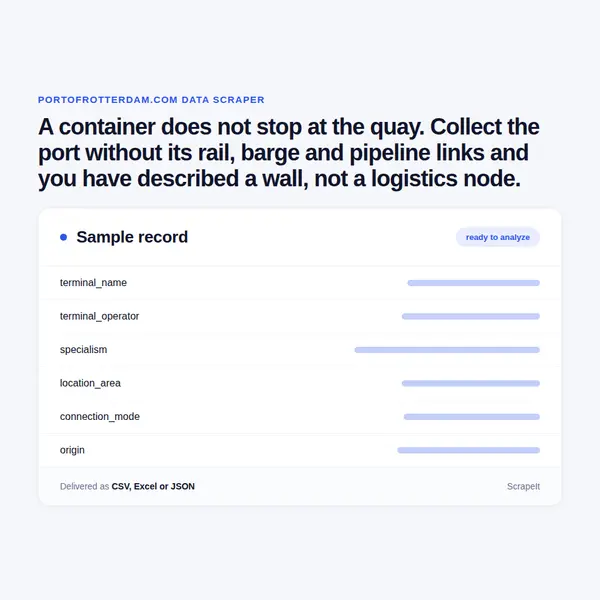
A container does not stop at the quay. Collect the port without its rail, barge and pipeline links and you have described a wall, not a logistics node.

Port of Rotterdam Scraper
Solutions

Managed port network data, run end to end by us

ScrapeIt runs the collection as a managed service. You name the modes, terminals or corridors; we build the pipeline with connections as a queryable network and mode as a field throughout, and hand back CSV, JSON, Excel or a push into your warehouse.

Published network data changes slowly, so this is usually a periodic collection with change records rather than a continuous feed, and we quote it that way.

We collect published information only, honour the crawl rules and pace requests. This is a public authority's own publication about infrastructure; it contains no commercial or personal data, and we do not present promotional capacity claims as measurements.

Port of Rotterdam fields in every export

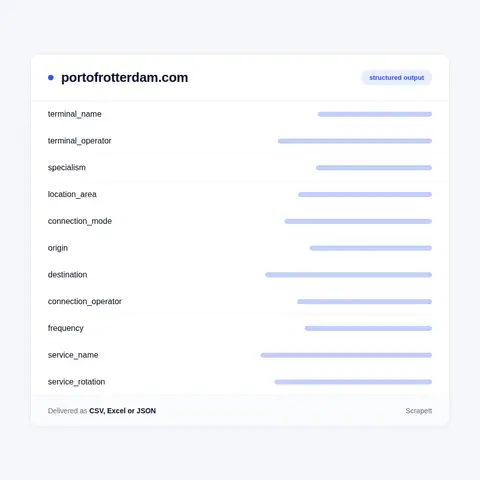
Terminal records carry the terminal name, operator, specialism such as container, liquid bulk or dry bulk, location within the port area, and the modes it connects to.

Connection records are the distinctive table: mode - rail, barge, road or pipeline - origin, destination, operator and frequency where published. Modelled as rows rather than described in prose, they form a network a planner can actually query.

Service records cover shipping services calling at the port with their operators and rotations where published, which links the maritime side to the inland side.

Mode is a first class field throughout, because the entire value of this source is that it distinguishes them. A dataset that collapses rail and barge into transport loses exactly what a modal shift analysis needs.

Every row carries the collection timestamp and the source address.

Port of Rotterdam fields in every export
Network modelling, modal analysis and limits

Network modelling, modal analysis and limits

Network modelling is the strongest use: terminals, connections and destinations as a graph, which supports routing, resilience and lead time analysis that a vessel feed cannot touch.

Modal share tracking over time shows how the rail and barge network develops, which matters to anyone with emissions reporting obligations as well as to policy researchers.

Terminal specialism mapping answers where a particular cargo type can actually be handled, which narrows a routing problem before any optimisation runs.

Limits stated plainly: this is what the authority publishes, not operational data. Real-time berth occupancy, actual volumes by shipper and commercial terms are not here, and a brief needing those needs terminal operators or commercial data providers. We say so rather than implying the port's site is an operations feed.

Europe's largest port as a published network

The Port of Rotterdam Authority runs Europe's largest seaport, and its site publishes a considerable amount about how the port actually works: terminals and their specialisms, shipping services calling there, and the inland connections that move cargo onward.

That last part is what makes this source different from vessel tracking. Tracking tells you a ship arrived. The port's own publications describe what happens next - which rail corridors, inland barge services and pipelines connect to which terminals, and where they go.

For anyone modelling supply chains that hinterland layer is the substance. A container discharged at Rotterdam reaches Germany, Switzerland or Poland through a network of services that are published and structurable, and no vessel feed contains them.

Connection and logistics sections respond directly with substantial content. Crawl rules are published and concern site infrastructure rather than editorial content.

Get a Quote
dev_w
25

Developers

customers
500+

Customers worldwide

pages
1 500 000 000+

Pages extracted

stime
15000+

Hours saved for our clients

Plans

Airplane

€199 / one-time

setup fee - included

Data limits100,000
Frequencyone-time
Run timeup to 5 days
Data storing7 days

Helicopter

€169 / mo

setup fee €499

Data limits250,000
Frequencymonthly
Run timeup to 5 days
Data storing14 days

Glasses

€229 / mo

setup fee €499

Data limits1,000,000
Frequencyweekly
Run timeup to 5 days
Data storing30 days

DNA

€549 / mo

setup fee €799

Data limits3,000,000
Frequency3 times daily
Run timesame day
Data storing90 days

Why the hinterland is the part nobody else publishes

Maritime data projects usually start with vessels because vessel data is available, and they usually end up unable to answer the question that prompted them.

Vessel movements tell you about ships. Supply chain questions are about cargo, and cargo leaves the port by rail, barge, road or pipe. That onward network is published by the port authority and by essentially nobody else in structured form, which makes this a genuinely non-substitutable source.

The second reason is modal shift, which is an active European policy objective. Moving freight from road to rail and barge is measurable if connections are collected by mode over time, and the port publishes enough to track how the network is changing.

The third is terminal specialism. Not every terminal handles every cargo, and a model that treats a port as one node with one capacity will misroute anything specialised - chemicals, liquid bulk, ro-ro. Terminal level detail is what makes a routing model credible.

The fourth is that a port authority publishes to attract business, which means the data is promotional in tone and generally accurate in substance. We collect the substance and do not treat marketing claims about capacity as measurements.

Our Blog

Reads Our Latest News & Blog

Learn how to use web scraping to solve data problems for your organization

How Artificial Intelligence Is Used In Web Scraping

How Artificial Intelligence Is Used In Web Scraping

Leveraging advances in technology, the AI-powered web scraper has skyrocketed in demand and is helping to expand capabilities by automating tedious daily tasks and speeding up data collection from thousands of websites several times over.

What is Web Scraping and What is it Used For?

What is Web Scraping and What is it Used For?

Web scraping is a method of obtaining web data by extracting it from pages of web resources with the help of a program, that is, in automatic mode. It is used to syntactically convert web pages into more usable forms.

Web Scraping for Machine Learning

Web Scraping for Machine Learning

If you specialize in machine learning, you need to feed large amounts of data to the algorithms. Web scraping is the easiest and the most efficient method of collecting the data from all over the Internet.

scrapeit logo

Who builds and keeps your port network feed

ScrapeIt is a managed extraction company, not a tool you have to learn. Our team builds the pipeline, watches it as the authority restructures its publications, and repairs it before a connection network goes out of date in your model.

You see a sample first, in your format, over the corridors you actually use, with connections as a network so you can test a routing query on real terminals.

FAQ

Is this the same as vessel tracking?

No, and that is the point. Vessel data tells you a ship arrived. This tells you what happens next - which rail, barge and pipeline services connect which terminals to which inland destinations. No vessel feed contains that.

Why is mode a separate field?

Because the entire value here is distinguishing rail from barge from road. Collapsing them into transport removes exactly what modal shift analysis and emissions reporting need, and it cannot be recovered afterwards.

Can I get real-time port operations?

Not from this source. Berth occupancy, actual volumes by shipper and commercial terms are not published here. That needs terminal operators or commercial providers, and we scope it separately rather than implying the authority's site is an operations feed.

Why does terminal specialism matter?

Because not every terminal handles every cargo. A model treating the port as one node with one capacity will misroute chemicals, liquid bulk or ro-ro. Terminal level detail is what makes a routing model credible rather than approximate.

Is promotional material a problem?

Only if you treat it as measurement. A port authority publishes to attract business, so capacity claims are marketing while the network structure is substance. We collect the substance and label claims as claims.

How does it Work?

Step 1 - Make a Request

You share your needs, expectations, and desired timeframe. We’ll suggest the best solution based on your request and budget.

Step 2 - Configuring Custom Web Crawlers

Our specialists configure the crawlers and extract a sample dataset for your review before proceeding with the full-scale extraction.

Step 3 - Collect and Deliver

Once you approve the sample, we launch the project and start full data collection. We gather, filter, and structure the data for easy use, delivering it on time in your preferred format.

Step 4 - Maintain and Support

Our team manages ongoing processes, monitors website changes, and supports all data extraction cycles. We can also help integrate data into your systems or create dashboards to simplify analysis.

Request a Quote

Tell us more about you and your project information.
Which sites, which fields, how often. A couple of lines is enough.

We reply within 1 business day. No obligation.

scrapiet

Scrapeit Sp. z o.o.
10/208 Legionowa str., 15-099, Bialystok, Poland
NIP: 5423457175
REGON: 523384582