MPA Singapore Scraper for Registry and Port Operations

Most of what passes through this port was never meant for Singapore. Read its throughput as national demand and you have measured the wrong country.

MPA Singapore Scraper
Solutions

Managed maritime authority data, run end to end by us

ScrapeIt runs the collection as a managed service. You name the domains - registry, port operations, bunkering, regulation; we build the pipeline with transshipment flagged, registry treated as regulatory rather than operational, and hand back CSV, JSON, Excel or a push into your warehouse.

Regulatory material changes on its own schedule, so we collect periodically with change records, which is what makes a monitoring product possible.

We collect published information only and pace politely; the absence of a crawl rules file is not an invitation. This is a public authority's publication and contains no commercial or personal data beyond vessel registration as published.

MPA Singapore fields in every export

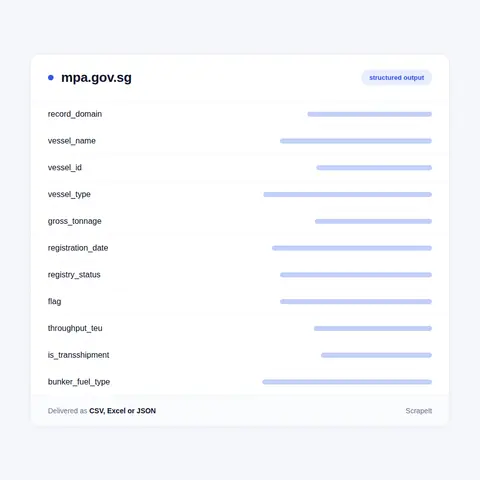
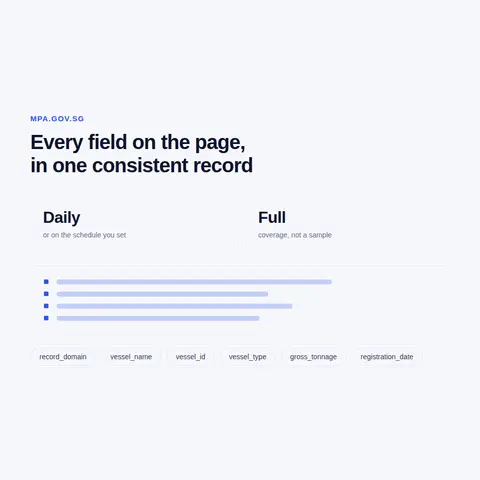
Registry records carry the vessel name, identification number, vessel type, gross tonnage, registration date and status as published, kept as a regulatory record rather than an operational one.

Port operations records cover services, requirements and procedures as published, with the category and applicability recorded so a client can tell which vessels or operations a rule concerns.

Bunkering is treated as its own domain, because Singapore is the world's largest bunkering port and fuel supply is a substantial and separately regulated activity rather than a footnote to container handling.

Throughput figures, where published, carry an explicit flag distinguishing transshipment from local cargo. That single field prevents the most common misreading of this port's numbers.

Every row carries the collection timestamp and the source address.

MPA Singapore fields in every export
Flag state analysis, fuel transition and limits

Flag state analysis, fuel transition and limits

Flag state analysis over time shows which vessel types register here and how that shifts, which is a readable signal about regulatory competition between registries and about owner preferences.

Fuel transition tracking is the most forward-looking use: as the largest bunkering port, changes in what fuels are available and regulated here lead the wider market, and the authority publishes regulatory material as the transition proceeds.

Regulatory monitoring - what requirements apply to which vessels and when they change - is directly operational for anyone with ships calling here, and it is a change-tracking product rather than a snapshot.

Limits: published regulatory and operational information only. No commercial terms, no real-time vessel positions, no shipper data. And throughput is transshipment-heavy, which we flag on the rows rather than in a footnote.

A maritime authority, not only a port

The Maritime and Port Authority of Singapore regulates the country's maritime sector. It runs port operations, maintains the Singapore ship registry, oversees bunkering and publishes information across all of it.

That breadth makes it a different kind of source from a port authority. A port publishes about its terminals; a maritime authority publishes about a flag, a fleet, a fuel market and a regulatory regime as well.

The ship registry in particular is a distinct dataset: vessels registered under the Singapore flag, which is a commercial choice made by owners worldwide rather than a statement about where ships operate. Registry data describes a regulatory relationship, not a geography, and reading it as a local fleet is a straightforward error.

Port operations, registry and maritime sector sections respond directly. There is no robots file at the service address, which we take as no stated restriction rather than an invitation, and we pace politely.

Get a Quote
dev_w
25

Developers

customers
500+

Customers worldwide

pages
1 500 000 000+

Pages extracted

stime
15000+

Hours saved for our clients

Plans

Airplane

€199 / one-time

setup fee - included

Data limits100,000
Frequencyone-time
Run timeup to 5 days
Data storing7 days

Helicopter

€169 / mo

setup fee €499

Data limits250,000
Frequencymonthly
Run timeup to 5 days
Data storing14 days

Glasses

€229 / mo

setup fee €499

Data limits1,000,000
Frequencyweekly
Run timeup to 5 days
Data storing30 days

DNA

€549 / mo

setup fee €799

Data limits3,000,000
Frequency3 times daily
Run timesame day
Data storing90 days

Why transshipment changes what the numbers mean

Singapore handles enormous container volumes and a large share of them are transshipment - cargo arriving on one vessel and leaving on another without entering the Singaporean economy at all.

That makes throughput a measure of the port's role as a hub rather than of Singaporean demand, and the distinction is not a technicality. An analyst reading this port's volumes as a demand indicator for Singapore is measuring Southeast Asian and global flows attributed to the wrong place. Anyone using the figures comparatively against a gateway port like Los Angeles is comparing two different things unless the transshipment share is recorded.

The second reason this source is distinctive is the registry. A ship registry is a regulatory dataset: which owners chose this flag, for which vessel types, and how that changes. It answers questions about regulatory competition between flag states and says nothing about where those ships sail.

The third is bunkering. As the largest bunker port, Singapore is where marine fuel pricing and availability are most visible, and fuel transition policy - the shift toward alternative marine fuels - is measurable here earlier than almost anywhere.

The fourth is the standard port authority limit: published regulatory and operational information, not commercial or real-time data.

Our Blog

Reads Our Latest News & Blog

Learn how to use web scraping to solve data problems for your organization

How Artificial Intelligence Is Used In Web Scraping

How Artificial Intelligence Is Used In Web Scraping

Leveraging advances in technology, the AI-powered web scraper has skyrocketed in demand and is helping to expand capabilities by automating tedious daily tasks and speeding up data collection from thousands of websites several times over.

What is Web Scraping and What is it Used For?

What is Web Scraping and What is it Used For?

Web scraping is a method of obtaining web data by extracting it from pages of web resources with the help of a program, that is, in automatic mode. It is used to syntactically convert web pages into more usable forms.

Web Scraping for Machine Learning

Web Scraping for Machine Learning

If you specialize in machine learning, you need to feed large amounts of data to the algorithms. Web scraping is the easiest and the most efficient method of collecting the data from all over the Internet.

scrapeit logo

Who builds and keeps your maritime feed

ScrapeIt is a managed extraction company, not a tool you have to learn. Our team builds the pipeline, tracks regulatory publications as they change, and repairs the collector before a monitoring series misses a requirement that took effect.

You see a sample first, in your format, over the domains you actually need, with transshipment flagged so you can see immediately what the throughput figures are and are not measuring.

FAQ

Can I use throughput as a demand indicator?

Not for Singapore. A large share is transshipment - cargo arriving on one vessel and leaving on another without entering the economy. Read as local demand it measures Southeast Asian and global flows attributed to the wrong country.

Can I compare this port against Los Angeles?

Only with the transshipment share recorded, which is why it is a field. A hub port and a gateway port handle structurally different traffic, and comparing raw totals compares two different phenomena.

What does the ship registry tell me?

Which owners chose this flag, for which vessel types, and how that changes over time. It is a regulatory relationship, not a geography - registry data says nothing about where those ships actually sail.

Why treat bunkering separately?

Because Singapore is the world's largest bunkering port and fuel supply is a substantial, separately regulated activity. It is also where the shift toward alternative marine fuels becomes visible earlier than almost anywhere else.

There is no robots file - does that mean anything goes?

No. Absence of a stated rule is not an invitation. We pace politely on a public authority's site and collect published material only, which is how we would work even where rules are published.

How does it Work?

Step 1 - Make a Request

You share your needs, expectations, and desired timeframe. We’ll suggest the best solution based on your request and budget.

Step 2 - Configuring Custom Web Crawlers

Our specialists configure the crawlers and extract a sample dataset for your review before proceeding with the full-scale extraction.

Step 3 - Collect and Deliver

Once you approve the sample, we launch the project and start full data collection. We gather, filter, and structure the data for easy use, delivering it on time in your preferred format.

Step 4 - Maintain and Support

Our team manages ongoing processes, monitors website changes, and supports all data extraction cycles. We can also help integrate data into your systems or create dashboards to simplify analysis.

Request a Quote

Tell us more about you and your project information.
Which sites, which fields, how often. A couple of lines is enough.

We reply within 1 business day. No obligation.

scrapiet

Scrapeit Sp. z o.o.
10/208 Legionowa str., 15-099, Bialystok, Poland
NIP: 5423457175
REGON: 523384582