ImportYeti Scraper for Supplier and Shipment Records

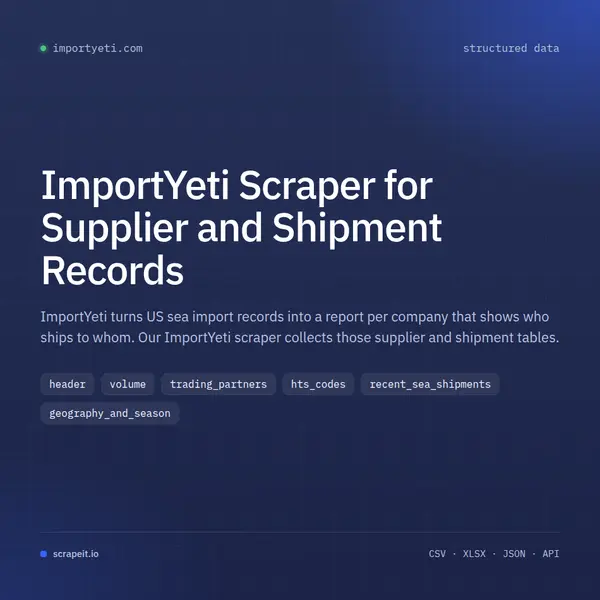
ImportYeti turns US sea import records into a report per company that shows who ships to whom. Our ImportYeti scraper collects those supplier and shipment tables.

Plans from €169 a month · Free project assessment · Reply within 1 business day

CSV · Excel · JSON · XML · FTP · SFTP · Amazon S3 · Google Cloud

importyeti.com
ImportYeti Scraper for Supplier and Shipment Records
importyeti.comwhat you get
Typical fields for logistics sites
carrierorigindestinationservice_typepricetransit_days
Delivery

API, JSON feed or CSV, XLSX and JSON files

Schedule

One-time, monthly, weekly, daily or 3 times a day

How to scrape ImportYeti without running a crawler

  1. You send

    ImportYeti pages, filters, fields and a schedule

  2. We run the scrapers

    Built, monitored and repaired by our team

  3. You receive the data

    API, JSON feed or CSV, XLSX and JSON files

You give us the starting point - a list of US importers, a list of overseas factories, an HS code or a product keyword - and we build the crawler that walks ImportYeti from there: search results to company reports, company reports to their suppliers, suppliers to their other customers. We run it, keep it working when the report layout changes, and handle pacing, proxy rotation and CAPTCHA handling as part of the managed service.

Each row keeps the report slug it came from, so Wal Mart's supplier list and Welspun Global Brands' customer list join on the same pair of keys. Runs are one-off or on the schedule you set, and the files arrive with field documentation in CSV, XLSX or JSONLines, by SFTP, Amazon S3 or our API.

ImportYeti data we extract from company and supplier reports

ImportYeti keeps two kinds of report. A US buyer lives at /company/ and a slug, such as /company/wal-mart; an overseas shipper lives at /supplier/, such as /supplier/welspun-global-brands. The two are mirror images: the company report lists Suppliers, the supplier report lists Customers, and the rest of the page has the same blocks. We extract from both:

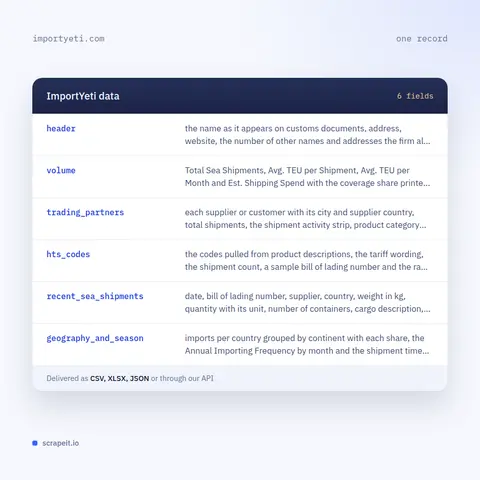
  • Headerthe name as it appears on customs documents, address, website, the number of other names and addresses the firm also trades under, Last Shipment Spotted and the date ImportYeti last synced the report.
  • VolumeTotal Sea Shipments, Avg. TEU per Shipment, Avg. TEU per Month and Est. Shipping Spend with the coverage share printed beside it.
  • Trading partnerseach supplier or customer with its city and supplier country, total shipments, the shipment activity strip, product category tags, an excerpt of the product descriptions and the top HS codes.
  • HTS codesthe codes pulled from product descriptions, the tariff wording, the shipment count, a sample bill of lading number and the raw cargo text that carried the code.
  • Recent sea shipmentsdate, bill of lading number, supplier, country, weight in kg, quantity with its unit, number of containers, cargo description, the trade lane label and Est. Freight Cost where the table fills it.
  • Geography and seasonimports per country grouped by continent with each share, the Annual Importing Frequency by month and the shipment time series behind the chart.

Customs descriptions are typed by shippers, so they arrive truncated, misspelt or full of purchase order numbers. We keep the text as filed and add tidy columns beside it, so nothing in the original is lost.

ImportYeti data we extract from company and supplier reports
Building an ImportYeti database: search, locations and history

Building an ImportYeti database: search, locations and history

A single report answers one question about one firm. Coverage of a whole product or region comes from the search side. The search page has four tabs - Companies and Suppliers, Addresses, Product Finder by HS Code and Product Finder - with filters for Type, Most Recent Shipment and Total Shipments and a switch to include related companies. Every result card carries the profile type, address, total shipments, most recent shipment and how many other names and addresses the business also uses, which is enough to rank a long list before opening any report.

Location pages add the map view: a sourcing location such as the Panipat district of Haryana, with its total sea shipments, total weight, total TEU, the date the figures were updated, its leading trading partners and an HS code breakdown. Crawled across a sourcing country, they show which towns ship which goods.

History comes from repeat runs. Each row is stamped with the run date, so a new supplier, a dropped one or a fresh HS code on a familiar relationship shows up as a dated change in your own table.

About ImportYeti and its customs records

Source
importyeti.com
Category
logistics sites
Delivery
API, JSON feed, CSV, XLSX
Plans
From €169 a month
Get a quote

ImportYeti is a US trade data site built on bills of lading for sea cargo entering the United States. Its CEO and co-founder, David Applegate, shipped the first version in April 2020, during the first Covid lockdown. The front page offers one search box over hundreds of millions of customs shipment records and says they are updated daily.

The organising idea is the relationship. Every importer is tied to the overseas suppliers that shipped to it, every supplier to its US customers, and each link carries a shipment count, product tags and HS codes. Charts run back to January 2015 and can be switched between monthly, seasonal and annual views, with markers for Covid lockdowns, Trump's tariffs and manifest confidentiality.

Two traits matter to anyone who uses the records. Names follow the paperwork, so Walmart's report is titled Wal Mart and lists hundreds of alternative names and addresses under which the same buyer appears. And the counters are labelled sea shipments: the reports describe ocean freight, with a toggle that hides internal suppliers and omitted data. The public reports cover US imports, and that is the layer this page describes.

25Developers
500+Customers
1.5BPages extracted
15,000+Hours saved for our clients

ImportYeti scraping plans and pricing

Airplane

€199one-time

Setup fee included

100,000
One-time
Up to 5 days
7 days

Helicopter

€169/ mo

Setup fee €499

250,000
Monthly
Up to 5 days
14 days

Glasses

€229/ mo

Setup fee €499

1,000,000
Weekly
Up to 5 days
30 days

Microscope popular

€349/ mo

Setup fee €499

2,000,000
Daily
Same day
60 days

DNA

€549/ mo

Setup fee €799

3,000,000
3 times daily
Same day
90 days

Delivery: CSV, JSON or XLSX files, our API or a JSON feed. MCP server on request.

Full plan details

What an ImportYeti dataset is used for

Customs records show behaviour rather than claims. A factory's website says it exports; its supplier report shows which US buyers received its containers, how often and under which HS codes.

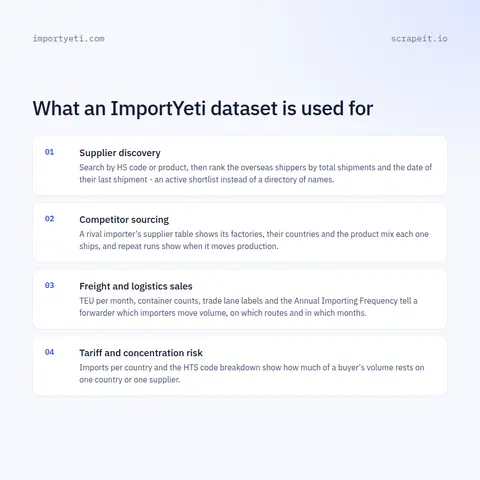
  • Supplier discoverySearch by HS code or product, then rank the overseas shippers by total shipments and the date of their last shipment - an active shortlist instead of a directory of names.
  • Competitor sourcingA rival importer's supplier table shows its factories, their countries and the product mix each one ships, and repeat runs show when it moves production.
  • Freight and logistics salesTEU per month, container counts, trade lane labels and the Annual Importing Frequency tell a forwarder which importers move volume, on which routes and in which months.
  • Tariff and concentration riskImports per country and the HTS code breakdown show how much of a buyer's volume rests on one country or one supplier.

About ScrapeIt

ScrapeIt is a managed web scraping service: we build, run and repair the crawlers, and you receive the dataset. Trade records are a particular kind of work - one buyer under hundreds of spellings, cargo text typed in a hurry, relationships that only make sense as a graph - so we deliver company, partner and shipment tables that join on stable keys. The project assessment is free and a sample comes first. Plans start from EUR 169 a month, or EUR 199 for a one-time extract.

FAQ

Still unsure? Write to info@scrapeit.io

Do you offer an ImportYeti API for shipment records?

Yes. The ScrapeIt ImportYeti API returns the company name, supplier, HS code, bill of lading number, weight and container count as JSON from an endpoint we host, refreshed on the schedule you set. The same records also come as CSV or XLSX files, a JSON feed or a load straight into your database.

Is it legal to scrape ImportYeti?

Yes. Company and supplier reports, their shipment tables and HTS code breakdowns are open to any visitor without an account. We collect only publicly available data - everything a visitor can see on ImportYeti - and we collect it legally. Where a record names a private person rather than a business, that name stays out under GDPR.

How often is ImportYeti data updated, and how often should we refresh?

ImportYeti says its records are updated daily, and every report shows the date it was last synced next to Last Shipment Spotted. A weekly run suits supplier monitoring across a category; a daily run suits a short watch list of importers whose new bills of lading you want the morning they appear.

Can you scrape every supplier of an importer, not just the first page?

Yes. We expand the Suppliers table past its first rows and follow each supplier into its own report. Because one buyer appears under many names and addresses, we also read the alternative names a report lists and merge them under one key, so a supplier filed against a variant spelling is not missed.

Does the ImportYeti dataset include contact details?

It includes what the report prints openly: the company name, address and website. The e-mails and phone numbers ImportYeti keeps masked are not part of the dataset, and we do not build profiles of the people who sign shipping documents.

How it works

  1. 1

    Make a request

    You share your needs, expectations, and desired timeframe. We'll suggest the best solution based on your request and budget.

  2. 2

    We configure the crawlers

    Our specialists configure the crawlers and extract a sample dataset for your review before proceeding with the full-scale extraction.

  3. 3

    Collect and deliver

    Once you approve the sample, we launch the project and start full data collection. We gather, filter, and structure the data for easy use, delivering it on time in your preferred format.

  4. 4

    Maintain and support

    Our team manages ongoing processes, monitors website changes, and supports all data extraction cycles. We can also help integrate data into your systems or create dashboards to simplify analysis.

Request a quote

Tell us which sites, which fields and how often. A couple of lines is enough to start.

  • We reply within 1 business day
  • A sample dataset before the full run
  • We sign an NDA on request
  • Delivery by API, JSON feed or files
Which sites, which fields, how often. A couple of lines is enough.

This form is protected by Google reCAPTCHA, which loads when you start filling it in; the Google Privacy Policy and Terms of Service apply. If you prefer not to use it, email us at info@scrapeit.io. Privacy & Cookie Policy

We reply within 1 business day. No obligation.

ImportYeti data from €169/month. Free project assessment, reply within 1 business day.