MSC Scraper for FAK Rates, Local Charges, Sailing Schedules and Tracking

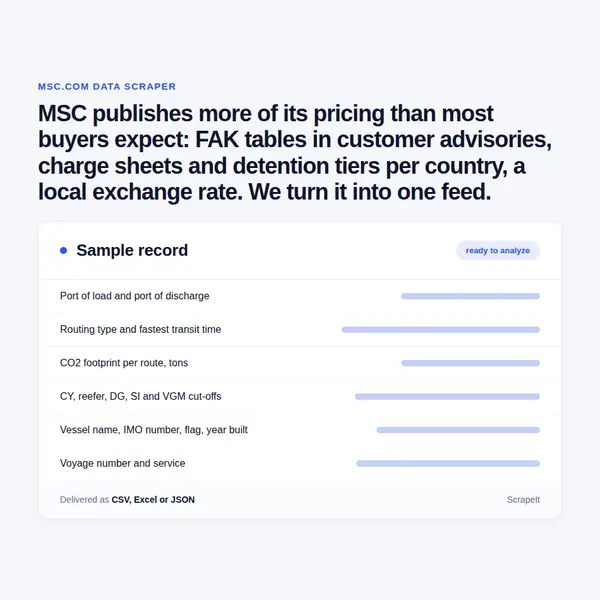
MSC publishes more of its pricing than most buyers expect: FAK tables in customer advisories, charge sheets and detention tiers per country, a local exchange rate. We turn it into one feed.

Plans from €169/month · Free project assessment · Reply within 1 business day

MSC Scraper
Solutions

MSC data scraping, run end to end as a managed feed

ScrapeIt runs the MSC scraper as a managed service. You name the port pairs, trades, countries and advisory types; we build collectors that extract MSC data from the schedules tool, tracking results for your own references, customer advisories, country pages and their PDF charge sheets, turn every PDF into rows and deliver CSV, JSON, Excel or a load into your warehouse.

msc.com sits behind commercial bot protection, so anti-bot handling, proxy rotation and CAPTCHA solving come with the service. No logins, no paywalls: myMSC stays out. When MSC renames a loop, moves a rotation between Suez and the Cape or changes a charge sheet layout, we patch the parser and backfill the gap.

MSC shipping schedule and tracking fields, leg by leg

Records are keyed the way MSC keys them - port codes, service names, voyage numbers, IMO numbers, container and Bill of Lading numbers - so repeated passes line up without fuzzy matching.

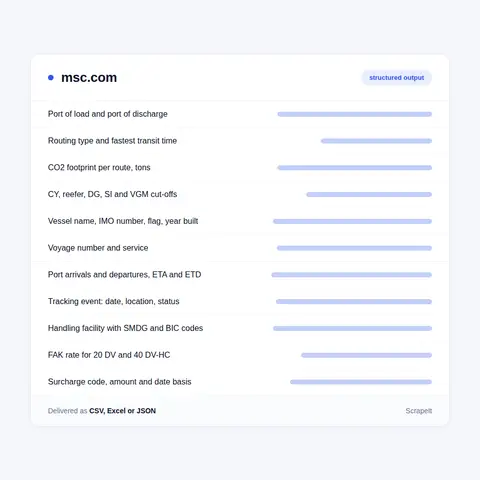
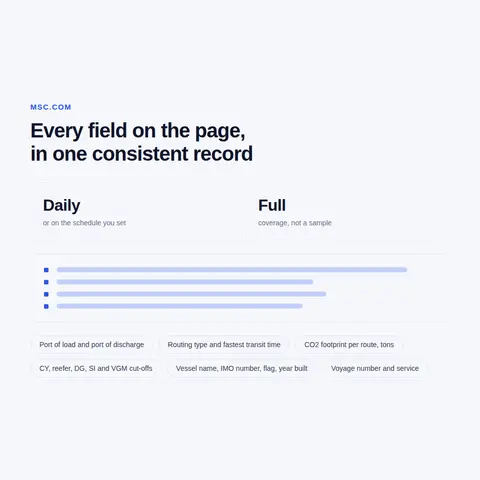
  • Point-to-point: an MSC shipping schedule point-to-point search returns port of load, port of discharge, fastest transit time, next departure, service, routing type and a CO2 footprint in tons per route. Each sailing opens into legs with ETA and ETD per call and optional intermediate calls.
  • Cut-offs: CY, reefer, DG, SI and VGM cut-off per leg, as date and time. Results sort by fastest transit time, next departure, port of load or port of discharge.
  • Vessel: vessel name, IMO number, flag and year built, with voyage number and service. The vessel search listed 1,444 ships by name and IMO number at the end of September 2026, 919 of them named MSC.
  • Arrivals and departures: for one port, every vessel and voyage calling, with ETA, ETD and service.
  • Tracking: MSC cargo tracking returns shipped from, port of load, port of discharge, shipped to, transhipment ports and a price calculation date per Bill of Lading; container type, latest move and POD ETA per container; and per event the date, location, description, empty or laden status, vessel and voyage, and the handling facility with its SMDG and BIC codes.
  • Vessel sharing: a VSA tool lists ships under vessel sharing and slot deals with IMO number, voyage, first EU or UK port, the ETA there and a customs office reference.

MSC shipping schedule and tracking fields, leg by leg
MSC shipping tariff pages: local charges, detention and exchange rates

MSC shipping tariff pages: local charges, detention and exchange rates

MSC local charges sit under Local Requirements on each country page, and every country office picks its own format. India links a dozen PDF sheets - export local charges, export THC, export detention, pre-carriage, first mile, import detention, destination THC, import local charges, on-carriage and last mile. Each line carries charge head, basis (per BL, per container, 20 FT or 40 FT), amount, currency, applicability by port or ICD, a mandatory or incidental flag and an effective date, and the THC sheet quotes terminal handling charges port by port for dry, reefer and out-of-gauge boxes, hazardous or not. The UAE sheet gives every line a tariff code, such as DOCEX for documentation or KIS for ISPS, with its VAT rate and a valid-from date. Pakistan, Qatar, Belgium and the United States link tariff files too, Colombia and Chile print their tables straight into the page, other desks list VGM fees, weighing charges or refundable container deposits, and some only explain the charges.

The MSC shipping line detention tariff shows the structure: free days, then daily rates per day band by equipment - 20' DV, 40' DV and HC, open top and flat rack, reefer, IMO variants and 45'. The rules matter as much as the rates: Chile starts the clock the day after the empty box leaves the gate, India counts the discharge date inside the free time, Colombia adds 25% to local charges for IMO cargo.

Most country pages also show an MSC exchange rate from the local currency to the US dollar with its own update stamp. MSC shipping charges, demurrage and detention and that rate turn an ocean price into a local invoice estimate.

From the MSC vessel schedule to country tariffs: what msc.com publishes

MSC stands for Mediterranean Shipping Company, the Geneva carrier Gianluigi Aponte founded in 1970, still owned by his family and now the largest container line by fleet capacity. An MSC scraper works against a carrier site rather than a marketplace: msc.com in twelve languages, with data spread over the schedules tool, shipment tracking, a newsroom of customer advisories and a local information section that gives each country its own page.

The MSC sailing schedule is searched three ways: point-to-point between two ports, by vessel, and as arrivals and departures at one port. Tracking takes a container, Bill of Lading or booking number. Customer advisories run back to 2014 and file every price announcement, surcharge and rotation change as a dated notice. Country pages, grouped under Africa, America, Asia Pacific, Europe and the Middle East, list MSC shipping locations - offices, ports and terminals with their MSC and SMDG codes - with opening hours, public holidays, an exchange rate and, where the local agency posts them, charge sheets.

Two more layers matter. Each trade on the East-West network has a service guide in PDF with port rotations and transit time grids, some in separate Suez and Cape of Good Hope editions; MSC has run that network alone since its 2M vessel sharing agreement with Maersk ended. And myMSC, the customer portal for quotes, bookings and documents, sits behind a login and stays out of scope.

Get a Quote
dev_w
25

Developers

customers
500+

Customers worldwide

pages
1 500 000 000+

Pages extracted

stime
15000+

Hours saved for our clients

Plans

MSC Scraping Plans and Pricing

Airplane

€199 / one-time

setup fee - included

Data limits100,000
Frequencyone-time
Run timeup to 5 days
Data storing7 days

Helicopter

€169 / mo

setup fee €499

Data limits250,000
Frequencymonthly
Run timeup to 5 days
Data storing14 days

Glasses

€229 / mo

setup fee €499

Data limits1,000,000
Frequencyweekly
Run timeup to 5 days
Data storing30 days

DNA

€549 / mo

setup fee €799

Data limits3,000,000
Frequency3 times daily
Run timesame day
Data storing90 days

Why scrape MSC data: prices move by advisory, schedules by the week

MSC does publish freight rates, and that is the first reason to collect at the carrier. Price announcements carry FAK rates by trade: a loading region, a discharge region, a 20 DV and a 40 DV-HC figure in US dollars, a validity window that opens on one date and closes no later than another, and the surcharges the rate already includes, such as the Global Fuel Surcharge and the ECA charge per TEU. MSC shipping rates become a dated series only if every notice is read and its columns kept straight.

Surcharge notices are the second reason. Each one names a code, a trade, an amount per 20', 40', 45' or reefer box and a date basis - gate-in, B/L or sailed date. The codes repeat: PSS for peak season, EFS for emergency fuel, PCS for the Panama Canal, ERC for equipment repositioning, plus congestion, piracy risk and Suez surcharges when routes shift. One MSC price announcement is a notice; a year of them is a price index.

Schedules are the third. Forwarders compare transit time per port pair, shippers watch blank sailing programmes around Chinese New Year and Golden Week, and terminals and hauliers plan around port arrivals and departures. There is no public MSC shipping cost calculator, so a landed estimate is built from the FAK line, the surcharges in force and the local charges at both ends - the feed carries all three.

Our Blog

Reads Our Latest News & Blog

Learn how to use web scraping to solve data problems for your organization

How Artificial Intelligence Is Used In Web Scraping

How Artificial Intelligence Is Used In Web Scraping

Leveraging advances in technology, the AI-powered web scraper has skyrocketed in demand and is helping to expand capabilities by automating tedious daily tasks and speeding up data collection from thousands of websites several times over.

What is Web Scraping and What is it Used For?

What is Web Scraping and What is it Used For?

Web scraping is a method of obtaining web data by extracting it from pages of web resources with the help of a program, that is, in automatic mode. It is used to syntactically convert web pages into more usable forms.

Web Scraping for Machine Learning

Web Scraping for Machine Learning

If you specialize in machine learning, you need to feed large amounts of data to the algorithms. Web scraping is the easiest and the most efficient method of collecting the data from all over the Internet.

scrapeit logo

The team behind your MSC shipping API and file deliveries

ScrapeIt is a managed web scraping agency, so you get people, not a tool to configure. One engineer owns your MSC feed from the first call: maps it to your schema, watches it through peak season, blank sailings and surcharge weeks, and fixes it the day a page changes shape. Deliveries come as files or through our API, whichever your stack prefers, and pricing follows the lanes, countries and refresh windows in scope, not the pages loaded. A sample comes first, so you can check it against a booking you know before anything is scheduled.

FAQ

Do you offer an MSC API?

Yes. The ScrapeIt MSC API returns the records we collect as JSON: point-to-point sailings with transit time, cut-offs, vessel and IMO number; port arrivals and departures; tracking events for your own container, Bill of Lading and booking numbers; FAK rates and surcharges from advisories with their validity dates; local charges, detention tiers and exchange rates per country. It refreshes on the schedule we agree - schedules daily, advisories as they post, country pages weekly - and the same data comes as CSV and XLSX files.

Where do MSC freight rates and surcharges come from?

From MSC's own customer advisories. Price announcements list FAK rates per trade for 20 DV and 40 DV-HC boxes, with the rate window and the surcharges already included, quoted base port to base port with out-ports on top. Surcharges such as PSS, EFS or PCS get their own notices with an amount per box and a start date. An MSC shipping quote for a specific booking is another matter: it is issued in myMSC, behind a login, so we leave it alone. We deliver the public side as one table: trade, rate, currency, surcharge codes, validity dates.

Can you run MSC container tracking on our own containers?

Yes. An MSC tracking number is one of three references: a container number, a Bill of Lading number or a booking number. To track an MSC container at scale we take your list of references, poll on the cadence you set and keep every event with date, location, description, vessel, voyage and facility codes, so a missed transshipment or a slipping POD ETA shows up as a change. Results come as files or through our MSC container tracking API. We track only references you give us, never other companies' shipments.

How often do MSC schedules, advisories and local charges change?

At three speeds. Schedules move daily: ETAs slide, calls are omitted and blank sailing programmes around Chinese New Year and Golden Week rewrite whole weeks. Price announcements arrive several times a month with validity windows as short as two weeks, and surcharge notices follow events. Local charge sheets and detention tariffs change a few times a year, each with an effective date printed on it, while exchange rates carry their own update stamp. We usually run schedules daily, advisories daily with a diff and country pages weekly.

Is it legal to scrape MSC?

We collect only publicly available data - everything a visitor can see on MSC - and we collect it legally. That means schedules, tracking results for references you own, customer advisories, country pages with their charge sheets, service guides and vessel lists. No logins, no paywalls: myMSC is never touched. Office details we take are company desks and generic mailboxes; named individuals and shipper or consignee details are not collected, and any personal data is handled under GDPR.

How does it Work?

Step 1 - Make a Request

You share your needs, expectations, and desired timeframe. We’ll suggest the best solution based on your request and budget.

Step 2 - Configuring Custom Web Crawlers

Our specialists configure the crawlers and extract a sample dataset for your review before proceeding with the full-scale extraction.

Step 3 - Collect and Deliver

Once you approve the sample, we launch the project and start full data collection. We gather, filter, and structure the data for easy use, delivering it on time in your preferred format.

Step 4 - Maintain and Support

Our team manages ongoing processes, monitors website changes, and supports all data extraction cycles. We can also help integrate data into your systems or create dashboards to simplify analysis.

Request a Quote

Tell us more about you and your project information.
Which sites, which fields, how often. A couple of lines is enough.

We reply within 1 business day. No obligation.

scrapiet

Scrapeit Sp. z o.o.
10/208 Legionowa str., 15-099, Bialystok, Poland
NIP: 5423457175
REGON: 523384582