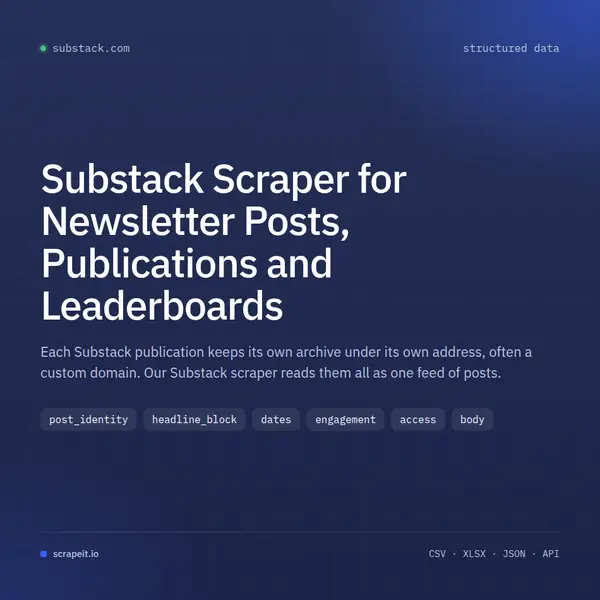
Substack Scraper for Newsletter Posts, Publications and Leaderboards

Each Substack publication keeps its own archive under its own address, often a custom domain. Our Substack scraper reads them all as one feed of posts.

Plans from €169 a month · Free project assessment · Reply within 1 business day

CSV · Excel · JSON · XML · FTP · SFTP · Amazon S3 · Google Cloud

substack.com
Substack Scraper for Newsletter Posts, Publications and Leaderboards
substack.comwhat you get
Typical fields for news sites
headlinesectionauthorpublished_aturlbody_text
Delivery

API, JSON feed or CSV, XLSX and JSON files

Schedule

One-time, monthly, weekly, daily or 3 times a day

Substack Crawler as a Managed Service

  1. You send

    Substack pages, filters, fields and a schedule

  2. We run the scrapers

    Built, monitored and repaired by our team

  3. You receive the data

    API, JSON feed or CSV, XLSX and JSON files

You give us the scope - a list of publications, one or more leaderboard categories, or a set of authors - and the fields you need; we build the Substack crawler, run it and keep it working as Substack updates its pages. Rendering, pacing, proxy rotation and CAPTCHA handling are part of the service. Substack web scraping across many independent sites only pays off when they land in one schema: publications on custom domains and on substack.com subdomains share our column set, so a newsletter that moved to its own address keeps its history. Output arrives as CSV, XLSX, JSON or JSONLines, through our API, to Amazon S3 or Google Drive, once or on the schedule you set. Plans start from EUR 169 a month, or EUR 199 for a one-time extract.

Substack Data We Extract From Posts and Archives

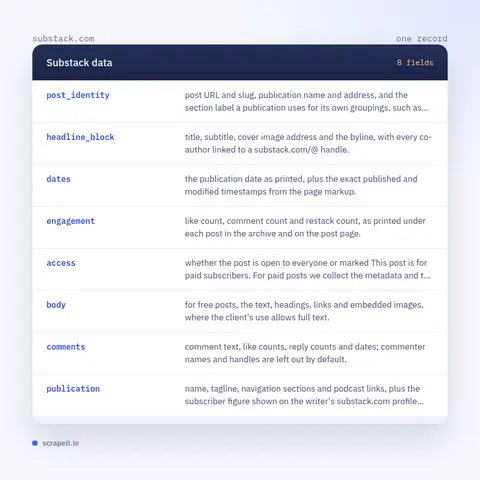
A Substack post lives at /p/ plus a slug on its publication's address, and the archive lists every post under Latest, Top and Discussions tabs. Our Substack scraper collects from both and returns one row per post:

  • Post identitypost URL and slug, publication name and address, and the section label a publication uses for its own groupings, such as Deepdives, with the section path under /s/.
  • Headline blocktitle, subtitle, cover image address and the byline, with every co-author linked to a substack.com/@ handle.
  • Datesthe publication date as printed, plus the exact published and modified timestamps from the page markup.
  • Engagementlike count, comment count and restack count, as printed under each post in the archive and on the post page.
  • Accesswhether the post is open to everyone or marked This post is for paid subscribers. For paid posts we collect the metadata and the free preview only, never the locked text.
  • Bodyfor free posts, the text, headings, links and embedded images, where the client's use allows full text.
  • Commentscomment text, like counts, reply counts and dates; commenter names and handles are left out by default.
  • Publicationname, tagline, navigation sections and podcast links, plus the subscriber figure shown on the writer's substack.com profile where one is displayed.

A full archive is read back to the publication's first post, not only the latest screen. Rows keep the post URL as the key, so reruns update counts instead of duplicating posts.

Substack Data We Extract From Posts and Archives
Substack Post Scraper Feeds, Leaderboards and Profiles

Substack Post Scraper Feeds, Leaderboards and Profiles

Beyond single publications, substack.com ranks them. The Bestsellers leaderboard runs per category - Technology, Business, Culture, U.S. Politics, Finance, Food & Drink, Science, Fiction, Crypto, History and many more - with two views, Top Bestsellers and Rising. Each entry gives a rank, the author and the publication. Daily snapshots of those lists show which newsletters climb, which fall away and how fast a new title breaks into its category.

Author profiles at substack.com/@handle tie a byline to its publication and add the publication's subscriber figure and a category rank such as #1 in Business where one has been earned. We take those publication-level figures, not the personal side of a profile. Recommendations one publication makes for others can be mapped into a network of who promotes whom.

Repeated runs turn the counters into series: likes and comments per post by day since publication, subscriber figures per publication by month, leaderboard rank by category over time. We deliver bylines and ranks as the platform shows them; other personal details stay out unless the project needs them, and are handled under GDPR.

About Substack and How Publications Are Organised

Source
substack.com
Category
news sites
Delivery
API, JSON feed, CSV, XLSX
Plans
From €169 a month
Get a quote

Substack is a publishing platform for newsletters and podcasts: writers run their own publications on it, send each post by e-mail and keep a web archive of everything they send. The company behind it is Substack Inc, and the substack.com home and reader app add a social layer of Home, Subscriptions, Podcasts, Chat, Activity and Explore.

For a data buyer the important part is structure. Each publication is a separate site, either at name.substack.com or on its own domain - The Pragmatic Engineer, for one, lives on newsletter.pragmaticengineer.com - yet every one of them uses the same layout: a home page, an archive, an About page, optional sections and a podcast page. That shared template is what lets one crawler read many independent newsletters.

Writers choose which posts are free and which are paid posts for paying subscribers, and they can lift the paywall from a post later. The free-or-paid state is therefore a field that changes, not a fixed property of a publication. Discovery runs through categories and the Bestsellers lists on substack.com, through author profiles and through the recommendations one publication makes for others.

25Developers
500+Customers
1.5BPages extracted
15,000+Hours saved for our clients

Substack scraping plans and pricing

Airplane

€199one-time

Setup fee included

100,000
One-time
Up to 5 days
7 days

Helicopter

€169/ mo

Setup fee €499

250,000
Monthly
Up to 5 days
14 days

Glasses

€229/ mo

Setup fee €499

1,000,000
Weekly
Up to 5 days
30 days

Microscope popular

€349/ mo

Setup fee €499

2,000,000
Daily
Same day
60 days

DNA

€549/ mo

Setup fee €799

3,000,000
3 times daily
Same day
90 days

Delivery: CSV, JSON or XLSX files, our API or a JSON feed. MCP server on request.

Full plan details

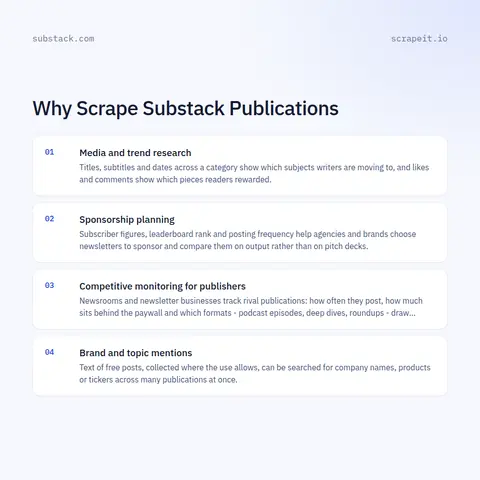
Why Scrape Substack Publications

Substack scraping gives a dated record of what independent writers publish and how their readers respond.

  • Media and trend researchTitles, subtitles and dates across a category show which subjects writers are moving to, and likes and comments show which pieces readers rewarded.
  • Sponsorship planningSubscriber figures, leaderboard rank and posting frequency help agencies and brands choose newsletters to sponsor and compare them on output rather than on pitch decks.
  • Competitive monitoring for publishersNewsrooms and newsletter businesses track rival publications: how often they post, how much sits behind the paywall and which formats - podcast episodes, deep dives, roundups - draw comments.
  • Brand and topic mentionsText of free posts, collected where the use allows, can be searched for company names, products or tickers across many publications at once.
  • Text corporaFree posts with their authors, dates and sections make an attributed corpus for language analysis, sentiment studies or tracking market commentary.

About ScrapeIt

ScrapeIt builds and runs data collection for clients who need web data without staffing a scraping team. News and publishing sites are a steady part of that work, and Substack is a special case: one platform, many independent sites, each with its own domain and its own paywall choices. We map publications to one schema, keep paid text out, deliver metadata and free content on your schedule and send field documentation with every dataset. A free assessment and a sample come first.

FAQ

Still unsure? Write to info@scrapeit.io

Do you offer a Substack API for posts and publications?

Yes. The ScrapeIt Substack API returns post URL, title, subtitle, authors, publication date, like and comment counts and the paid flag as JSON from an endpoint we host, refreshed on the schedule you set. The same data also comes as CSV files, a JSON feed or a load into your database, and an MCP server is available on request.

Is it legal to scrape Substack?

Yes. Archives, headlines, bylines, dates, engagement counts, free posts and leaderboards are open to any visitor without signing in. We collect only publicly available data - everything a visitor can see on Substack - and we collect it legally. Paid posts are limited to their metadata and free preview.

How do you scrape Substack articles on custom domains?

The same way as on substack.com subdomains: we start from the archive, collect every /p/ link and read each post page. Custom domains and name.substack.com addresses share one layout, so all of them land in one table with a publication column.

Can I get a Substack dataset of a whole leaderboard category?

Yes. We take the publications listed under Top Bestsellers and Rising in the categories you choose, then collect each one's archive and About page. The result links rank, publication, author, subscriber figure and every post, and reruns record how rank and counts move.

How often should Substack data be refreshed?

Likes, comments and restacks keep changing after a post goes out, so engagement work usually runs daily while posts are new and less often later. Leaderboards are worth a daily snapshot, while an archive only needs a pass after new posts appear. A post can also switch from paid to free, which a scheduled run catches.

How it works

  1. 1

    Make a request

    You share your needs, expectations, and desired timeframe. We'll suggest the best solution based on your request and budget.

  2. 2

    We configure the crawlers

    Our specialists configure the crawlers and extract a sample dataset for your review before proceeding with the full-scale extraction.

  3. 3

    Collect and deliver

    Once you approve the sample, we launch the project and start full data collection. We gather, filter, and structure the data for easy use, delivering it on time in your preferred format.

  4. 4

    Maintain and support

    Our team manages ongoing processes, monitors website changes, and supports all data extraction cycles. We can also help integrate data into your systems or create dashboards to simplify analysis.

Request a quote

Tell us which sites, which fields and how often. A couple of lines is enough to start.

  • We reply within 1 business day
  • A sample dataset before the full run
  • We sign an NDA on request
  • Delivery by API, JSON feed or files
Which sites, which fields, how often. A couple of lines is enough.

This form is protected by Google reCAPTCHA, which loads when you start filling it in; the Google Privacy Policy and Terms of Service apply. If you prefer not to use it, email us at info@scrapeit.io. Privacy & Cookie Policy

We reply within 1 business day. No obligation.

Substack data from €169/month. Free project assessment, reply within 1 business day.