Onet Scraper for Polish News Across Portal Verticals

Polish inflects everything, including your brand name. Match on the nominative alone and you lose most of the mentions without ever seeing the gap.

Onet Scraper
Solutions

Managed Polish media collection, run end to end by us

ScrapeIt runs the collector as a managed service. You name the verticals, sections and the brands or products you track; we build the pipeline with declension-aware matching for your specific names, run it on your cadence and hand back CSV, JSON, Excel or a push into your warehouse, with the surface form recorded on every match.

Cadence is per front. News and business verticals during an active story justify frequent passes; lifestyle and archive work run slower.

We collect what the site renders publicly, honour the crawl rules it publishes and pace requests. The journalism is copyrighted and the terms restrict reuse, so the dataset is metadata and publicly rendered text for analysis rather than material for republication. Bring the use case to your own counsel before the project starts.

Onet fields in every export

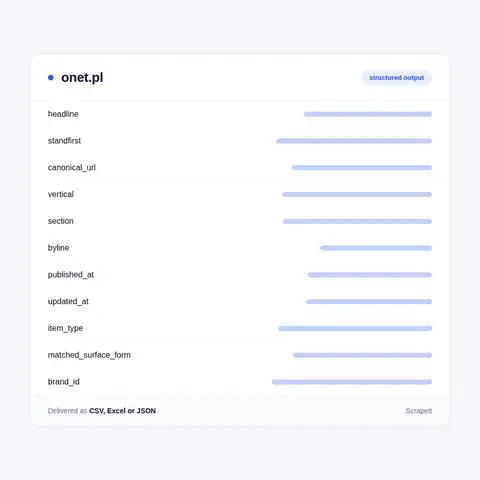
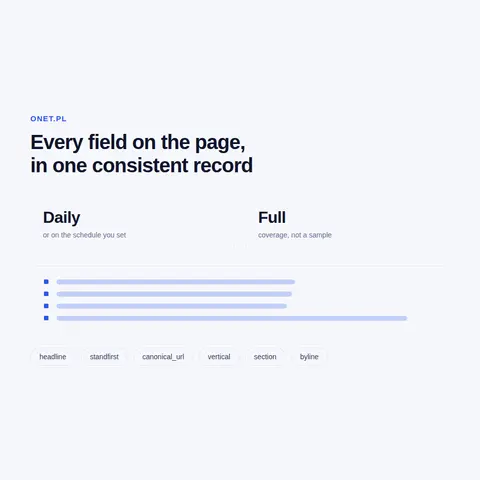
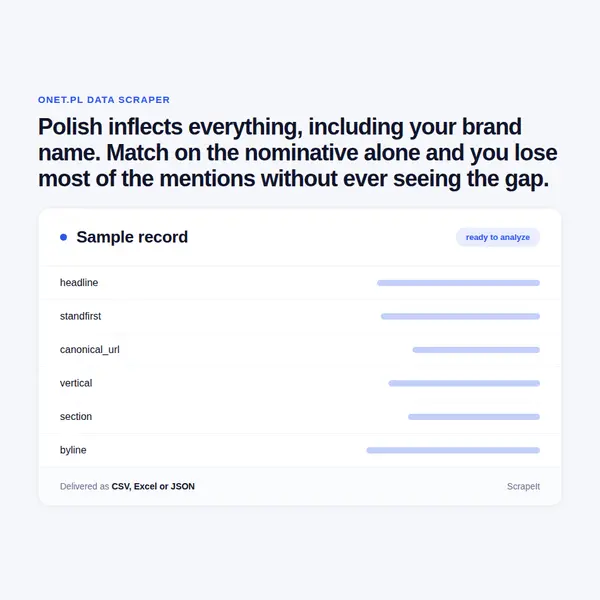
The article record covers canonical URL, headline, standfirst, vertical and section, byline where published, publication timestamp, last updated timestamp, item type and the article identifier.

Vertical is a separate field from section because on a portal they are different things. A story in the business vertical and a story in the business section of the news vertical are not the same object, and a client comparing coverage across Polish media needs to know which they are holding.

Text is stored in Polish with its diacritics intact, never transliterated in place. Polish diacritics are routinely stripped in URLs and slugs but present in body text, and normalising them away at collection time destroys the ability to match accurately later.

Brand and product matches are delivered with the surface form that was found, not just a flag. When a name appears in an inflected form, the row records which form, which is what lets a client audit the matching rather than trust it.

Then the usual context: topic tags where published, word count, lead image URL, front position from repeated observation, outbound links, and the collection timestamp on every row.
Onet fields in every export
Verticals, diacritics and comparison with other Polish media

Verticals, diacritics and comparison with other Polish media

Vertical scoping is the first decision and it is worth making explicitly. For company monitoring the business and technology verticals usually carry more than general news; for public affairs the opposite is true. We agree the list before collection rather than discovering the gap in the first report.

Diacritic handling runs throughout. Source text keeps its diacritics; matching handles both the diacritic and the stripped form because URLs, slugs and some user generated text drop them. Normalising the stored text would be simpler and would quietly reduce accuracy, so we do not.

Translation, where a client wants it, is a separate labelled field. The Polish source text is never overwritten, because anything that might be quoted or challenged has to be verifiable against the original.

Comparison with other Polish outlets is the usual extension. One portal is a large slice of the Polish online conversation and not the whole of it, and a share of voice number means little until at least two or three sources are collected on the same matching rules.

A portal, not just a newsroom

Onet is one of Poland's largest online portals, and portal is the operative word. News sits alongside business, sport, technology, entertainment and lifestyle verticals, several of them on their own subdomains, with their own fronts and their own editorial rhythms.

That structure decides how a project here is scoped. Collecting the news vertical alone gives you the political and general coverage and misses the business and technology verticals where most company coverage actually appears. Collecting everything without a plan buries the signal under lifestyle content.

The verticals respond normally and the site publishes crawl rules that permit ordinary collection. Fronts carry ordered selections, and article pages carry structured markup with headline, publisher and timestamps.

The language is the real work. Polish is heavily inflected: nouns change form by case, and a brand or product name inside a sentence frequently appears in a form that does not match its nominative spelling. Any matching built without that loses a large share of hits silently, which is far worse than losing them loudly.

Get a Quote
dev_w
25

Developers

customers
500+

Customers worldwide

pages
1 500 000 000+

Pages extracted

stime
15000+

Hours saved for our clients

Plans

Airplane

€199 / one-time

setup fee - included

Data limits100,000
Frequencyone-time
Run timeup to 5 days
Data storing7 days

Helicopter

€169 / mo

setup fee €499

Data limits250,000
Frequencymonthly
Run timeup to 5 days
Data storing14 days

Glasses

€229 / mo

setup fee €499

Data limits1,000,000
Frequencyweekly
Run timeup to 5 days
Data storing30 days

DNA

€549 / mo

setup fee €799

Data limits3,000,000
Frequency3 times daily
Run timesame day
Data storing90 days

Why Polish inflection is the whole problem

An English language monitoring pipeline pointed at Polish media reports confidently and is wrong by a wide margin, and nothing in the output signals it.

The reason is grammatical. Polish nouns decline through seven cases, and a brand name used naturally in a sentence appears in a form that differs from the one you configured. Matching on the nominative alone catches the headline and misses the body, which is where most mentions live. The count that comes back is not a sample, it is a biased subset weighted towards headlines.

We build the matching around the actual forms a name takes, including the awkward ones, and we record the surface form on every match so the client can check the rule rather than trust it. That is a setup decision made per brand, not a filter switched on afterwards.

The second reason is the portal structure. Company coverage in Poland concentrates in the business and technology verticals rather than in general news, so a project scoped to the news vertical alone will find far less than exists, and will conclude the market is quiet when it is not.

The third is that Poland is a market where local media matters disproportionately relative to international coverage. A brand can be discussed extensively in Polish and barely at all in English, and only Polish collection shows it.

Our Blog

Reads Our Latest News & Blog

Learn how to use web scraping to solve data problems for your organization

How Artificial Intelligence Is Used In Web Scraping

How Artificial Intelligence Is Used In Web Scraping

Leveraging advances in technology, the AI-powered web scraper has skyrocketed in demand and is helping to expand capabilities by automating tedious daily tasks and speeding up data collection from thousands of websites several times over.

What is Web Scraping and What is it Used For?

What is Web Scraping and What is it Used For?

Web scraping is a method of obtaining web data by extracting it from pages of web resources with the help of a program, that is, in automatic mode. It is used to syntactically convert web pages into more usable forms.

Web Scraping for Machine Learning

Web Scraping for Machine Learning

If you specialize in machine learning, you need to feed large amounts of data to the algorithms. Web scraping is the easiest and the most efficient method of collecting the data from all over the Internet.

scrapeit logo

Who builds and keeps your Polish media feed

ScrapeIt is a managed extraction company, not a tool you have to learn. Our team builds the pipeline, maintains the matching rules as your product names change, and repairs the collector before your Polish coverage goes quiet for the wrong reason.

You see a sample first, in your format, over the verticals you actually track, with the matched surface forms visible so you can check the rule on real sentences rather than on a promise.

FAQ

What goes wrong if Polish inflection is ignored?

You lose most of the mentions and the output gives no sign of it. Polish nouns decline through seven cases, so a brand used naturally in a sentence appears in a form that does not match the one you configured. Matching on the nominative catches headlines and misses bodies, which is where most mentions are. The result is a biased subset presented as a count.

How do you know the matching is right?

Because every match records the surface form that was found, not just a flag. You can read the sentence and check the rule rather than trusting it. The rules are built per brand at setup, since the awkward forms differ by name and there is no general filter that handles them all.

Which verticals should I collect?

For company monitoring, business and technology usually carry more than general news; for public affairs it is the reverse. It is the first decision on this source and worth making explicitly, because a project scoped to news alone will find far less than exists and conclude the market is quiet.

Do you strip Polish diacritics?

Not from the stored text. Source text keeps its diacritics; the matching handles both the diacritic and the stripped form, because URLs, slugs and some user generated text drop them. Normalising the stored text would be simpler and would quietly reduce accuracy later.

Is one portal enough to monitor Poland?

No. It is a large slice of the Polish online conversation, not all of it, and a share of voice number means little until two or three sources are collected on the same matching rules. We scope that at the start rather than letting a single source stand in for the market.

How does it Work?

Step 1 - Make a Request

You share your needs, expectations, and desired timeframe. We’ll suggest the best solution based on your request and budget.

Step 2 - Configuring Custom Web Crawlers

Our specialists configure the crawlers and extract a sample dataset for your review before proceeding with the full-scale extraction.

Step 3 - Collect and Deliver

Once you approve the sample, we launch the project and start full data collection. We gather, filter, and structure the data for easy use, delivering it on time in your preferred format.

Step 4 - Maintain and Support

Our team manages ongoing processes, monitors website changes, and supports all data extraction cycles. We can also help integrate data into your systems or create dashboards to simplify analysis.

Request a Quote

Tell us more about you and your project information.
Which sites, which fields, how often. A couple of lines is enough.

We reply within 1 business day. No obligation.

scrapiet

Scrapeit Sp. z o.o.
10/208 Legionowa str., 15-099, Bialystok, Poland
NIP: 5423457175
REGON: 523384582