Grainger Data: 3 MRO Catalogs with UNSPSC, 250K Products from Cromwell
Full MRO catalogs from Grainger, Fastenal and Cromwell for a product content company: UNSPSC, EAN, every attribute and a taxonomy sheet.
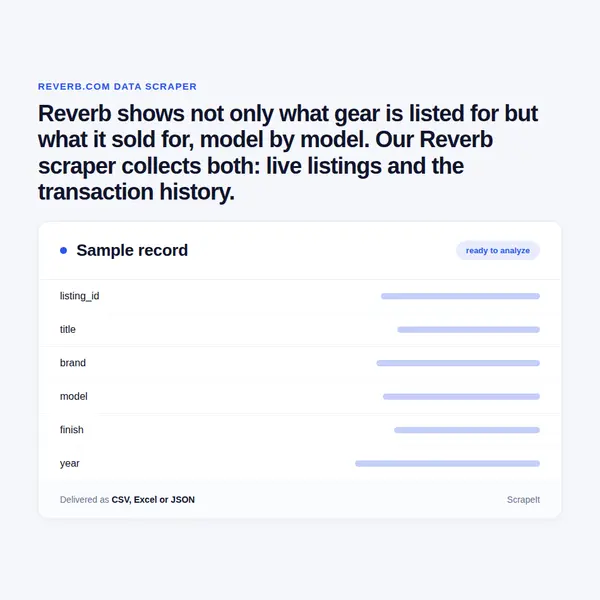
Reverb shows not only what gear is listed for but what it sold for, model by model. Our Reverb scraper collects both: live listings and the transaction history.
Plans from €169 a month · Free project assessment · Reply within 1 business day
CSV · Excel · JSON · XML · FTP · SFTP · Amazon S3 · Google Cloud
API, JSON feed or CSV, XLSX and JSON files
ScheduleOne-time, monthly, weekly, daily or 3 times a day
Reverb pages, filters, fields and a schedule
Built, monitored and repaired by our team
API, JSON feed or CSV, XLSX and JSON files
You decide which part of Reverb matters: a category such as effects pedals or archtop guitars, a list of brands and models, the conditions worth counting, a price band, and the shipping region and currency your analysis should see. We build the crawler, run it on that scope and repair it whenever Reverb reworks its pages. Reverb builds its search cards and Price Guide panels with scripts, so rendering, pacing, proxy rotation and CAPTCHA handling are part of the service.
The project assessment is free, a sample extract shows the real columns before you commit, and field documentation travels with every delivery. Runs can be a one-off pull or a schedule you set - daily to catch price drops and new Transaction History rows, weekly for market studies.
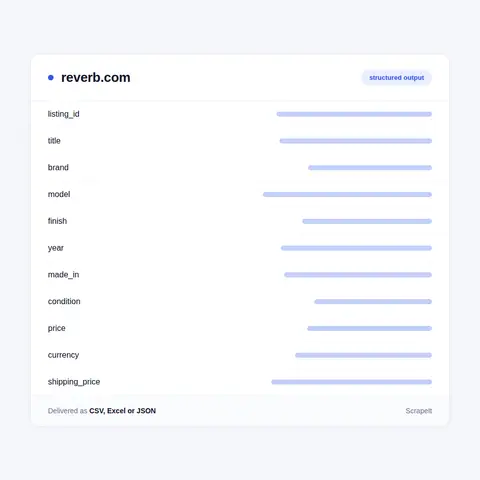
A Reverb listing lives at reverb.com/item/ followed by a numeric id and a slug written from the title; the id is the key we keep from run to run. Every row is one listing, read the way a visitor sees it:
Many sellers are individual musicians. Their usernames, profile links and photos of themselves are personal data, so we leave them out by default and keep the gear, its price and the seller's country.
A listing matched to a catalogue model links to its Reverb product page at reverb.com/p/ plus a make-and-model slug. That page gathers the live listings of that model, a Product Specs block, an editorial overview, product reviews and the Reverb Price Guide panel - the part that holds the sold prices. The panel gives an Estimated Price Range based on a stated number of orders in Good to Mint condition, a Price History graph by month, and a Transaction History table with the date, condition and final price of each recorded sale in used condition. A model filter narrows it to one variant, such as a label or a production run.
Reverb's own notes explain how to read them: the figures exclude Brand New, B Stock, Fair, Poor and Non-functioning items, prices exclude shipping and tax, and the estimate rests on US sales prices even when it is displayed in another currency. We keep each transaction as its own row, tied to the product and variant, and refresh the table on schedule so new sales are added as they appear.
To track Reverb price drops, repeated runs re-read listings by id and log every change of price and status. Coverage of live stock follows Reverb's search filters: category, condition, brand, price, decade, year, country of origin, seller location, Ships To, and the Find a Deal options Accepts Offers, On Sale and Free Shipping.
Reverb is a marketplace for new, used, vintage and rare music gear: guitars and basses, pedals and amplifiers, keyboards and synths, drums, recording and live sound equipment. It holds no stock of its own. Every item is listed by a seller, from a musician selling a spare pedal to a guitar dealer, a music store or a brand's own shop.
Condition is its core vocabulary. Brand New is reserved for authorised dealers and makers of handmade gear, B-Stock covers opened, returned and demo units, and used gear is graded from Mint down to Non-functioning, with the definition of the grade printed on the listing itself. Three page types matter for data: the listing; the product page, which groups the listings of one make and model and carries the Price Guide; and the shop, with its location, policies and seller reviews.
Reverb sells to buyers worldwide from one catalogue. On a first visit it sets a shipping region and a currency from the visitor's location - prices in zloty for a visitor in Poland, for example - and locale paths such as reverb.com/uk/ or reverb.com/ca/ open the same listings. A listing without a shipping rate for the chosen region says so, and the Ships To filter decides what a search returns.
Delivery: CSV, JSON or XLSX files, our API or a JSON feed. MCP server on request.
Full plan detailsReverb publishes what gear actually sold for, model by model, next to the live asking prices. That pairing turns its pages into a working price reference for used music gear.
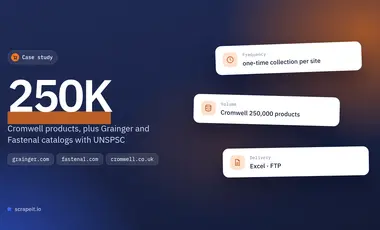
Full MRO catalogs from Grainger, Fastenal and Cromwell for a product content company: UNSPSC, EAN, every attribute and a taxonomy sheet.
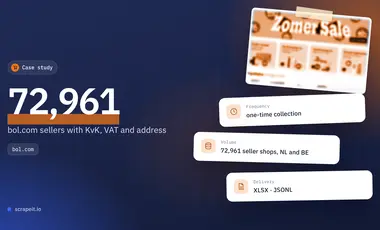
Every seller shop on bol.com with its trade name, business address, KvK and VAT number, collected once: 72,961 shops in 18 days.
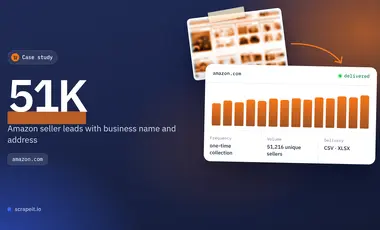
A one-time B2B lead file from Amazon seller profiles: 51,216 sellers with business name and address, 13,366 of them in the US and Canada.
Learn how to use web scraping to solve data problems for your organization
If you sell online, run a marketplace, or advise e-commerce clients, you already know why eBay matters: it’s one of the few places where big retailers compete side by side with thousands of small merchants and private sellers.
E-commerce teams do not just need “some” competitor data anymore. They need a continuous stream of real prices, discounts, stock levels, reviews, and seller behavior from the platforms that actually shape their markets.
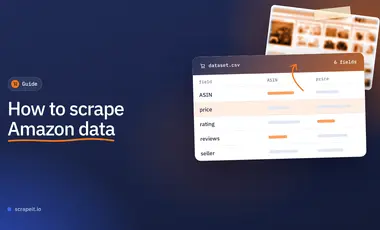
Amazon provides valuable information gathered in one place: products, reviews, ratings, exclusive offers, news, etc. So scraping data from Amazon will help solve the problems of the time-consuming process of extracting data from e-commerce.

ScrapeIt is a managed web scraping service: we build, run and maintain the crawlers and deliver the data, so nobody on your team writes or babysits scraping code. Marketplaces where every listing is a single item from a different seller need constant upkeep, and Reverb is a clear case - condition grades to normalise, a sold-price record to keep, listings that drop in price or sell. Personal data is processed under GDPR and we never profile individual sellers. Plans start from EUR 169 a month, or EUR 199 for a one-time extract.
Still unsure? Write to info@scrapeit.io
Yes. The ScrapeIt Reverb API returns listing id, brand, model, condition, price, shipping cost and the Transaction History rows of each product as JSON from an endpoint we host, refreshed on the schedule you set. The same data also comes as CSV or XLSX files, a JSON feed or straight into your database.
Yes. Listings, product pages with their Price Guide panel and the shop details of dealers are shown to any visitor without an account. We collect only publicly available data - everything a visitor can see on Reverb - and we collect it legally. Private sellers' usernames and photos stay out of the rows by default.
Yes. A scheduled run re-reads the listings you follow, records each price drop with the original and the new price, and notes when a listing sells, because its page then reads "That listing sold". For the price actually paid, the product's Transaction History is the better source, since an accepted offer can close below the asking price.
They come from the Transaction History on each Reverb product page: one line per recorded sale of a used item, with its date, condition and final price. Above it, the Estimated Price Range states how many orders it is based on and covers Good to Mint condition. Reverb notes that the estimate uses US sales prices and that its figures leave out shipping and tax.
Any that a visitor can choose. Reverb shows prices and shipping costs for the chosen shipping region and currency, and its Ships To filter limits a search to gear that ships there, so we fix both per run - United States with US dollars, or United Kingdom with pounds - and store them on every row. For cross-border studies we repeat the same slice under several regions and join the rows on the listing id.
You share your needs, expectations, and desired timeframe. We'll suggest the best solution based on your request and budget.
Our specialists configure the crawlers and extract a sample dataset for your review before proceeding with the full-scale extraction.
Once you approve the sample, we launch the project and start full data collection. We gather, filter, and structure the data for easy use, delivering it on time in your preferred format.
Our team manages ongoing processes, monitors website changes, and supports all data extraction cycles. We can also help integrate data into your systems or create dashboards to simplify analysis.
Tell us which sites, which fields and how often. A couple of lines is enough to start.
Reverb data from €169/month. Free project assessment, reply within 1 business day.