eBay Data: 1.9M Auto Parts Listings from eBay.de, Specs Translated
About 1.9 million auto parts listings from eBay.de with brand, OEM, EAN and fitment, plus titles and specs machine-translated for the client's team.
Learn More
One seed variety on True Leaf Market is sold as a packet, an ounce, a pound and a 25 lb sack, and the price per ounce is never the same twice. We collect all of it.
Plans from €169/month · Free project assessment · Reply within 1 business day
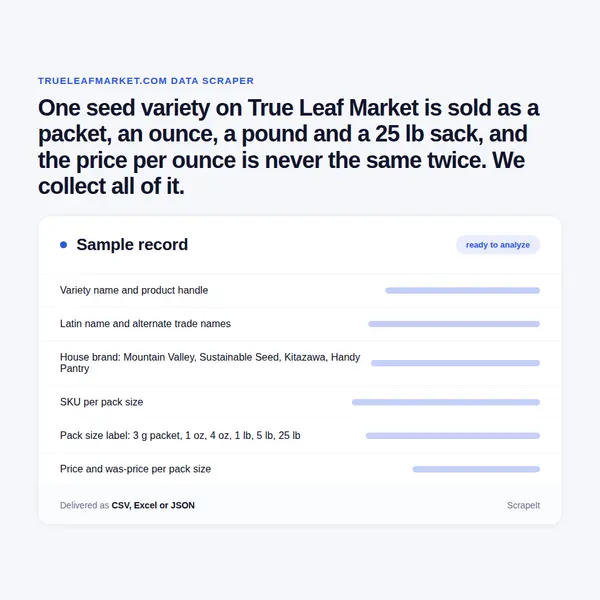
We build and run the True Leaf Market scraper as a managed job. You name the categories, the varieties or the whole catalogue; we design the schema, write the crawl, run it weekly, daily or by season, and hand back clean rows. Anti-bot handling, proxy rotation and CAPTCHA solving are part of the service, so access is our problem rather than yours.
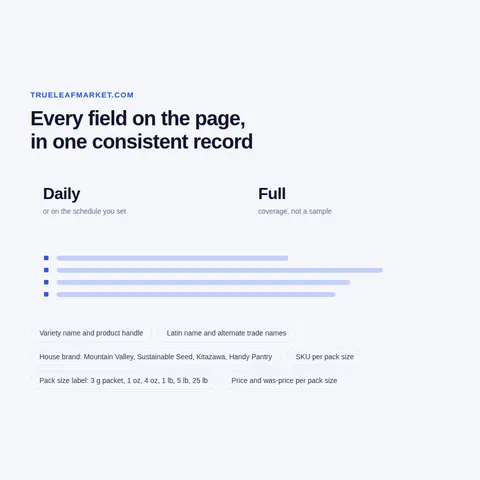
Delivery is CSV, JSON, Excel, a feed into your warehouse or an endpoint we host. The usual shape is a variety table and a pack-size table joined on the handle, plus a category table and a collection date on every row so price history accumulates instead of overwriting itself. We take only what any visitor sees; buyer names attached to reviews are personal data and we leave them out by default.
A seed row is not a clothing row with different labels. Each variety page carries two attribute tables, Basic product information and Growing information, and the field set changes with what the seed is for.
All of it is on the public page. We extract True Leaf Market attributes into one flat table with a column per attribute, which is the shape a category manager can sort.
Seed retail runs on a calendar and the catalogue shows it. There are 48 planting collections built as month crossed with zone band - seeds to plant in September for zones 7b to 9a, in October for zones 1 to 7a, and so on round the year - so a crawl in March and a crawl in October return different front rows, different promoted varieties and different stock. Availability moves with them: the vegetable filter currently counts about 305 items out of stock beside 2,013 in stock, and in the clearance collection more are gone than remain. A dataset built once in spring describes spring.
Clearance is its own signal. When a lot tests below the germination standard set by the USDA and the state of Utah, the company marks it down, labels it low germ and moves it to a clearance collection under a separate handle, with the tested rate written into the copy - a kale lot there reads 73 percent germination, non-refundable, and links back to the full-price page. Overstock deals sit in a second discount collection for high-germination surplus. Track those two and you are watching inventory pressure rather than marketing.
What the variety page does not carry: the germination result for the lot in your hand. That lives behind a lot-number lookup, and packing year and seed treatment are not published as fields at all. We do not invent them.
True Leaf Market is a Salt Lake City seed house selling since 1974, and it runs its own storefront rather than a rented shop template. Stock goes out under house labels - Mountain Valley Seed Company, Sustainable Seed Company, Kitazawa Seed Company, Handy Pantry - and the label travels with the item as a brand field. The catalogue splits into gardening, microgreens, sprouting, wheatgrass, cover crops, flower bulbs, live plants, mushroom kits, growing kits and garden supplies, with free growing guides and recipes alongside. As of September 2026 the site map currently lists roughly 4,043 item pages, about 727 category pages and around 884 articles.
Addresses are flat and stable. A variety sits at /products/cucumber-ashley, a category at /collections/vegetable-garden-seed, and a pack size is a query on the item address, ?variant=38926624264. No numeric id appears in the path, so the handle is the join key - and a discounted lot gets a handle of its own, which is why kale-lacinato-seeds and kale-seeds-lacinato-clearance-seeds are two pages for the same variety. Listings page with ?page=N and the ladder ends: the vegetable category stops at page 50 with about 25 tiles on each. Ask for page 51 and the site quietly returns page one instead of an error, which is how a naive crawl collects the same rows forever. Since the Vegetable filter alone currently counts 2,318 items, paging a category end to end does not reach all of it. Coverage comes from the facets and the item map instead.
Get a Quote
Developers

Customers worldwide

Pages extracted

Hours saved for our clients
€199 / one-time
setup fee - included
€169 / mo
setup fee €499
€229 / mo
setup fee €499
€349 / mo
setup fee €499
€549 / mo
setup fee €799
Delivery: CSV, JSON or XLSX files, our API or a JSON feed. MCP server on request.
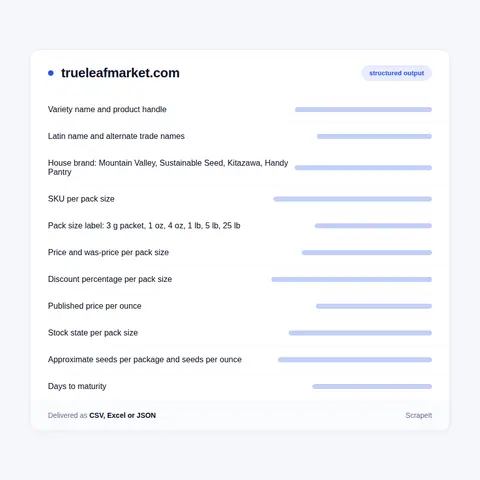
Full plan details →Here is what makes True Leaf Market price data unlike an electronics feed. The same seed is sold in four to six pack sizes, and the cost per unit weight collapses as the pack grows. Ashley cucumber runs from 5.34 dollars an ounce in the one-ounce size down to 0.51 at twenty-five pounds. Bhut Jolokia ghost pepper is offered from 45 mg up to a pound, and its ounce price falls from the thousands to about 104 dollars. A sticker of 2.99 against a sticker of 20.11 says nothing until both are divided by grams.
The site does part of that arithmetic itself, printing a per-ounce figure and a save percentage on each size button, but only inside one variety. Nobody publishes the cross-variety table, and nobody publishes it against your own price list. That is the table buyers ask us for: variety, page address, pack size, price, price per gram, seeds per pack, category, sub-category, sowing method, sun or shade, life cycle, days to maturity and hardiness zone, one row per size.
With it a seed company can see where its packet price sits against the same variety elsewhere, which sizes a rival offers and which it skips, whether the bulk discount ladder is steeper or flatter, and which varieties are carried at all. Assortment gaps show up as absent rows, and that is often the more useful finding.

About 1.9 million auto parts listings from eBay.de with brand, OEM, EAN and fitment, plus titles and specs machine-translated for the client's team.
Learn More
A one-off Takealot product list for an entrepreneur choosing niches: only products rated 4 stars or higher with at least 50 reviews.
Learn More
Trendyol product data for an e-commerce startup reselling Turkish fashion: 27 categories in JSON on FTP, with in-stock status for every size.
Learn MoreLearn how to use web scraping to solve data problems for your organization

If you sell online, run a marketplace, or advise e-commerce clients, you already know why eBay matters: it’s one of the few places where big retailers compete side by side with thousands of small merchants and private sellers.

E-commerce teams do not just need “some” competitor data anymore. They need a continuous stream of real prices, discounts, stock levels, reviews, and seller behavior from the platforms that actually shape their markets.
Amazon provides valuable information gathered in one place: products, reviews, ratings, exclusive offers, news, etc. So scraping data from Amazon will help solve the problems of the time-consuming process of extracting data from e-commerce.
ScrapeIt owns the pipeline so nothing lands on your desk. There is no software to install and no dashboard to watch: our engineers write the crawler, follow the site as it turns over between seasons, and repair the job before a column empties on your side.
A sample cut of real rows for the varieties you care about arrives before anything is signed, so the schema is agreed on data you can open rather than on a promise. After that it is files or an endpoint on a schedule, and a named engineer who answers when something changes shape.
Yes. The ScrapeIt True Leaf Market API returns variety name, Latin name, days to maturity, hardiness zone and the price, stock and price per ounce of every pack size as JSON from an endpoint we host, refreshed on the schedule you set. The same data also comes as CSV or Excel files or straight into your database.
We deliver variety name, handle, page address, Latin name, alternate names, brand, SKU, category path, badges, description, images, rating and review count, then the growing block: days to maturity, days to germination, seeding depth, plant and row spacing, height, spread, growth habit, soil, temperature, light requirement, hardiness zones, life cycle, direct sow, start indoors. For microgreens and sprouts you also get presoak, medium, seeding rate per tray, blackout time and harvest window. Per pack size: SKU, price, was-price, discount, stock and price per ounce. Not published: lot germination results, packing year, seed treatment and any wholesale cost.
By normalizing to weight and to seed count. Every size is delivered as its own row with its own price, and we add a price per gram and, where the description gives approximate seeds per package or seeds per ounce, a cost per thousand seeds. Without that step the numbers are not comparable: on a single ghost pepper page the smallest sachet and the one-pound bag differ by more than thirtyfold per ounce. The site prints a per-ounce figure inside one variety only, so the cross-variety and cross-vendor comparison has to be built in the dataset.
More often than most categories, because this one has a season. Planting collections are organised by month and hardiness zone band, promotions rotate with the sowing calendar, and hundreds of items move between in stock and out of stock across the year, with clearance lots appearing and selling out quickly. Weekly is the common cadence for price and stock; monthly is enough for descriptive attributes such as spacing or zone, which rarely move. Each row carries the date it was collected, so trends survive the refresh.
Yes. We take the public variety pages: variety name, Latin name, growing information, every pack size with its price and stock, badges, rating and review count. We collect only publicly available data - everything a visitor can see on True Leaf Market - and we collect it legally. We never take personal data.
Step 1 - Make a Request
You share your needs, expectations, and desired timeframe. We’ll suggest the best solution based on your request and budget.
Step 2 - Configuring Custom Web Crawlers
Our specialists configure the crawlers and extract a sample dataset for your review before proceeding with the full-scale extraction.
Step 3 - Collect and Deliver
Once you approve the sample, we launch the project and start full data collection. We gather, filter, and structure the data for easy use, delivering it on time in your preferred format.
Step 4 - Maintain and Support
Our team manages ongoing processes, monitors website changes, and supports all data extraction cycles. We can also help integrate data into your systems or create dashboards to simplify analysis.
True Leaf Market data from €169/month. Free project assessment, reply within 1 business day.

Scrapeit Sp. z o.o.
10/208 Legionowa str., 15-099, Bialystok, Poland
KRS: 0000996672
NIP: 5423457175
REGON: 523384582