Grainger Data: 3 MRO Catalogs with UNSPSC, 250K Products from Cromwell
Full MRO catalogs from Grainger, Fastenal and Cromwell for a product content company: UNSPSC, EAN, every attribute and a taxonomy sheet.
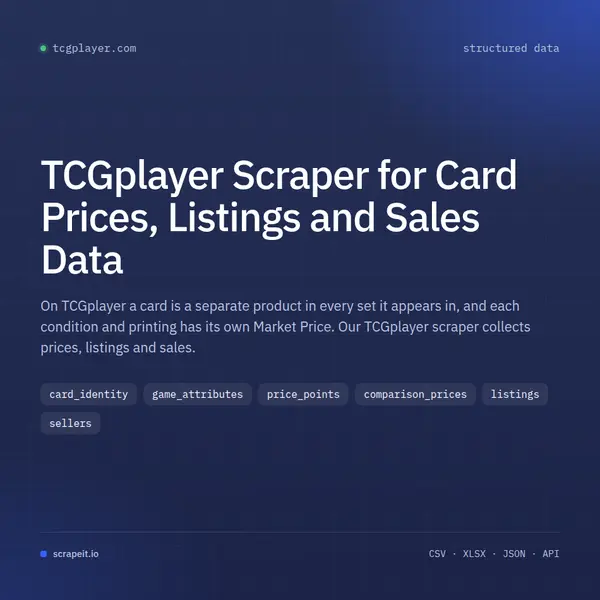
On TCGplayer a card is a separate product in every set it appears in, and each condition and printing has its own Market Price. Our TCGplayer scraper collects prices, listings and sales.
Plans from €169 a month · Free project assessment · Reply within 1 business day
CSV · Excel · JSON · XML · FTP · SFTP · Amazon S3 · Google Cloud
API, JSON feed or CSV, XLSX and JSON files
ScheduleOne-time, monthly, weekly, daily or 3 times a day
TCGplayer pages, filters, fields and a schedule
Built, monitored and repaired by our team
API, JSON feed or CSV, XLSX and JSON files
TCGplayer web scraping is delivered as a service: you set the scope and receive the data. The scope starts from a product line - Magic: The Gathering, Pokemon, Yu-Gi-Oh!, One Piece - narrowed to sets, to a list of product ids or to the inventory of chosen sellers, plus the conditions and printings you care about.
Writing the crawlers, running them and repairing them after site changes is our side. A TCGplayer product page assembles its prices and its listing table in the browser after loading, so rendering, pacing, proxy rotation and anti-bot handling are our job, not yours. When we scrape data from TCGplayer the Ship to Country setting is fixed per project, because it decides which listings appear. Delivery is a one-off file or a schedule, in CSV, Excel or JSON.
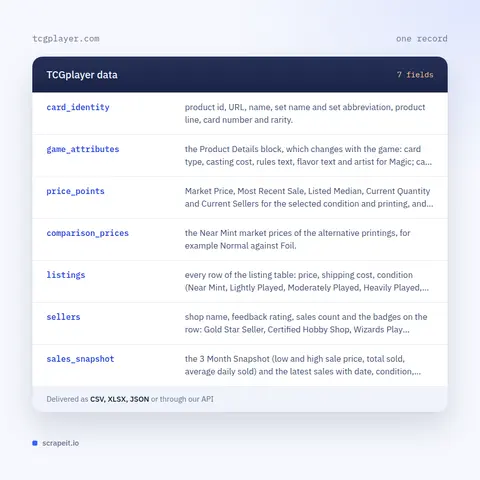
Our TCGplayer data scraper works from the product id, the number that follows /product/ in every product address. One id is one card in one set - a search for Sol Ring returns a separate product for each set it was printed in - or one sealed item. Per id we extract:
Search results give a lighter row per product - set, rarity, number, listing count, lowest price and Market Price - and the Price Guide lists a whole set with printing, condition, rarity, number and Market Price, singles and sealed products in separate tables.
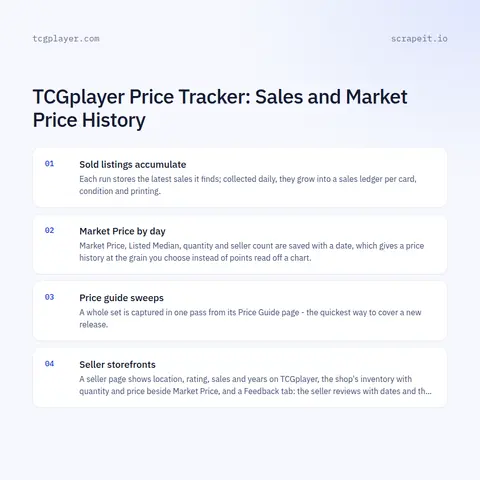
The product page draws a Market Price History chart over one, three, six or twelve months and lists the latest sales. For a visitor who is not signed in that list is short - a handful of the most recent sales. We never log in, so a TCGplayer price tracker is built the other way - by reading the public figures on a schedule and keeping every reading.
Seller feedback is signed with masked buyer handles. We treat those as personal data and leave them out by default.
TCGplayer is a marketplace for collectible trading card games and describes itself as an eBay company. The cards are listed by local game stores and independent sellers, and some listings are marked as fulfilled by TCGplayer Direct. All prices are shown in US dollars, and a Ship to Country selector decides which listings and shipping costs a visitor sees.
The catalogue is a strict hierarchy. At the top are product lines: Magic: The Gathering, Yu-Gi-Oh!, Pokemon in separate English and Japanese lines, Disney Lorcana, One Piece Card Game, Digimon, Star Wars: Unlimited, Flesh and Blood and dozens of smaller games, with supplies, Funko and miniatures alongside. Each line is divided into sets, each set into products, and a product is either a single card as it was printed in that set or a sealed item such as a booster box.
The figure everything else hangs on is Market Price, which TCGplayer describes as based on thousands of daily transactions. It is quoted per product, per condition and per printing, so a Near Mint foil and a Lightly Played non-foil of the same card are two different price series. A dataset that drops condition or printing has merged prices the site itself keeps apart.
Delivery: CSV, JSON or XLSX files, our API or a JSON feed. MCP server on request.
Full plan detailsA card on TCGplayer has no single price. It has a Market Price, a lowest listing, a median and a most recent sale, each split by condition and printing. A TCGplayer price scraper puts all of them into your own systems.
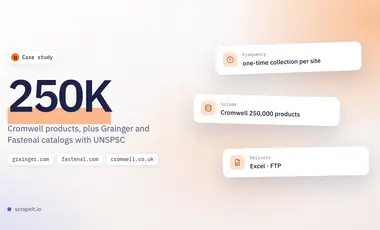
Full MRO catalogs from Grainger, Fastenal and Cromwell for a product content company: UNSPSC, EAN, every attribute and a taxonomy sheet.
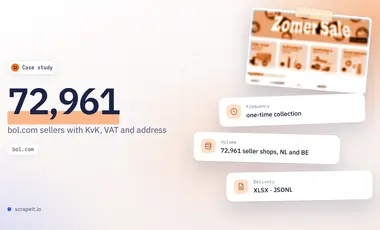
Every seller shop on bol.com with its trade name, business address, KvK and VAT number, collected once: 72,961 shops in 18 days.
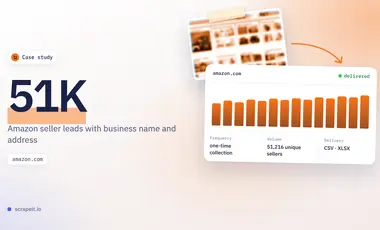
A one-time B2B lead file from Amazon seller profiles: 51,216 sellers with business name and address, 13,366 of them in the US and Canada.
Learn how to use web scraping to solve data problems for your organization

If you sell online, run a marketplace, or advise e-commerce clients, you already know why eBay matters: it’s one of the few places where big retailers compete side by side with thousands of small merchants and private sellers.

E-commerce teams do not just need “some” competitor data anymore. They need a continuous stream of real prices, discounts, stock levels, reviews, and seller behavior from the platforms that actually shape their markets.
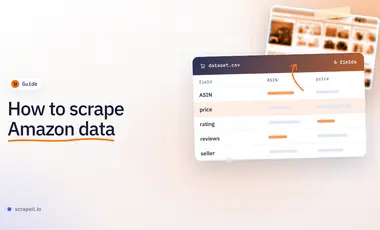
Amazon provides valuable information gathered in one place: products, reviews, ratings, exclusive offers, news, etc. So scraping data from Amazon will help solve the problems of the time-consuming process of extracting data from e-commerce.

ScrapeIt collects web data as a managed service. We design the crawl, operate it, keep it working and deliver the dataset on your schedule, with documentation for every field.
Collectibles marketplaces such as TCGplayer reward precision over volume: one card name covers many versions, and a price means nothing without its condition. We keep product id, set, card number, condition and printing as separate columns in every row, so the prices join to your own catalogue without guesswork. Name the games and sets you follow; we assess the project free of charge and can cut a sample from real rows.
Still unsure? Write to info@scrapeit.io
Yes. The ScrapeIt TCGplayer API returns product id, card name, set, card number, condition, printing, Market Price, Listed Median and the lowest listing with shipping as JSON from an endpoint we host, refreshed on the schedule you set. We can also send the same rows as CSV or XLSX files, publish them as a JSON feed or load them into your database.
Yes. Product pages, search results, price guides, listing tables and seller storefronts on tcgplayer.com can be read by anyone who opens the site. We collect only publicly available data - everything a visitor can see on TCGplayer - and we collect it legally. The longer sales history shown to signed-in members stays out, because we do not log in.
TCGplayer states that all prices are shown in US dollars, and we deliver them in USD exactly as displayed. Shipping is a separate column, because it depends on the seller and on the Ship to Country setting. Every row carries the currency code, so converting to CAD on your side is a single step.
Yes. A TCGplayer dataset can be a single set, a full product line such as Pokemon or Lorcana, a list of product ids or the inventory of chosen sellers. Singles and sealed products are kept apart, and Japanese Pokemon is a separate line from English. Sets released later can be added to a running project.
It goes back to the first run of your project. Without signing in, a visitor sees only the latest few sales and a three-month summary for each card, so we store those on every run and the record grows from there. Daily runs give the fullest ledger for cards that sell several times a day.
You share your needs, expectations, and desired timeframe. We'll suggest the best solution based on your request and budget.
Our specialists configure the crawlers and extract a sample dataset for your review before proceeding with the full-scale extraction.
Once you approve the sample, we launch the project and start full data collection. We gather, filter, and structure the data for easy use, delivering it on time in your preferred format.
Our team manages ongoing processes, monitors website changes, and supports all data extraction cycles. We can also help integrate data into your systems or create dashboards to simplify analysis.
Tell us which sites, which fields and how often. A couple of lines is enough to start.
TCGplayer data from €169/month. Free project assessment, reply within 1 business day.