Formula 1 Scraper for Results, Timing and Standings Data

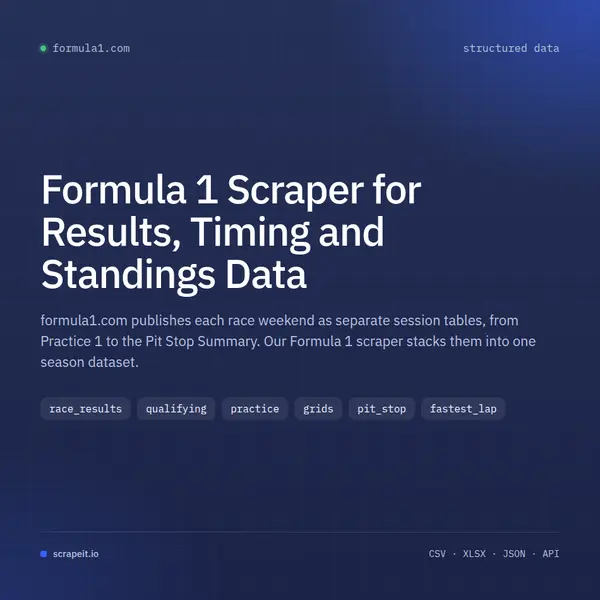
formula1.com publishes each race weekend as separate session tables, from Practice 1 to the Pit Stop Summary. Our Formula 1 scraper stacks them into one season dataset.

Plans from €169 a month · Free project assessment · Reply within 1 business day

CSV · Excel · JSON · XML · FTP · SFTP · Amazon S3 · Google Cloud

formula1.com
Formula 1 Scraper for Results, Timing and Standings Data
formula1.comwhat you get
Typical fields for sports sites
leaguehome_teamaway_teamstart_timescoreodds
Delivery

API, JSON feed or CSV, XLSX and JSON files

Schedule

One-time, monthly, weekly, daily or 3 times a day

Scrape Formula 1 results as a managed service

  1. You send

    Formula 1 pages, filters, fields and a schedule

  2. We run the scrapers

    Built, monitored and repaired by our team

  3. You receive the data

    API, JSON feed or CSV, XLSX and JSON files

You tell us which seasons and which session tables you need; we run the Formula 1 scraper and deliver the files. A typical brief is the current season kept up to date round by round, or an archive build covering many seasons in one extract. We map every weekend by its race id, pick up practice, sprint and qualifying tables as they fill, and collect race result, pit stops and fastest laps once the chequered flag falls. Anti-bot handling, pacing, proxy rotation and page rendering are included, as is the repair work when the site changes its layout between seasons. Output is CSV, Excel or JSON on a fixed schema, and documentation for each column comes with the first delivery.

Formula 1 data from every session table

Each session is its own table under an address such as /en/results/2025/races/1256/japan/qualifying. The numeric race id in that path is the join key for a weekend, while the three-letter driver abbreviation (VER, NOR, PIA) and the car number tie a driver's rows together across sessions.

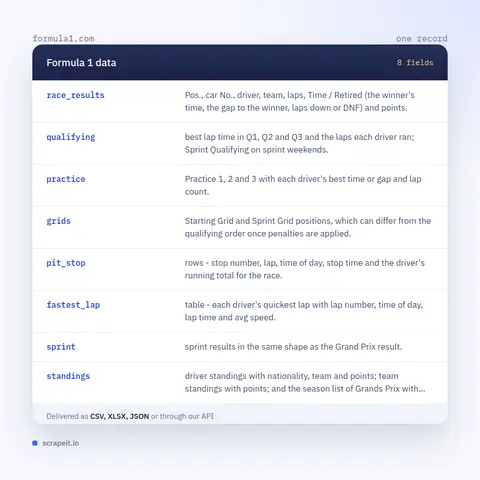
  • Race results - Pos., car No., driver, team, laps, Time / Retired (the winner's time, the gap to the winner, laps down or DNF) and points.
  • Qualifying - best lap time in Q1, Q2 and Q3 and the laps each driver ran; Sprint Qualifying on sprint weekends.
  • Practice - Practice 1, 2 and 3 with each driver's best time or gap and lap count.
  • Grids - Starting Grid and Sprint Grid positions, which can differ from the qualifying order once penalties are applied.
  • Pit stop rows - stop number, lap, time of day, stop time and the driver's running total for the race.
  • Fastest lap table - each driver's quickest lap with lap number, time of day, lap time and avg speed.
  • Sprint - sprint results in the same shape as the Grand Prix result.
  • Standings - driver standings with nationality, team and points; team standings with points; and the season list of Grands Prix with date, winner, team, laps and race time.

Every table becomes one row per driver per session, with season, round, race id and session type attached, so a whole season sits in one long table you can filter by session.

Formula 1 data from every session table
Building a Formula 1 results database

Building a Formula 1 results database

Session tables are the core. The rest of formula1.com adds the context a timing sheet lacks.

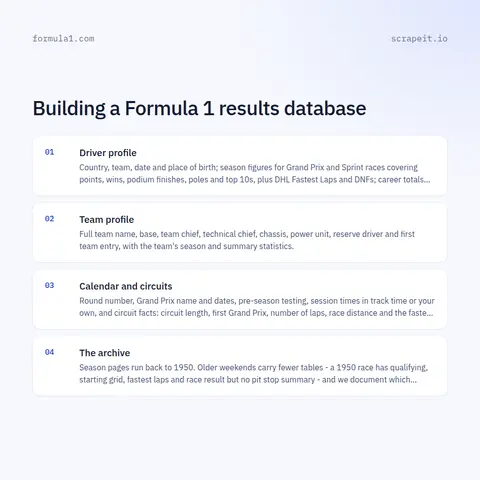
  • Driver profilecountry, team, date and place of birth; season figures for Grand Prix and Sprint races covering points, wins, podium finishes, poles and top 10s, plus DHL Fastest Laps and DNFs; career totals for Grands Prix entered, career points, highest race finish, highest grid position, pole position count and World Championship titles.
  • Team profilefull team name, base, team chief, technical chief, chassis, power unit, reserve driver and first team entry, with the team's season and summary statistics.
  • Calendar and circuitsround number, Grand Prix name and dates, pre-season testing, session times in track time or your own, and circuit facts: circuit length, first Grand Prix, number of laps, race distance and the fastest lap time with its driver and year.
  • The archiveseason pages run back to 1950. Older weekends carry fewer tables - a 1950 race has qualifying, starting grid, fastest laps and race result but no pit stop summary - and we document which columns exist for each era.
  • Change over a seasonprofile figures and standings are always current totals, so scheduled runs keep a dated copy after each round and the championship fight becomes a series rather than a final table.

How formula1.com is organised

Source
formula1.com
Category
sports sites
Delivery
API, JSON feed, CSV, XLSX
Plans
From €169 a month
Get a quote

formula1.com calls itself the official home of Formula 1 racing. Schedule, results, standings, driver and team pages, news and video sit under one main menu: Schedule, Results, Standings, Drivers and Teams, with Store, Tickets, Hospitality, F1 TV and sign-in in the bar above.

Results is the section that matters for data. A year selector comes first, then a choice of Races, Drivers, Teams or Awards, then a single Grand Prix. Open a race and a session strip lists everything held that weekend: Practice 1 to 3 on a standard weekend, or Practice 1, Sprint Qualifying, Sprint Grid and Sprint on a sprint weekend, followed by Qualifying, Starting Grid, Pit Stop Summary, Fastest Laps and Race Result.

Identifiers are built into the paths: a numeric race id with the country slug for each weekend, and for drivers a code such as LANNOR01 in their season results address. In the tables a driver shows as a full name with a three-letter abbreviation, and a team under its entry name, so the Team column reads McLaren or Red Bull Racing.

F1 TV is a subscription product. The results, standings, profiles and calendar described here are open to every visitor, and that open layer is what we collect.

25Developers
500+Customers
1.5BPages extracted
15,000+Hours saved for our clients

Formula 1 scraping plans and pricing

Airplane

€199one-time

Setup fee included

100,000
One-time
Up to 5 days
7 days

Helicopter

€169/ mo

Setup fee €499

250,000
Monthly
Up to 5 days
14 days

Glasses

€229/ mo

Setup fee €499

1,000,000
Weekly
Up to 5 days
30 days

Microscope popular

€349/ mo

Setup fee €499

2,000,000
Daily
Same day
60 days

DNA

€549/ mo

Setup fee €799

3,000,000
3 times daily
Same day
90 days

Delivery: CSV, JSON or XLSX files, our API or a JSON feed. MCP server on request.

Full plan details

What a Formula 1 statistics database is used for

Formula 1 timing is precise to the thousandth of a second and published in the same layout every weekend, so one season compares cleanly with the next.

  • Performance analysisQ1 to Q3 times, practice gaps and fastest laps with average speed show relative car pace across the season, circuit by circuit.
  • Strategy studiesPit stop laps and stop times set against finishing positions show how races were won on strategy at each track.
  • Media and broadcast graphicsGrids, results and standings feed newsroom tables, previews and on-screen graphics.
  • Fantasy gamesPoints, DNFs, grid-to-finish changes and sprint results score fantasy line-ups week by week.
  • Historical researchResults from the first championship season onward and career totals such as podiums, poles and titles support long-run comparisons of drivers, teams and eras.
  • Partner reportingPoints and finishing positions per team, round by round, put a number on the on-track season a sponsor backed.

About ScrapeIt

ScrapeIt builds and runs crawlers for teams that need data without operating scrapers themselves. Formula 1 is a calendar job: tables fill session by session over a race weekend, so we time runs to the weekend schedule and check again once the classification is final. You get a free project assessment, a sample and documentation for every field. Runs can be one-off, weekly or tied to each Grand Prix.

FAQ

Still unsure? Write to info@scrapeit.io

Do you offer a Formula 1 API for results and timing?

Yes. The ScrapeIt Formula 1 API returns race results, Q1 to Q3 times, pit stops, fastest laps with average speed and championship points as JSON from an endpoint we host, updated on the schedule you choose. The same tables are also available as CSV or Excel files, through a JSON feed, or loaded into your database.

Is it legal to scrape Formula 1?

Yes. Results, standings, session tables, driver and team profiles and the race calendar are published openly on formula1.com. We collect only publicly available data - everything a visitor can see on Formula 1's website - and we collect it legally. Drivers appear in their sporting role, and their names and results are the data.

How far back do Formula 1 results go?

The season selector on formula1.com reaches back to 1950. Recent seasons carry the full set of session tables, while early ones hold fewer - the 1950 British Grand Prix has qualifying, starting grid, fastest laps and race result. We list the available tables per season before the extract starts.

Can you get Formula 1 pit stop data for every race?

For every race where the Pit Stop Summary is published, yes. Each row holds the stop number, car number, driver, team, lap, time of day, stop time and the driver's running total, and joins to the race result through the race id and the driver abbreviation.

How soon after a Grand Prix is the dataset updated?

We schedule passes around the weekend: practice and qualifying tables after each session, then race result, fastest laps and pit stops once the race ends, and a later pass to pick up any change to the classification. Standings and profile totals are refreshed in the same run.

How it works

  1. 1

    Make a request

    You share your needs, expectations, and desired timeframe. We'll suggest the best solution based on your request and budget.

  2. 2

    We configure the crawlers

    Our specialists configure the crawlers and extract a sample dataset for your review before proceeding with the full-scale extraction.

  3. 3

    Collect and deliver

    Once you approve the sample, we launch the project and start full data collection. We gather, filter, and structure the data for easy use, delivering it on time in your preferred format.

  4. 4

    Maintain and support

    Our team manages ongoing processes, monitors website changes, and supports all data extraction cycles. We can also help integrate data into your systems or create dashboards to simplify analysis.

Request a quote

Tell us which sites, which fields and how often. A couple of lines is enough to start.

  • We reply within 1 business day
  • A sample dataset before the full run
  • We sign an NDA on request
  • Delivery by API, JSON feed or files
Which sites, which fields, how often. A couple of lines is enough.

This form is protected by Google reCAPTCHA, which loads when you start filling it in; the Google Privacy Policy and Terms of Service apply. If you prefer not to use it, email us at info@scrapeit.io. Privacy & Cookie Policy

We reply within 1 business day. No obligation.

Formula 1 data from €169/month. Free project assessment, reply within 1 business day.