Spotify Scraper for Artist, Track and Playlist Data

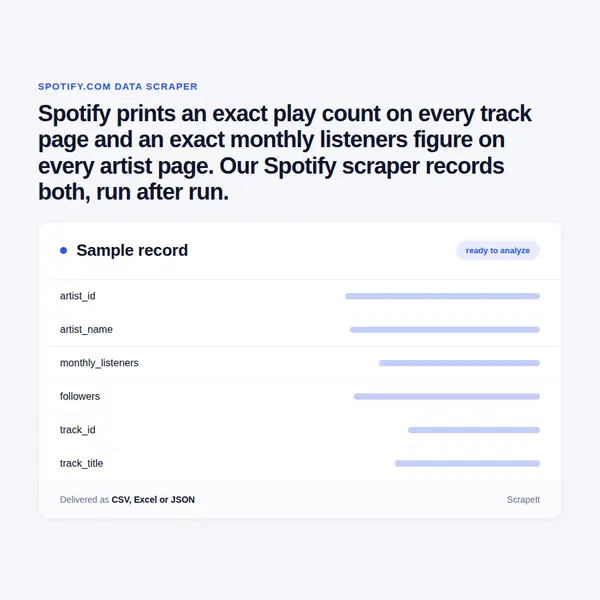
Spotify prints an exact play count on every track page and an exact monthly listeners figure on every artist page. Our Spotify scraper records both, run after run.

Plans from €169/month · Free project assessment · Reply within 1 business day

Spotify Scraper
Solutions

How the Spotify Data Scraper Service Works

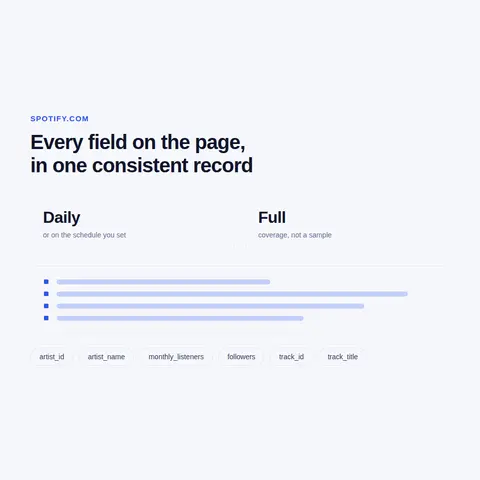
You name the slice of the catalogue: a list of artists, a label's releases, the editorial playlists of a genre, the chart playlists of chosen countries, a set of podcasts. We scrape Spotify through its web player, open.spotify.com. The crawler is ours to build, operate and fix whenever the player is redesigned, and it runs one-off or on a schedule - daily, weekly or on demand.

The player is drawn by scripts and serves a different catalogue per market, so rendering, pacing and country-by-country proxy rotation come with the service. We read catalogue metadata as a visitor without an account sees it: no listening history, no private libraries, no lyrics or full audio. Playlists are taken from Spotify's own editors and from curators such as labels and brands; playlists of private listeners are left out.

Spotify Artist Scraper: Listeners, Albums and Tracks

Each object in the player has a 22-character id in its address - /artist/, /album/, /track/, /playlist/, /show/ or /episode/ followed by the id - and that id is the key of a row. What the pages give a visitor:

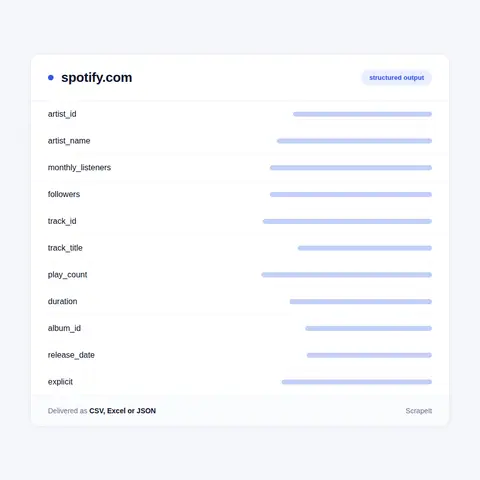
  • Artist - name, artist id, monthly listeners down to the last digit, Followers, the world rank badge where Spotify shows one, the cities with the most listeners and the count for each, the About text, links to social profiles and the Artist pick.
  • Popular tracks - the Popular list in its order, each song with its total play count and duration.
  • Discography - Popular releases, Albums, Singles and EPs and Compilations, each release with its type and year, plus the Appears On and Featuring shelves.
  • Album - title, artists, release date, number of songs, total running time, the track list with disc and track numbers, durations and explicit marks, and the copyright and phonogram lines that name the rights holder.
  • Track - title, every credited artist, album, release date, duration, play count and the explicit mark.
  • Related - Fans also like, Artist Playlists, the playlists and albums an artist is discovered on, music videos and the tracks recommended from a given song.
  • Podcasts - show title, publisher, About text, categories and the star rating with its number of ratings; for each of the episodes, title, date, duration and description.

Tracks credited to several artists are returned with every artist id, so collaborations can be counted from either side, and cover art comes as image addresses. Release dates are kept as full dates where the page states them and as years where it does not. Nothing in these rows describes a listener.

Spotify Artist Scraper: Listeners, Albums and Tracks
Spotify Playlist Scraper: Editorial Lists, Charts and History

Spotify Playlist Scraper: Editorial Lists, Charts and History

Playlists are where the catalogue turns into rankings.

  • Editorial and curated playlists. Title, description, owner, saves, number of songs, total length and the ordered list with artists, album, duration and explicit mark. To scrape a Spotify playlist properly, keep the order: position is the editorial signal.
  • Chart playlists. The Charts hub groups Daily Song Charts - Top 50 for the world and per country - and Weekly Song Charts under the name Top Songs. A Top 50 playlist is updated daily, shows a plays figure beside each track and counts the new entries in its header.
  • Genres. A genre hub such as Pop lists its playlists with follower counts - a map of what Spotify puts forward in each genre.
  • Podcast Charts. Top Podcasts per country with rank, show and publisher.
  • History. Play counts, monthly listeners, followers and saves are shown as today's value only. Read on a schedule and matched by id, they become daily growth curves and chart trajectories.

Chart positions are read from these chart playlists, which open without an account like the rest of the player.

About Spotify and Its Open Web Player

Spotify launched in 2008 as a music streaming service and later added podcasts and audiobooks. The company behind it is Spotify AB, and it reports being available in 184 markets. The part a data buyer can read is the web player, which shows catalogue pages to visitors who are not signed in.

The catalogue we read is a graph of six object types - artist, album, track, playlist, show and episode - linked to one another and each addressed by its own id. Browse pages sit on top of the graph: genre hubs, the Charts hub and the shelves of an artist page.

Three things shape a crawl. Availability is decided per market: where a release or a show is not offered, Spotify answers with a page saying it is not available in your region, so the country a run is read from belongs in the data. The interface language follows the visitor, while names, ids and counters do not. And the counters differ in kind: a play count only grows, while monthly listeners is a moving figure that rises and falls.

Get a Quote
dev_w
25

Developers

customers
500+

Customers worldwide

pages
1 500 000 000+

Pages extracted

stime
15000+

Hours saved for our clients

Plans

Spotify Scraping Plans and Pricing

Airplane

€199 / one-time

setup fee - included

Data limits100,000
Frequencyone-time
Run timeup to 5 days
Data storing7 days

Helicopter

€169 / mo

setup fee €499

Data limits250,000
Frequencymonthly
Run timeup to 5 days
Data storing14 days

Glasses

€229 / mo

setup fee €499

Data limits1,000,000
Frequencyweekly
Run timeup to 5 days
Data storing30 days

DNA

€549 / mo

setup fee €799

Data limits3,000,000
Frequency3 times daily
Run timesame day
Data storing90 days

Delivery: CSV, JSON or XLSX files, our API or a JSON feed. MCP server on request.

Full plan details →

Why Scrape Spotify Catalogue Data

Labels and artists see their own numbers; nobody is handed everyone else's in one table. Building that table - in effect an artist database with a date on each row - is the reason to ask whether you can scrape Spotify at all.

  • A&R and scouting. Monthly listeners and followers tracked weekly across a long list of emerging artists surface the fastest growers before a chart does.
  • Catalogue valuation. Play counts per track, read on a schedule, give the daily stream rate of a catalogue - the input a royalty estimate starts from.
  • Playlist intelligence. Which editorial playlists carry a track, at what position and for how long, and how many saves the playlist has: the basis for pitching and for judging what a placement was worth.
  • Chart monitoring by country. Top 50 entries with their plays figures show where a release breaks first and how it travels between markets.
  • Release tracking. New albums and singles per label or artist with release dates and first-week play counts.
  • Podcast research. Shows by category with star rating, episode cadence and chart rank per country.

Our Blog

Reads Our Latest News & Blog

Learn how to use web scraping to solve data problems for your organization

How Artificial Intelligence Is Used In Web Scraping

How Artificial Intelligence Is Used In Web Scraping

Leveraging advances in technology, the AI-powered web scraper has skyrocketed in demand and is helping to expand capabilities by automating tedious daily tasks and speeding up data collection from thousands of websites several times over.

What is Web Scraping and What is it Used For?

What is Web Scraping and What is it Used For?

Web scraping is a method of obtaining web data by extracting it from pages of web resources with the help of a program, that is, in automatic mode. It is used to syntactically convert web pages into more usable forms.

Web Scraping for Machine Learning

Web Scraping for Machine Learning

If you specialize in machine learning, you need to feed large amounts of data to the algorithms. Web scraping is the easiest and the most efficient method of collecting the data from all over the Internet.

scrapeit logo

About ScrapeIt

ScrapeIt builds and runs web crawlers as a service: you describe the dataset, we deliver it. For streaming catalogues that means long id lists revisited on a fixed clock, because a counter that was not read on the day leaves a hole in the series that nothing fills afterwards.

Before work starts we assess the project free of charge, and a sample can be ordered to check the columns. We never log in and never collect listener data. Plans start from EUR 169 a month, or EUR 199 for a one-time extract.

FAQ

Do you offer a Spotify API for artist and track data?

Yes. The ScrapeIt Spotify API returns artist id, monthly listeners, followers, track id, play count, duration and release date as JSON from an endpoint we host, with access by key, updated as often as you choose. Files in CSV, XLSX or JSONLines and drops to Amazon S3, SFTP or your own database carry the same columns.

Is it legal to scrape Spotify?

Yes. Artist, album, track, playlist and podcast pages of the web player can be opened by anyone, signed in or not. We collect only publicly available data - everything a visitor can see on Spotify - and we collect it legally. Listener accounts, private playlists and whatever sits behind sign-in are never touched.

What does a Spotify charts scraper collect?

The chart playlists of the Charts hub: Top 50 daily charts and Top Songs weekly charts, global and per country, with position, track, artists and - on Top 50 - the plays figure. Podcast Charts add the Top Podcasts ranking per country. Stored run after run, they become a chart history with entry dates, peaks and days on chart.

Does the Spotify podcast scraper cover shows and episodes?

Yes. A show page gives title, publisher, description, categories, the star rating with its number of ratings and the list of episodes; every episode has its own page with title, date, duration and description. Podcasts are available per market, so we read each show from a country where it opens.

How often should play counts and monthly listeners be refreshed?

Daily, if you want growth rates. Spotify displays current totals only, so yesterday's value exists only if it was captured yesterday. Weekly runs are enough for discography and playlist membership, which change slowly, while Top 50 needs a daily pass because the chart is replaced every day.

How does it Work?

Step 1 - Make a Request

You share your needs, expectations, and desired timeframe. We’ll suggest the best solution based on your request and budget.

Step 2 - Configuring Custom Web Crawlers

Our specialists configure the crawlers and extract a sample dataset for your review before proceeding with the full-scale extraction.

Step 3 - Collect and Deliver

Once you approve the sample, we launch the project and start full data collection. We gather, filter, and structure the data for easy use, delivering it on time in your preferred format.

Step 4 - Maintain and Support

Our team manages ongoing processes, monitors website changes, and supports all data extraction cycles. We can also help integrate data into your systems or create dashboards to simplify analysis.

Request a Quote

Tell us more about you and your project information.
Which sites, which fields, how often. A couple of lines is enough.

We reply within 1 business day. No obligation.

Spotify data from €169/month. Free project assessment, reply within 1 business day.

scrapiet

Scrapeit Sp. z o.o.
10/208 Legionowa str., 15-099, Bialystok, Poland
NIP: 5423457175
REGON: 523384582