The Entire Iherb Supplements Catalog, Captured End-to-End in 3 Days
Scraping supplement products from iHerb.com with full details, including descriptions and packaging variations.
Learn More
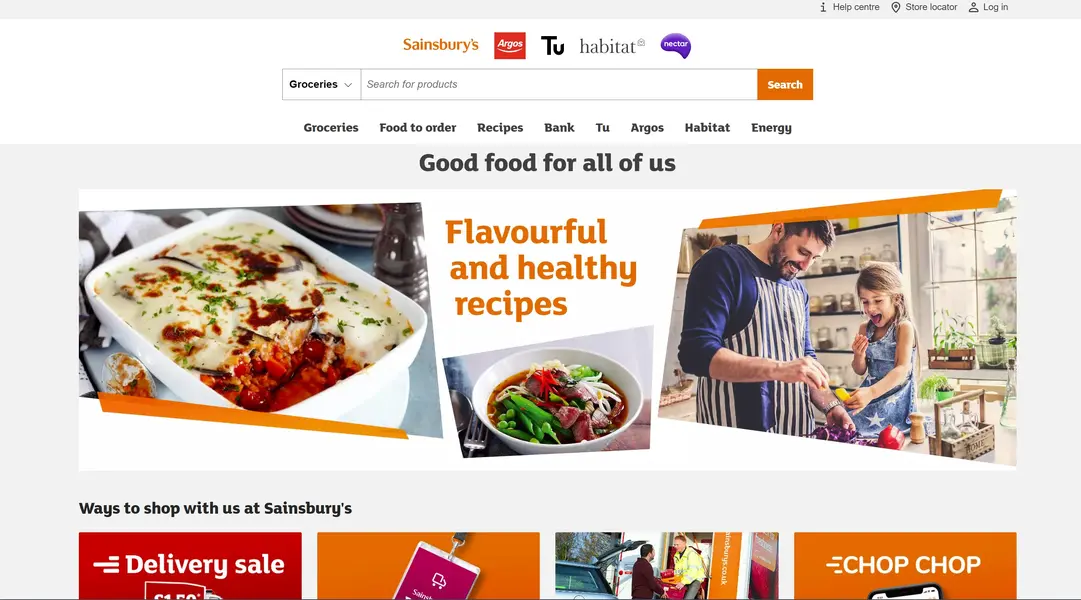
Managed extraction of Sainsbury's grocery listings: shelf price next to Nectar Price, price per unit, pack size, promotion type and availability, refreshed on your schedule.
Plans from €169/month · Free project assessment · Reply within 1 business day
We run the crawler, watch it, and repair it when the site moves. You receive files, not a scraper to maintain.
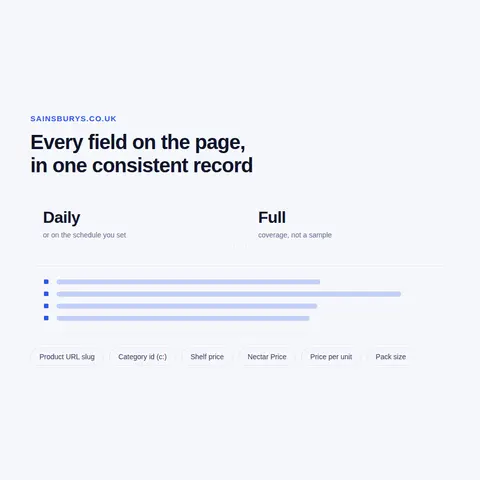
Change detection is part of the job. Field mappings are checked on every run, and a shift in the page structure becomes a ticket for us rather than a broken column for you.
A standard grocery extract lines up the two prices that decide a UK basket, plus the fields that make them comparable.
Every row is stamped with the run timestamp and the URL it came from. Without those two columns a price history cannot be audited.
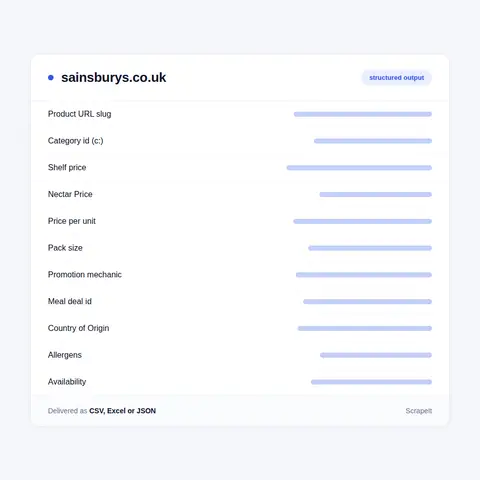
Grocery buyers rarely stop at price. Sainsbury's product pages reproduce the pack copy, and that is where category and compliance work happens.
These fields answer questions price alone cannot. Which lines on a shelf carry a given allergen. How a supplier's protein per 100g compares across its competitors. How much of a category is sourced from a single country, and what that means if origin rules change.
Sainsbury's runs its grocery business on www.sainsburys.co.uk under the /gol-ui/ path. The older groceries.sainsburys.co.uk hostname no longer resolves, so a crawler still pointed at it fails at DNS rather than at the page.
A product sits at /gol-ui/product/ followed by a slug. Some products carry an extra category segment before the slug, as in /gol-ui/product/--desserts--/. There is no numeric product code in the address. The slug is the key, and it normally carries the pack size, so a rename or a pack change moves the product to a new URL. Accented characters are percent-encoded inside the slug.
Browse pages follow the department, aisle and shelf taxonomy and end in a category id written as c: plus digits, for example /gol-ui/groceries/baby-and-toddler/baby-meals/pouches/c:1018688. Search is a path segment rather than a query string: /gol-ui/SearchResults/ plus the encoded term.
Listing pages still accept the WebSphere Commerce parameters the platform grew up on. pageSize and beginIndex drive offset pagination, orderBy takes pipe-joined values such as PRICE_ASC and TOP_SELLERS, and facet takes numeric ids. Captured URLs also carry catalogId, langId=44 and storeId=10151. Filters can sit in the path too, as brand:taste-the-difference or facet:Shop Fish Multibuy.
Get a Quote
Developers

Customers worldwide

Pages extracted

Hours saved for our clients
€199 / one-time
setup fee - included
€169 / mo
setup fee €499
€229 / mo
setup fee €499
€349 / mo
setup fee €499
€549 / mo
setup fee €799
Delivery: CSV, JSON or XLSX files, our API or a JSON feed. MCP server on request.
Full plan details →UK grocery carries a two-tier price. The standard shelf price and the Nectar Price sit on the same card, and a shopper with a linked Nectar card is charged the lower one. A dataset holding only one of those numbers describes a market that does not exist. Storing both, with the stated end date, is what lets you see whether a rival cut the real price or lifted the reference price ahead of a loyalty window.
That question is not academic. The CMA examined loyalty pricing in 2024, and the Price Marking Order amendments that took effect in April 2026 tightened how unit prices and scheme prices must be shown. Both make a defensible price history worth keeping.
Price per unit is the second axis. Ranges move by pack size, and a headline cut sometimes arrives inside a smaller pack. Normalising to price per kg or per litre catches that quietly.
Then there is range. Sainsbury's rotates seasonal lines through hub pages such as the BBQ and Christmas features, and its value tier now sits under the Stamford Street name. Weekly snapshots show which of your lines were delisted, which competitor lines appeared, and where a shelf has a gap.
Scraping supplement products from iHerb.com with full details, including descriptions and packaging variations.
Learn More
Daily scraping of lowest prices for 150K products on Allegro.pl to support marketplace pricing and margin optimization.
Learn More
Regular monitoring of Ralph Lauren clothing, footwear, and accessories sold across Amazon subdomains: AE, DE, ES, FR, IT, NL, PL, UK.
Learn MoreLearn how to use web scraping to solve data problems for your organization
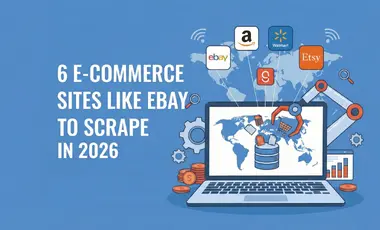
If you sell online, run a marketplace, or advise e-commerce clients, you already know why eBay matters: it’s one of the few places where big retailers compete side by side with thousands of small merchants and private sellers.

E-commerce teams do not just need “some” competitor data anymore. They need a continuous stream of real prices, discounts, stock levels, reviews, and seller behavior from the platforms that actually shape their markets.
Amazon provides valuable information gathered in one place: products, reviews, ratings, exclusive offers, news, etc. So scraping data from Amazon will help solve the problems of the time-consuming process of extracting data from e-commerce.
ScrapeIt is a managed web scraping agency. We scope the fields with you, build the crawler, run it on a schedule, and hand over clean data in the format your team already uses. There is no library to install and no proxy pool to babysit.
We have no connection to Sainsbury's, and we collect only what is publicly visible without an account. Send us a shelf or a list of URLs and we will confirm which fields are reachable before any work starts.
Yes. Both prices are rendered on the same product card, the standard price and the loyalty price shown as "with Nectar", so one row can hold both figures and the gap between them. Where the offer states a date it runs until, we capture that as well. Your Nectar Prices are a different thing: those are up to ten personalised offers a week, visible only inside a logged-in account, and we do not collect them.
Yes. Sainsbury's shows a per unit figure on the card, written as a price followed by "/ unit". We keep the string as displayed and add a normalised column in price per kg, per litre or per item, so packs of different sizes line up. Pack size is parsed from the product title and from the URL slug, which normally both carry it. That pairing is what exposes a price cut delivered through a smaller pack.
In part. Sainsbury's states that it delivers your order from a store local to you and allocates that store by postcode, and its help pages note that the availability of Nectar Prices may vary by store. Slot booking, trolley and account paths sit behind a login, so we stay off them. Catalogue, pricing and promotion data is collected from the public browse and product pages.
They are separate crawls with separate catalogues. Argos, Habitat and Nectar sit on their own domains. Tu clothing runs on tuclothing.sainsburys.co.uk with its own sitemap index and its own identifier format, where product URLs are /product/tuc followed by digits. Habitat is the exception that also appears inside the grocery site under homeware-and-outdoor. Sainsbury's own help pages state that Nectar Prices are not available at Argos, Habitat or Tu clothing, so loyalty pricing does not carry across the group.
Yes. The ScrapeIt Sainsbury's API returns the shelf price, Nectar Price, price per unit, pack size, promotion mechanic and availability as JSON from an endpoint we host, refreshed on the schedule you set. The same data also comes as CSV or XLSX files or straight into your database. The product page is a client-rendered React application, so the first response holds no product data at all. Extracting it therefore needs a real rendering environment, a conservative request rate and steady monitoring, which is the work we take on. We keep volumes low and stay off the account, trolley and slot pages. We collect only publicly available data - everything a visitor can see on Sainsbury's - and we collect it legally.
Step 1 - Make a Request
You share your needs, expectations, and desired timeframe. We’ll suggest the best solution based on your request and budget.
Step 2 - Configuring Custom Web Crawlers
Our specialists configure the crawlers and extract a sample dataset for your review before proceeding with the full-scale extraction.
Step 3 - Collect and Deliver
Once you approve the sample, we launch the project and start full data collection. We gather, filter, and structure the data for easy use, delivering it on time in your preferred format.
Step 4 - Maintain and Support
Our team manages ongoing processes, monitors website changes, and supports all data extraction cycles. We can also help integrate data into your systems or create dashboards to simplify analysis.
Sainsbury's data from €169/month. Free project assessment, reply within 1 business day.

Scrapeit Sp. z o.o.
10/208 Legionowa str., 15-099, Bialystok, Poland
NIP: 5423457175
REGON: 523384582