ResearchGate Scraper for Publications, Citations, Reads, Journals and Institutions

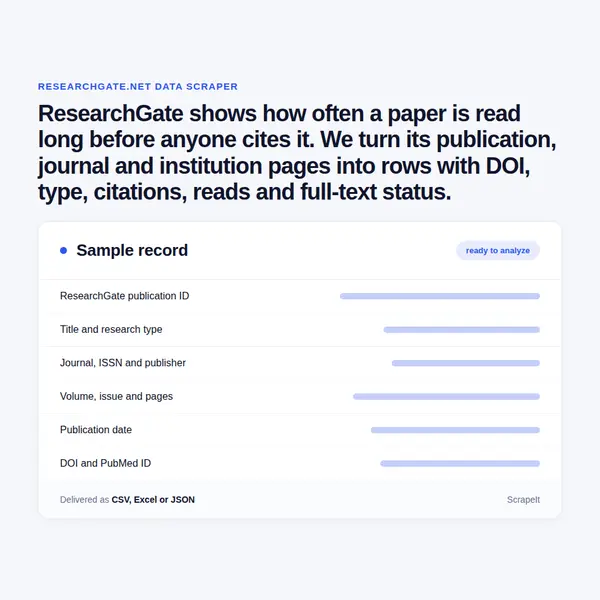
ResearchGate shows how often a paper is read long before anyone cites it. We turn its publication, journal and institution pages into rows with DOI, type, citations, reads and full-text status.

Plans from €169/month · Free project assessment · Reply within 1 business day

ResearchGate Scraper
Solutions

Managed ResearchGate Scraping, From a DOI List to Whole Journals

ScrapeIt handles ResearchGate data scraping end to end. You bring the scope - DOIs, a set of journals, institutions or topics - and we write the ResearchGate crawler, run it on our infrastructure and fix it whenever the site changes. Scraping ResearchGate means meeting a site that screens automated traffic hard, which is why anti-bot handling, proxy rotation and CAPTCHA solving come with the service. Only public pages are collected: no logins, no paywalls. Every row keeps the ResearchGate publication ID, the DOI and the ISSN, so papers, journals and institutions join across runs. Files arrive as CSV, JSON, XLSX, BibTeX or RIS in S3, SFTP or your warehouse, or through the ScrapeIt ResearchGate API, daily, weekly or once.

ResearchGate Data in Every Publication Record, Field by Field

To extract ResearchGate data, we turn each public publication page into one row, and the columns keep the labels the page itself uses.

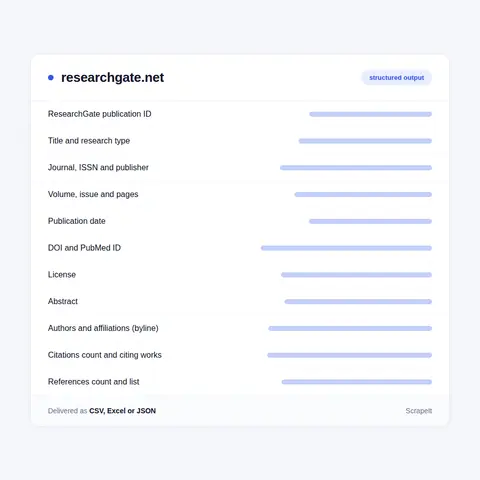
  • Identity. The ResearchGate publication ID from the page address, the URL, the title, the research type - Article, Preprint, Conference Paper, Chapter, Book, Thesis, Poster, Presentation, Data and others - and the Last Updated date printed at the foot of the page.
  • Source. Journal title, ISSN and publisher, volume, issue and page range. A conference paper names its conference and where it took place; a chapter names its book, pages and publisher.
  • Identifiers and license. DOI, PubMed ID where the record has one, and the license, such as CC BY 4.0. A DOI beginning 10.13140 was issued by ResearchGate itself, for a thesis, preprint or dataset that had no DOI of its own.
  • Abstract and figures. The abstract, the number of figures and each figure's caption. Figures and tables have pages of their own tied to the publication ID, so a caption never loses its paper.
  • Citations and references. Both totals and both lists, every entry with title, type, date and journal. For citing works the page often quotes the passage that mentions the paper, which shows how it was used, not only that it was.
  • Full-text availability. PDF Available, Full-text available, Publisher preview available or a request button, with the link to a public full-text where one exists.
  • Byline. Author names and the institutions attached to them, as printed in the bibliographic record.
  • Topic. The subject label the page files the paper under, where it shows one.

ResearchGate IEEE papers, clinical trials and humanities chapters share this schema, so one feed holds them all. We leave out researcher profiles, contact details, followers, the RG Score, the Research Interest Score and any other personal metric, and members' questions and answers; an author's name appears only inside a paper's bibliographic record.

ResearchGate Data in Every Publication Record, Field by Field
Journals, Institutions and Topics in the ResearchGate Database

Journals, Institutions and Topics in the ResearchGate Database

ResearchGate journal pages sit at /journal/ plus the title and ISSN. They carry the publisher, online and print ISSN, links to the journal website and author guidelines, aims and scope, top-read articles with reads in the past 30 days, and every recent article with its Reads, Citations and access badge, page by page. Where available, a metrics block adds the Journal Impact Factor and CiteScore with their year, acceptance rate, days from submission to first decision and to publication, and the article processing charge. That is the price field on ResearchGate, stated in the journal's own currency - dollars for PLOS One, Swiss francs for Sensors - so amount and currency travel in separate columns.

ResearchGate institution pages are aggregates: name, city and country, website, the number of members and the latest publications with journal, Reads and Citations. Members name their own institution, papers are assigned to one institution by ResearchGate's algorithms from the paper's metadata, and the page is not made or approved by the institution, so the counts are ResearchGate's attribution, not an official output figure.

ResearchGate topic pages count the publications on a subject and list the newest, with filters for full-text availability and for articles, preprints, conference papers and literature reviews. A listing currently stops at 10,000 records, so a big topic is taken in slices by type and full-text filter, or through the journals that publish on it.

ResearchGate Papers, Journals and Institutions: How the Site Fits Together

A ResearchGate scraper works through the pages that the Berlin-based network builds around each piece of research. ResearchGate is a professional network for scientists, open to active researchers only, and at the end of September 2026 it reports more than 25 million members, 160 million publication pages and 2.3 billion citations. What is ResearchGate used for? Researchers share their work, follow colleagues and watch how it is read; for everyone else, ResearchGate research papers form a public index in which each record lists the works that cite it.

ResearchGate publication pages are created in two ways: by ResearchGate from public metadata held in other literature databases, or by an author adding a paper. That split explains the data. The bibliographic record - title, type, journal, date, DOI, abstract, references - comes from the publishing world, while full-texts and figures come from authors who upload them and from partner publishers, so coverage is dense where either is active and thin where neither is.

Three aggregate layers sit above the papers: journal pages, institution pages and topic pages. ResearchGate is not a journal and runs no peer review of its own. Are ResearchGate papers peer reviewed? A journal article carries the review of the journal that published it, a preprint carries a notice that it may not have been peer reviewed yet, and the type field keeps the two apart in every row.

Get a Quote
dev_w
25

Developers

customers
500+

Customers worldwide

pages
1 500 000 000+

Pages extracted

stime
15000+

Hours saved for our clients

Plans

ResearchGate Scraping Plans and Pricing

Airplane

€199 / one-time

setup fee - included

Data limits100,000
Frequencyone-time
Run timeup to 5 days
Data storing7 days

Helicopter

€169 / mo

setup fee €499

Data limits250,000
Frequencymonthly
Run timeup to 5 days
Data storing14 days

Glasses

€229 / mo

setup fee €499

Data limits1,000,000
Frequencyweekly
Run timeup to 5 days
Data storing30 days

DNA

€549 / mo

setup fee €799

Data limits3,000,000
Frequency3 times daily
Run timesame day
Data storing90 days

Why Teams Scrape ResearchGate Data: Reads Arrive Before Citations

Citations take years to build up, while ResearchGate reads start as soon as a paper's page goes up. A read is counted when someone opens a paper's summary, clicks one of its figures or opens the full-text, from members and signed-out visitors alike, with authors' own visits and bot traffic left out. ResearchGate citations, in turn, are matched from research items held on the site, so both numbers reflect ResearchGate's own coverage. That makes ResearchGate statistics an early signal to set beside citation counts from elsewhere.

  • Publishers and editors set Reads and Citations for their own titles against rival journals, follow top-read articles and reads in the past 30 days, and keep acceptance rates and review times in the same table.
  • Research offices and funders roll papers up by institution and build ResearchGate rankings of journals and institutions from reads and citations, never from personal scores.
  • Pharma and technology scouts watch a topic or a DOI list and see which ResearchGate academic papers draw readers first and which can be read in full.
  • Bibliometrics and machine learning teams assemble abstracts, figure captions and citation links into a training or search corpus.

Is ResearchGate a scholarly source? It is a platform rather than a publisher: a journal article on it carries its journal's review, a preprint does not, and the type and source columns let an analyst keep or drop either.

Our Blog

Reads Our Latest News & Blog

Learn how to use web scraping to solve data problems for your organization

How Artificial Intelligence Is Used In Web Scraping

How Artificial Intelligence Is Used In Web Scraping

Leveraging advances in technology, the AI-powered web scraper has skyrocketed in demand and is helping to expand capabilities by automating tedious daily tasks and speeding up data collection from thousands of websites several times over.

What is Web Scraping and What is it Used For?

What is Web Scraping and What is it Used For?

Web scraping is a method of obtaining web data by extracting it from pages of web resources with the help of a program, that is, in automatic mode. It is used to syntactically convert web pages into more usable forms.

Web Scraping for Machine Learning

Web Scraping for Machine Learning

If you specialize in machine learning, you need to feed large amounts of data to the algorithms. Web scraping is the easiest and the most efficient method of collecting the data from all over the Internet.

scrapeit logo

ResearchGate Dataset or ResearchGate Scraper API: How an Order Works

ScrapeIt is a managed web scraping agency, so there is no tool to learn. Tell us the question - one journal's full article list, the recent output of fifty institutions tracked month by month, or the full-text papers in a narrow topic - and an engineer on our side designs the collection and keeps it running. A sample comes first, so you check fields and fill rates before committing. The price of a ResearchGate feed is set by what it covers and how often it runs, not by the pages it loads.

FAQ

Do you offer a ResearchGate API?

Yes. The ScrapeIt ResearchGate API returns public ResearchGate data as JSON on the schedule you set: publication records with ID, title, type, journal, ISSN, DOI, PubMed ID, date, license, abstract and full-text status, citation and reference lists, figure captions, journal pages with their metrics and article lists, and institution and topic aggregates. Every delivery can also be taken as CSV or XLSX, or as BibTeX and RIS for a reference manager.

Is ResearchGate open access, and how is full-text status recorded?

Partly. A full-text is public when an author shares it publicly or an open access publisher supplies the version of record; subscription articles from partner publishers show a preview with the abstract, figures and first page; other papers offer only a request to the authors. We record that status on every row - PDF Available, Full-text available, Publisher preview available or none - with the link to any public full-text, so you can filter to papers that can be read in full.

Can you scrape ResearchGate by journal, institution, topic or DOI list?

Yes, and the entry point shapes the result. A journal page lists its articles page by page, newest first, with Reads and Citations. An institution page lists the latest publications attributed to it, which we collect on a schedule to build its record over time. A topic listing returns the newest publications on a subject and can be narrowed to full-text only or by type. A DOI list is matched paper by paper. Rows keep the ResearchGate publication ID, so a paper found twice is delivered once.

How often can ResearchGate data be refreshed, and in what formats?

Each layer gets its own cadence. Reads and top-read lists move daily, so daily or weekly snapshots show the trend. Citation counts grow as ResearchGate matches new citing papers and can fall when duplicates are merged, so we store every snapshot instead of overwriting it. Journal Impact Factor and CiteScore change once a year. Teams that export ResearchGate data to spreadsheets take CSV or XLSX; product teams take JSON or Parquet, delivered to S3, SFTP or a warehouse.

Is it legal to scrape ResearchGate?

We collect only publicly available data - everything a visitor can see on ResearchGate - and we collect it legally. That covers publication pages, figures, citation and reference lists, journal pages and institution and topic aggregates, with no logins and no paywalls. Personal data is kept to the author names printed in a byline and handled under GDPR.

How does it Work?

Step 1 - Make a Request

You share your needs, expectations, and desired timeframe. We’ll suggest the best solution based on your request and budget.

Step 2 - Configuring Custom Web Crawlers

Our specialists configure the crawlers and extract a sample dataset for your review before proceeding with the full-scale extraction.

Step 3 - Collect and Deliver

Once you approve the sample, we launch the project and start full data collection. We gather, filter, and structure the data for easy use, delivering it on time in your preferred format.

Step 4 - Maintain and Support

Our team manages ongoing processes, monitors website changes, and supports all data extraction cycles. We can also help integrate data into your systems or create dashboards to simplify analysis.

Request a Quote

Tell us more about you and your project information.
Which sites, which fields, how often. A couple of lines is enough.

We reply within 1 business day. No obligation.

scrapiet

Scrapeit Sp. z o.o.
10/208 Legionowa str., 15-099, Bialystok, Poland
NIP: 5423457175
REGON: 523384582