SpringerLink Scraper for Articles, Chapters, eBooks and Local Prices

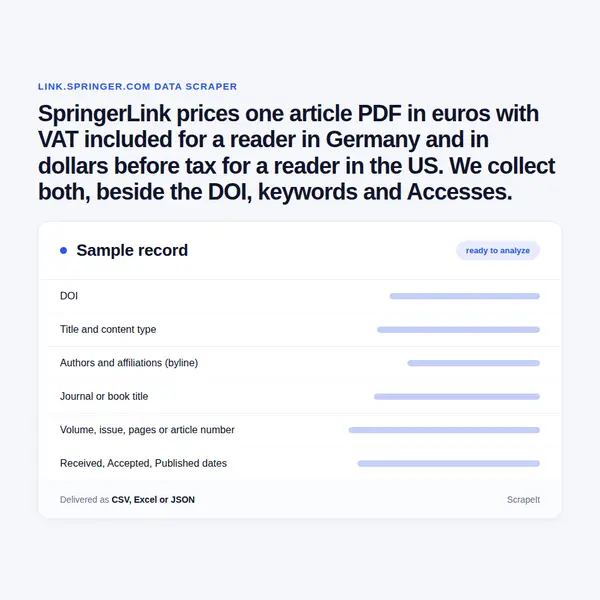
SpringerLink prices one article PDF in euros with VAT included for a reader in Germany and in dollars before tax for a reader in the US. We collect both, beside the DOI, keywords and Accesses.

Plans from €169/month · Free project assessment · Reply within 1 business day

SpringerLink Scraper
Solutions

SpringerLink Scraper API or Scheduled Files, Run by ScrapeIt

ScrapeIt builds the collector, runs it and repairs it when SpringerLink changes its templates. Anti-bot handling, proxy rotation and CAPTCHA solving are part of the managed service, and this platform needs them: it screens automated traffic with a browser challenge before a page is served. Price runs go out from the markets you name, so each row keeps the currency and VAT note that market sees. Catalogue runs are seeded from journal, series and conference pages rather than from search. A sample comes first; then the same schema arrives on your schedule as CSV, JSON, XLSX, BibTeX or RIS, through our SpringerLink scraper API or pushed to S3, SFTP or your warehouse.

SpringerLink Data Scraping, Field by Field: Articles, Chapters and Books

An article page and a chapter page share one skeleton, and we extract SpringerLink data under the labels the page itself prints.

  • Record. Title, content type as printed - Article, Research, Conference paper, Chapter - with a type code such as OriginalPaper or ReviewPaper, the journal or book it belongs to, volume, issue, page range or article number, and year.
  • DOI anatomy. A current article DOI embeds the journal ID and the year: 10.1007/s10994-026-07103-0 belongs to journal 10994, Machine Learning. A book DOI is built on its eBook ISBN, and a chapter adds an underscore and a number, as in 10.1007/978-3-319-24574-4_28.
  • Dates. Received, Accepted, Published and Issue date, plus Version of record on newer articles and First Online on chapters.
  • Bylines. Authors or editors with the affiliations printed beside them.
  • Abstract and keywords. Some chapters mark their keyword list as added by machine and not by the authors; we keep that flag, so machine terms never pass for author terms.
  • Metrics. Accesses, Citations, Altmetric and Mentions. Large counts are printed rounded with a k or m suffix, so we deliver the label as shown and a parsed number beside it.
  • Access. SpringerLink open access articles carry the Open access label, a Creative Commons licence line and funding notes such as Open Access funding enabled and organized by Projekt DEAL.
  • References. The cited-works list, one row per entry.

SpringerLink books add the richest block of SpringerLink metadata, Bibliographic Information: Book Title and Subtitle, Series Title, a publisher imprint such as Springer Cham, eBook Packages, Copyright Information, a separate ISBN and publication date for each format, Series ISSN and E-ISSN, Edition Number, Number of Pages, Number of Illustrations split into b/w and colour, and Topics. Author names stay a bibliographic field: we build no researcher profiles, contact lists or dossiers.

SpringerLink Data Scraping, Field by Field: Articles, Chapters and Books
Journals, Book Series and Conferences in a SpringerLink Dataset

Journals, Book Series and Conferences in a SpringerLink Dataset

SpringerLink journals each open on a home page with a Publishing model, Hybrid or Open access, and a metrics panel: Journal Impact Factor, 5-year Journal Impact Factor, Submission to first decision (median) and Downloads for the year. Around it sit the Editor-in-Chief, the number of open access articles, Electronic and Print ISSN, the Abstracted and indexed in list, collections, volumes and issues, and each SpringerLink call for papers with its status and submission deadline. Online First articles are live and citable by DOI before they join an issue.

SpringerLink book series and conference series add structure no article page shows. Lecture Notes in Computer Science carries its subseries LNAI and LNBI, and a conference series page lists every edition with dates, host city, number of papers and number of volumes. SpringerLink conference proceedings often state in About this book how many papers were selected from how many submissions, and SpringerLink papers inside them point back to both series.

Is SpringerLink peer reviewed? Review happens title by title, and the evidence sits on the page: Received and Accepted dates, the median time to first decision and those acceptance figures. Disciplines tie the catalogue together. Search filters by content type, publishing model, date published, language, discipline, subdiscipline, subject, Sustainable Development Goals and accessibility, and browsing starts from broad areas such as Biological Sciences, Mathematics or Technology and Engineering.

What the SpringerLink Database Holds: Journals, Books, Proceedings and Protocols

SpringerLink is Springer Nature's reading and buying platform at link.springer.com, and a SpringerLink scraper works on a catalogue that has grown by absorbing its sister sites. The site now brands itself Springer Nature Link, while the address and the SpringerLink name in its page metadata stay the same. The former springer.com, springeropen.com, biomedcentral.com, palgrave.com and apress.com have all moved in, and the four EMBO Press journals moved too, so BMC and SpringerOpen titles, Palgrave Macmillan and Apress books sit beside the Springer list in one design.

What is SpringerLink in size? At the end of September 2026 Springer Nature put it at more than 10 million scientific documents: journals, eBooks, reference works and protocols across science, technology, medicine, the humanities and social sciences. Search reaches content from Springer, Nature Portfolio, Palgrave Macmillan, Adis, BMC and Apress.

Every object type has its own address, and that is how a crawl gets scoped. Journals live under /journal/ with a numeric ID, articles and chapters under /article/ and /chapter/ with their DOI, books under /book/ with the book DOI, book series under /series/, conference series under /conference/, and reference works and lab protocols under /referencework/ and /protocol/. Book pages carry a type label - Textbook, Conference proceedings, Reference work - and some reference works run as a Living Edition, whose entries go online one by one, each with its own DOI, long before the printed set is complete.

Get a Quote
dev_w
25

Developers

customers
500+

Customers worldwide

pages
1 500 000 000+

Pages extracted

stime
15000+

Hours saved for our clients

Plans

SpringerLink Scraping Plans and Pricing

Airplane

€199 / one-time

setup fee - included

Data limits100,000
Frequencyone-time
Run timeup to 5 days
Data storing7 days

Helicopter

€169 / mo

setup fee €499

Data limits250,000
Frequencymonthly
Run timeup to 5 days
Data storing14 days

Glasses

€229 / mo

setup fee €499

Data limits1,000,000
Frequencyweekly
Run timeup to 5 days
Data storing30 days

DNA

€549 / mo

setup fee €799

Data limits3,000,000
Frequency3 times daily
Run timesame day
Data storing90 days

SpringerLink Price Monitoring by Country, Currency and Format

The buy box is what makes SpringerLink price monitoring possible. An anonymous visitor sees a price for every way to own an item: Buy article PDF for a journal article, Buy Chapter for a single chapter, and eBook, Softcover Book or Hardcover Book for the whole title, each with a format note such as Available as EPUB and PDF or Durable hardcover edition. Every price names its market. A reader in Germany sees Price includes VAT (Germany); a reader in the US sees Price excludes VAT (USA) and the line Tax calculation will be finalised at checkout.

Billing currency follows the buyer: dollars for the Americas, pounds for Great Britain, Swiss francs for Switzerland, yen for Japan and euros for Europe, Africa and Asia-Pacific. One ISBN therefore needs one row per market, captured from that market on the same day. A second layer sits beside it: Springer+ sells units, 10 a month on Basic or 120 over six months on Standard, one per article or chapter and at most seven per complete eBook. Forthcoming titles show Pre-order Book with an expected publication date, so the buy box doubles as a release calendar.

The rows serve publishers benchmarking list prices by discipline and format, booksellers checking eBook against print, library buyers weighing single purchases against subscriptions, and anyone building a SpringerLink alternative - a discovery layer or a reading-list tool - who must match SpringerLink research papers to price and access by DOI.

Our Blog

Reads Our Latest News & Blog

Learn how to use web scraping to solve data problems for your organization

How Artificial Intelligence Is Used In Web Scraping

How Artificial Intelligence Is Used In Web Scraping

Leveraging advances in technology, the AI-powered web scraper has skyrocketed in demand and is helping to expand capabilities by automating tedious daily tasks and speeding up data collection from thousands of websites several times over.

What is Web Scraping and What is it Used For?

What is Web Scraping and What is it Used For?

Web scraping is a method of obtaining web data by extracting it from pages of web resources with the help of a program, that is, in automatic mode. It is used to syntactically convert web pages into more usable forms.

Web Scraping for Machine Learning

Web Scraping for Machine Learning

If you specialize in machine learning, you need to feed large amounts of data to the algorithms. Web scraping is the easiest and the most efficient method of collecting the data from all over the Internet.

scrapeit logo

Why Teams Scrape SpringerLink Data With ScrapeIt

ScrapeIt is a managed data collection agency. We write the collectors, host them, keep them alive through redesigns and deliver clean files, so you maintain no crawler code and rent no proxies. Scholarly publishing is familiar ground, from DOI anatomy to ISBN formats and per-market pricing.

The scope is what a visitor sees: no logins, no paywalls, no institutional sign-ins. Subscription full text and PDFs stay out of the dataset. What you receive is the record, its metrics and its price in each market, collected the same way on every run.

FAQ

Do you offer a SpringerLink API?

Yes. The ScrapeIt SpringerLink API returns article, chapter and book records as JSON: DOI, title, content type, bylines with affiliations, journal or book, volume, issue, pages, dates, keywords, open access flag, Accesses, Citations and Altmetric, plus the buy-box price for every market you track. You can query the latest snapshot or a dated history, and the same data ships as CSV and XLSX exports on a daily, weekly or monthly schedule.

Which fields come back when you extract SpringerLink data?

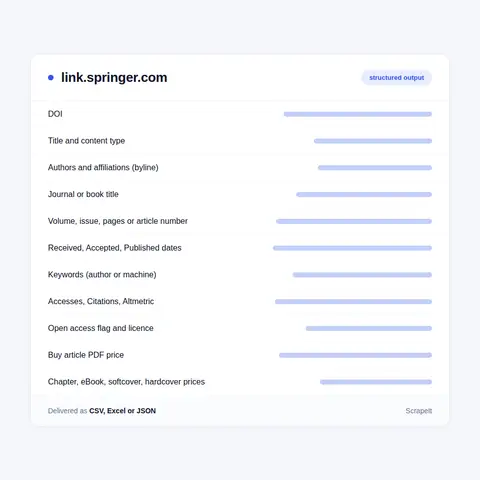
For articles and chapters: title, content type, DOI, journal or book, volume, issue, page range or article number, Received, Accepted and Published dates, bylines with affiliations, abstract, keywords with an author or machine flag, Accesses, Citations, Altmetric, Mentions, open access status, licence and funding note. For books: every Bibliographic Information field, the table of contents with page ranges, and the price of each format. Journal, series and conference pages add their own fields.

Can you track SpringerLink prices by country and currency?

Yes, and it is the most common request. Each row carries the format - article PDF, chapter, eBook, softcover or hardcover - with amount, currency, the VAT note as printed and the market it came from. Because currency follows the buyer's region, one ISBN becomes one row per market, all captured the same day, so a difference is a real price gap and not an artefact of timing. Springer+ unit offers and pre-order dates can ride in the same feed.

How often can SpringerLink data be refreshed?

By field, not by calendar. Prices and pre-order dates suit a weekly pass, daily around a launch. Accesses, Citations and Altmetric move steadily and read well as monthly snapshots. Online First articles are worth a weekly check, since volume, issue and pages arrive after publication. Journal metrics change once a year, when the new Impact Factor year appears. Bibliographic fields are collected once and revisited on correction. Delivery is CSV, JSON, XLSX, BibTeX or RIS.

Is it legal to scrape SpringerLink?

Yes. We collect only publicly available data - everything a visitor can see on SpringerLink - and we collect it legally. No logins, no paywalls: we never use institutional access and never take subscription full text or PDFs, only the records, metrics and prices shown to any visitor. Author names appear only as bylines, as in any reference list, and personal data is handled under GDPR.

How does it Work?

Step 1 - Make a Request

You share your needs, expectations, and desired timeframe. We’ll suggest the best solution based on your request and budget.

Step 2 - Configuring Custom Web Crawlers

Our specialists configure the crawlers and extract a sample dataset for your review before proceeding with the full-scale extraction.

Step 3 - Collect and Deliver

Once you approve the sample, we launch the project and start full data collection. We gather, filter, and structure the data for easy use, delivering it on time in your preferred format.

Step 4 - Maintain and Support

Our team manages ongoing processes, monitors website changes, and supports all data extraction cycles. We can also help integrate data into your systems or create dashboards to simplify analysis.

Request a Quote

Tell us more about you and your project information.
Which sites, which fields, how often. A couple of lines is enough.

We reply within 1 business day. No obligation.

scrapiet

Scrapeit Sp. z o.o.
10/208 Legionowa str., 15-099, Bialystok, Poland
NIP: 5423457175
REGON: 523384582