TicketSwap Scraping for Fan to Fan Ticket Resale Data and Price Caps

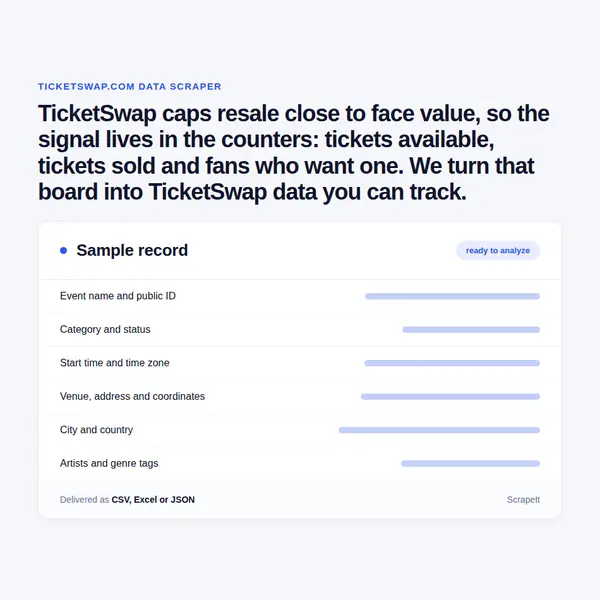
TicketSwap caps resale close to face value, so the signal lives in the counters: tickets available, tickets sold and fans who want one. We turn that board into TicketSwap data you can track.

TicketSwap Scraper
Solutions

How ScrapeIt Runs TicketSwap Scraping and Delivers the Feed

ScrapeIt builds the collector, runs it on our own infrastructure and repairs it when TicketSwap changes its pages. Anti-bot handling, proxy rotation and CAPTCHA solving are part of the service, and this marketplace needs them: it puts a verification screen in front of automated clients before any event renders. We extract TicketSwap data from public pages only, with no account, no purchases, no Auto buy orders and no raffle entries. Sellers and buyers here are private people, so their names, profiles and contact details are never collected; the extract stops at event, ticket type, prices and counts.

A sample arrives before anything is scheduled, with every field named as it will be delivered. After sign-off we run hourly through monthly and ship CSV, JSON or XLSX, an endpoint you query, or files in S3, SFTP or your warehouse.

What a TicketSwap Scraper Collects per Event, Ticket Type and Listing

Field names below are TicketSwap's own, read from the data every public event page carries, so a TicketSwap scraper returns them as the platform defines them rather than as parsed screen labels.

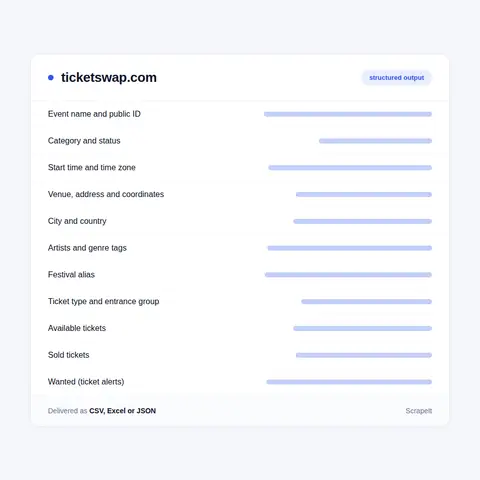
  • Event core. name, category such as CONCERTS or FESTIVALS, status from ACTIVE to EXPIRED, startDate and endDate with the UTC offset, timeZone such as Europe/Amsterdam, isStartTimeUnknown, the festival alias, organiser brand, artists with genres and social links, and genre tags.
  • Three counters. availableTicketsCount, soldTicketsCount and ticketAlertsCount, printed in the header as available, sold and wanted. They count tickets, not listings; the header stops at 99+ while the data keeps the exact figure, and the same trio repeats on every ticket type.
  • Ticket type. numeric id, title, entrance or non-entrance group, start and end dates, isPopular, autoBuyEnabled with autoBuyCount and the most tickets one Auto buy order may take, and, where Auto buy runs, maximumAllowedPrice: the ceiling for that type in the same fee-inclusive terms as listing prices.
  • Listing. numeric id, time listed, TicketSwap resale price per ticket with buyer fees included, and currency, for the cheapest available offers of each type; lowestPrice gives the floor for the whole event. An offer is available, reserved or sold, and a reservation lasts 10 minutes in the cart and 30 once payment starts before an unpaid ticket returns to sale.
  • Venue and audience. venue name, street address, postcode, latitude and longitude, website, city, country and number of upcoming events there, plus the totals of fans marked Interested and Going.
  • Sales setup. the organiser resale block with its terms link, the official shop and its state, the sealed ticket provider such as Weeztix, and issuance methods from PDF and PKPASS to CLOSED_LOOP and delayed transfer.

The original price a seller declares and the ticket count of each listing sit on the listing page itself, which the site closes to crawlers, so face value in the extract is derived from the published ceiling or taken from the organiser shop the event links to.

What a TicketSwap Scraper Collects per Event, Ticket Type and Listing
TicketSwap Max Price and TicketSwap Fees: How the Resale Ticket Price Cap Works

TicketSwap Max Price and TicketSwap Fees: How the Resale Ticket Price Cap Works

The cap changes at the border. The TicketSwap price limit defaults to 120% of the final tier price, even for a ticket bought as an early bird. Italy, Denmark, Poland, France, Ireland and Belgium allow 105%, Australia 110%, and Portugal, Norway and Canada 100%. Organisers can go lower: Paradiso in Amsterdam caps resale at face value, Le Guess Who? at 105%.

TicketSwap fees are fixed, so prices convert back. Buyers add a 7% service fee to the seller's price and a 3% transaction fee on top, so a seller's 80.00 reaches the board as 88.17; a regional minimum service fee applies to cheap tickets, EUR 1.50 in Western Europe and EUR 2.58 in Switzerland. TicketSwap seller fees are 5% of the sale. We store the seller's figure beside the board price.

Queues take tickets before the board shows them. With Auto buy, fans leave a maximum price and a deadline; a new listing goes to the highest matching maximum in line, earliest first on a tie, and sells at once. High-demand ticket types run app-only raffles instead, 90 seconds to join and ten minutes to pay. On those events the available count understates the flow, and the sold counter tells the real story.

Organiser resale. Some organisers buy tickets back and resell them under Resale tickets, inside a band of usually 80% to 120% of the original price, sometimes with a Min floor. Under shared resale, anything above the original price is split 50/50 or 80/20 in the organiser's favour.

How Does TicketSwap Resale Work? Events, Ticket Types, Listings and Venues

The TicketSwap marketplace is a fan to fan resale market for e-tickets, run by TicketSwap B.V. in Amsterdam. Every seller works under a ceiling, by default 120% of the base price: face value plus the ticket provider's fee, or the latest tier price the organiser released. TicketSwap scraping reads prices against it. That ceiling is the core of any TicketSwap vs StubHub or Viagogo comparison, since on those open exchanges the seller sets the price within local law. Twickets and fanSALE are the names commonly weighed as a TicketSwap alternative; Twickets also caps at face value plus fees.

An event lives at /{category}-tickets/{slug}-{date}-{id}, a short public id in the address and a UUID behind it, in one of nine categories from concert and club to museum and amusement-park. A ticket type has a numeric id and a title such as Golden Circle - Standing, Weekend or Parking, grouped as entrance or non-entrance. A listing is one seller's offer inside a type. A venue sits at /location/{slug}/{id} with address and coordinates. TicketSwap festivals also get an alias such as /festival-tickets/a/lowlands-festival that ties the yearly dates together.

The sitemap is sharded by object type, and in September 2026 it listed about 177,000 event pages, 53,000 artist pages and 43,000 venues. It holds upcoming dates only: TicketSwap past events drop out and their pages switch to ended, so the archive and its price history must be kept by the collector. Museums and theme parks such as the Van Gogh Museum and Efteling sit at /event/{slug}/{uuid} as ongoing events. The UK, Irish and Australian domains fold into ticketswap.com, while other markets keep local ones such as ticketswap.nl and ticketswap.de.

Get a Quote
dev_w
25

Developers

customers
500+

Customers worldwide

pages
1 500 000 000+

Pages extracted

stime
15000+

Hours saved for our clients

Plans

Airplane

€199 / one-time

setup fee - included

Data limits100,000
Frequencyone-time
Run timeup to 5 days
Data storing7 days

Helicopter

€169 / mo

setup fee €499

Data limits250,000
Frequencymonthly
Run timeup to 5 days
Data storing14 days

Glasses

€229 / mo

setup fee €499

Data limits1,000,000
Frequencyweekly
Run timeup to 5 days
Data storing30 days

DNA

€549 / mo

setup fee €799

Data limits3,000,000
Frequency3 times daily
Run timesame day
Data storing90 days

Is There a TicketSwap API? What Exists and What Scraping Covers

Straight answer: there is no public TicketSwap API. No developer portal, no API documentation for outside developers, no key and no market feed. The web app reads from a private GraphQL layer built for its own screens, and an older public GraphQL endpoint now answers every call with a request to upgrade the application. Integrations run on the supply side only: ticket providers such as Paylogic, Weeztix, Ingresse and Showshappening hand sellers to TicketSwap from their own order emails and wallets, and partner organisers set resale rules for their own events.

Fan to fan ticket resale data at market scale therefore comes from public pages, and a capped market asks different questions from an open exchange:

  • Unmet demand. Wanted against available per ticket type measures a queue that price cannot clear, because price may not rise past the cap.
  • TicketSwap price tracker. The nearest thing to a TicketSwap price alert is the ticket alert, which tells one fan that a ticket in budget appeared and keeps no record. A resale ticket price tracker built from our runs logs the cheapest listing against the ceiling and becomes the TicketSwap price history the site does not publish.
  • Resale velocity. The sold counter is cumulative, so two readings give the tickets resold between them, with no guessing from offers that vanished.
  • Organiser exposure. Which events run organiser resale, sealed tickets or an official shop, by city, venue and promoter.

Our Blog

Reads Our Latest News & Blog

Learn how to use web scraping to solve data problems for your organization

How Artificial Intelligence Is Used In Web Scraping

How Artificial Intelligence Is Used In Web Scraping

Leveraging advances in technology, the AI-powered web scraper has skyrocketed in demand and is helping to expand capabilities by automating tedious daily tasks and speeding up data collection from thousands of websites several times over.

What is Web Scraping and What is it Used For?

What is Web Scraping and What is it Used For?

Web scraping is a method of obtaining web data by extracting it from pages of web resources with the help of a program, that is, in automatic mode. It is used to syntactically convert web pages into more usable forms.

Web Scraping for Machine Learning

Web Scraping for Machine Learning

If you specialize in machine learning, you need to feed large amounts of data to the algorithms. Web scraping is the easiest and the most efficient method of collecting the data from all over the Internet.

scrapeit logo

Working With ScrapeIt on TicketSwap Data and Price History

ScrapeIt is a managed web scraping agency. You name the countries, cities, venues, festival aliases or artists and the fields you need; we plan the crawl, keep it healthy and return files that load without cleaning. Pricing follows volume and refresh rate, and you check a sample of your own events before any recurring run. Most TicketSwap projects start with one festival season or one city, a field list agreed in writing, and a cadence that tightens in the final days before each date, when most resale happens.

FAQ

Is there TicketSwap API documentation or a public API for developers?

Not a public one. TicketSwap offers no developer portal, no API documentation and no key sign-up, and its older public GraphQL endpoint now only asks callers to upgrade their application. The website runs on a private GraphQL layer made for its own screens. Integrations exist on the supply side - Paylogic, Weeztix and other ticket providers connect for SecureSwap and sealed tickets, and partner organisers manage resale rules for their own events - but none of them returns other events or the market. For events, ticket types, counters and prices across many cities, public pages are the source, and we deliver them in the shape an API would.

Which TicketSwap data fields can you extract per event and ticket type?

Per event: name, category, status, start and end time with offset and time zone, venue with address, postcode and coordinates, city and country, artists, genre tags, festival alias, organiser brand, lowest price, the available, sold and wanted counters, Interested and Going totals, organiser resale and official shop state, sealed ticket provider and issuance methods. Per ticket type: id, title, entrance or non-entrance group, its own three counters, Auto buy flag and queue size, and the price ceiling where published. Per listing: id, time listed, fee-inclusive price and currency.

What are the TicketSwap supported countries and currencies, and how do caps differ?

Events run mostly across Europe, with browse pages country by country from Iceland and Ireland to Romania and Serbia, plus dates in New York, Toronto, Los Angeles, Melbourne and Sao Paulo. Sellers need a bank account in a supported payout country, a list that also covers Australia, Brazil, Canada, Mexico and the United States, and they list in their own currency, from euro, pound and Swiss franc to the Nordic, Central European and dollar currencies; buyers see a conversion, so every row keeps the currency it was read in. The cap is 120% by default, 105% in Italy, Denmark, Poland, France, Ireland and Belgium, 110% in Australia and 100% in Portugal, Norway and Canada.

How often should prices be refreshed for a TicketSwap price history, and in what formats?

By phase. Most resale happens in the last days before a date, and on raffle or Auto buy events a ticket changes hands within minutes, so a watchlist runs hourly in the final week while the rest of a city or festival season runs daily. The sold counter is cumulative, so even a daily reading gives a clean count of resales between runs, and each run adds resale ticket prices per type to the record. Because the sitemap drops past dates, we keep each event's history on our side, keyed on TicketSwap's own ids. Output is CSV, JSON or XLSX, an endpoint we host, or a load into S3, SFTP or your warehouse.

Is it legal to scrape TicketSwap, and what do you leave out?

We read public pages only, at a polite rate, and skip the paths the robots file closes, among them listing detail, user profiles, ticket alerts and the cart. The Trust and Safety rules ban scripts and automated programs that buy or sell on a priority basis or get around platform rules, so we never sign in, buy, join a raffle or place an Auto buy order. Names, profiles, social links and contact details of sellers and buyers stay out, and Interested and Going are kept as totals only. Have counsel review your use case before a long-running feed starts.

How does it Work?

Step 1 - Make a Request

You share your needs, expectations, and desired timeframe. We’ll suggest the best solution based on your request and budget.

Step 2 - Configuring Custom Web Crawlers

Our specialists configure the crawlers and extract a sample dataset for your review before proceeding with the full-scale extraction.

Step 3 - Collect and Deliver

Once you approve the sample, we launch the project and start full data collection. We gather, filter, and structure the data for easy use, delivering it on time in your preferred format.

Step 4 - Maintain and Support

Our team manages ongoing processes, monitors website changes, and supports all data extraction cycles. We can also help integrate data into your systems or create dashboards to simplify analysis.

Request a Quote

Tell us more about you and your project information.
Which sites, which fields, how often. A couple of lines is enough.

We reply within 1 business day. No obligation.

scrapiet

Scrapeit Sp. z o.o.
10/208 Legionowa str., 15-099, Bialystok, Poland
NIP: 5423457175
REGON: 523384582