Vivid Seats Scraper for Resale Listings, Seat Maps and Ticket Price Data

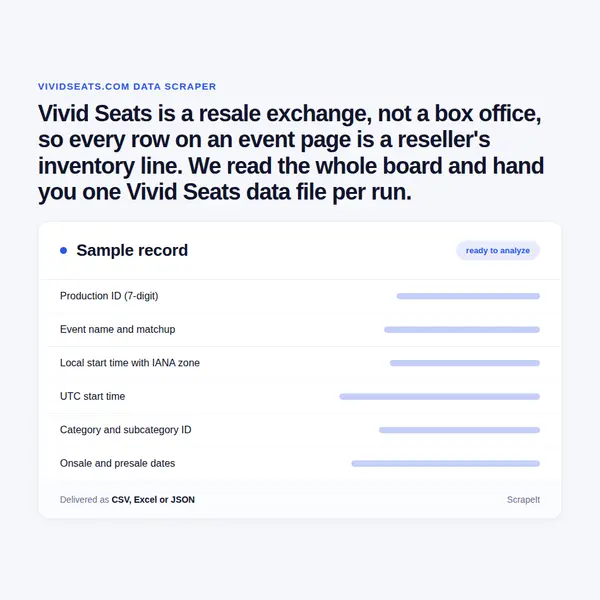
Vivid Seats is a resale exchange, not a box office, so every row on an event page is a reseller's inventory line. We read the whole board and hand you one Vivid Seats data file per run.

Vivid Seats Scraper
Solutions

How ScrapeIt Runs Vivid Seats Extraction and Ships It

ScrapeIt builds the collector, runs it on our own infrastructure and repairs it when the marketplace moves. Anti-bot handling, proxy rotation and CAPTCHA solving are part of the managed service, and this storefront needs all three: it meets automated clients with a challenge screen long before an event renders, and the listing panel fills only once a real browser has finished.

We extract Vivid Seats data from public pages, keep event, listing, venue and performer as joined tables, and return one file. Vivid Seats scraping here means no accounts, no checkout and no purchase automation; seller identities, buyer names and order records stay untouched. A sample arrives before the full run so field names and coverage can be checked. After sign off we run to your schedule, hourly through monthly, and watch for layout and payload changes. Delivery is CSV, JSON, XLSX or an endpoint you call, pushed to S3, SFTP or your warehouse.

What Sits Inside a Vivid Seats Event, Ticket Listing, Seat Map and Venue Record

The names below are the platform's own, read off a live event page, its map payload and the seller schema behind both - Vivid Seats data comes from that pair, not from a feed.

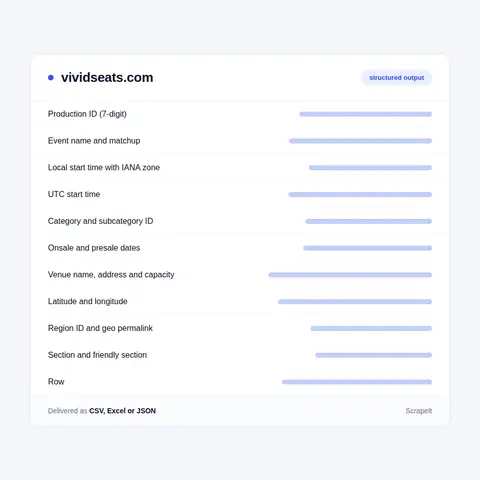
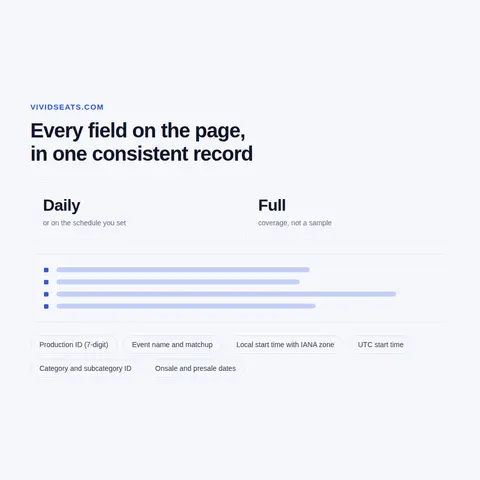
  • Production core. id, name, localDate carrying the IANA zone in brackets, utcDate, categoryId and subCategoryId, ifNecessary for a playoff game that may never be played, productionDelayType such as NONE or RESCHEDULED, onsaleDate and presale1Date, primaryIntegrated, a parkingPid for the same night's parking, plus webPath and the legacy organicUrl.
  • The price block on every event. minPrice, maxPrice, avgPrice and medianPrice, then minAipPrice and maxAipPrice for the same seats with fees folded in, a showAip switch, listingCount, ticketCount, and lastPricingRefresh - a timestamp, not a date, because a busy Vivid Seats price surface turns over several times a day.
  • A listing row. section and friendlySection, row and friendlyRow, lowSeat and highSeat, quantity and shownQuantity, splitType of DEFAULT, ANY, CUSTOM or NEVERLEAVEONE, listPrice with its currency code, seatType of CONSECUTIVE, ALTERNATING, GA or PIGGYBACK, stockType from HARD through PAPERLESS to MOBILE_TRANSFER, inHandDate, zoneSeating, instantTransfer, electronicTransfer, disclosures, and a status of AVAILABLE, ON_HOLD or DEPLETED.
  • What the shopper sees on that row. Section, Row, a quantity band written as 1-4 tickets, a Deal Score with its word grade, a Fees Incl. figure against an Original Price toggle, badges such as Lowest Price in Section, Super Seller and Seat Saver, seat features from Aisle Seats to Field Pass Included and Restricted/Obstructed View, and a disclosure line saying whether the seller is a trader.
  • Venue and performer. venue id, name, street address, city, state, coordinates, timezone, capacity, regionId and parkingVenueId; performer id, name, nickname, urlName, master flag, category with subCategories and two revenue ranks.
  • Map and demand. a static image, an SVG file and a JSON companion keyed per configuration, so one stadium reads Lower Level - Sideline and Gridiron Level - Prime for football but 100 Level, Floor, General Admission and ADA for a concert. Two demand counters ride along: fans shopping now and fans who bought recently.

What Sits Inside a Vivid Seats Event, Ticket Listing, Seat Map and Venue Record
All-In Prices, Deal Score, Split Rules and the Reward Credit That Never Reaches the Listing

All-In Prices, Deal Score, Split Rules and the Reward Credit That Never Reaches the Listing

Two prices sit on every row. The marketplace runs All-In Pricing, so the number on the card already holds the service and delivery fee, with taxes landing at checkout; one toggle flips the same listing back to Original Price. Outside the United States a currency block rides with the payload - source code, target code and rate - and converted figures are marked informational while the deal table under the map stays in dollars. Any Vivid Seats price feed that mixes those readings compares different numbers.

Deal Score is a rating, not a discount. It runs 1 to 10 with word grades - Fantastic, Excellent, Very Good, Great, Good - built from seat location, view and obstruction, the venue, and demand. The five best value rows sit in a plain table under the map with section, row, price and score.

Split rules decide which quantities exist. A seller picks DEFAULT, ANY, CUSTOM or NEVERLEAVEONE, so four seats may sell as four only, as any count, as a named set, or as anything that leaves no single seat behind. Set a quantity filter and both the count and the lowest price move.

The loyalty program moves the wallet, not the listing. Vivid Seats Rewards is app-only: buy ten tickets, earn a Reward Credit worth the average of those ten before taxes, fees and processing, then spend it on the eleventh. A Lowest Price Guarantee pays 115% of a difference found on a named rival marketplace as site credit, capped per claim. Neither changes the number on the page, so a scraped figure is the shelf price and loyalty has to be modelled beside it.

How the Vivid Seats Catalogue Is Wired: Productions, Performers, Venues, Matchups and Geos

Vivid Seats is a resale exchange and only that. It holds no promoter allocation, and its seller rules say so plainly: you may not list tickets before you have bought them, and you must deliver them by the method you received them. House properties are the narrow exception - the College Basketball Crown carries its own primary sales terms. For a Vivid Seats scraper the consequence is structural. There is no face value column to anchor against, the site itself warns that resale prices sit above or below face, and one seat can be live on several exchanges at once.

Four object types hold the catalogue together. A production is a single performance and owns a seven digit id. A performer is the act, team, tour or festival. A venue is the building. A matchup is a fixture between two acts, addressed by both performer ids joined with a hyphen rather than by any event key of its own. Around them sit editorial collections under /custom, country and city guides under /geo, and city pages under /region keyed by an internal region id.

Addresses follow one grammar: slug, entity type, id, with the category folded into the slug behind a double hyphen, as in houston-texans-tickets--sports-nfl-football. Every record also keeps a legacy .html address beside the modern one, so an event answers at two live URLs and a crawl that treats them as separate pages doubles its own work. Categories are shallow integers, not a deep tree: Concerts 2, Sports 3, Theater 4, with subcategories such as NFL Football 1, Rap/Hip Hop 15 and Rock 18. The sitemap is sharded by object type, and in September 2026 the production shards carried about 325,000 event pages against roughly 18,000 venue pages.

Get a Quote
dev_w
25

Developers

customers
500+

Customers worldwide

pages
1 500 000 000+

Pages extracted

stime
15000+

Hours saved for our clients

Plans

Airplane

€199 / one-time

setup fee - included

Data limits100,000
Frequencyone-time
Run timeup to 5 days
Data storing7 days

Helicopter

€169 / mo

setup fee €499

Data limits250,000
Frequencymonthly
Run timeup to 5 days
Data storing14 days

Glasses

€229 / mo

setup fee €499

Data limits1,000,000
Frequencyweekly
Run timeup to 5 days
Data storing30 days

DNA

€549 / mo

setup fee €799

Data limits3,000,000
Frequency3 times daily
Run timesame day
Data storing90 days

Is There a Vivid Seats API? The Only Published One Faces Sellers

Straight answer: there is no public Vivid Seats API for buyers. No developer portal answers, no catalogue key can be applied for, and the affiliate program offers deep links, banners and reporting rather than a feed. The one specification the company does publish belongs to SkyBox, the point of sale it owns and hands to resellers for nothing. It is a full OpenAPI document, and it is the mirror image of what a data buyer wants: it reads and writes your own inventory, never the market's.

Its shape still matters, because it is the schema the marketplace runs on. A request carries three headers at once - an application token, an API token and an account id - and both tokens come from a SkyBox account plus a separate application sign-up, so nothing answers without one. Behind them sit resources for inventory, tickets, events, venues, performers, invoices, purchases, holds, pricing groups, replenishment groups, webhooks, and a research dashboard with a seat map heat map and section level profit history. Inventory exports come whole or as a delta, and price history is a per listing endpoint. One resource asks the platform to link an event to its StubHub twin, which says plainly how this supply really works.

So a Vivid Seats API key and a crawl answer different questions. The key manages one broker's shelf. The crawl reads the whole board - every listing on the event, its split rule, its grade, the all-in figure and the figure before fees. When you need the market rather than your own stock, public pages are the source, and that is where we scrape Vivid Seats.

Our Blog

Reads Our Latest News & Blog

Learn how to use web scraping to solve data problems for your organization

How Artificial Intelligence Is Used In Web Scraping

How Artificial Intelligence Is Used In Web Scraping

Leveraging advances in technology, the AI-powered web scraper has skyrocketed in demand and is helping to expand capabilities by automating tedious daily tasks and speeding up data collection from thousands of websites several times over.

What is Web Scraping and What is it Used For?

What is Web Scraping and What is it Used For?

Web scraping is a method of obtaining web data by extracting it from pages of web resources with the help of a program, that is, in automatic mode. It is used to syntactically convert web pages into more usable forms.

Web Scraping for Machine Learning

Web Scraping for Machine Learning

If you specialize in machine learning, you need to feed large amounts of data to the algorithms. Web scraping is the easiest and the most efficient method of collecting the data from all over the Internet.

scrapeit logo

Working With ScrapeIt on a Vivid Seats Feed

ScrapeIt is a managed web scraping agency. You name the leagues, tours, cities, venues and fields you need; we design the crawl, run it, watch it, and hand back a file that loads without cleaning. Pricing follows volume and refresh rate, and the first sample costs nothing. In practice a Vivid Seats project starts with one league, one tour or one building, a field list agreed in writing, and a cadence that keeps listing counts and price bands current without leaning on the site harder than it tolerates.

FAQ

Does Vivid Seats have a public API, and what does it actually cover?

Not for buyers. There is no public catalogue API, no developer portal to register with and no key to request; the affiliate program hands out deep links, banners and sales reporting instead of a feed. The only specification the company publishes is the SkyBox OpenAPI, and SkyBox is the seller side point of sale it owns. Calls there need an application token, an API token and an account id together, and they read and write your own inventory, invoices, purchases and pricing groups - not other sellers' listings. Everything a market watcher wants, from section and row to split rule and all-in price, comes off the public event pages.

Which fields can you deliver for each Vivid Seats event and ticket listing?

Per event: id, name, local and UTC start time with the IANA zone, category and subcategory, date and time TBD flags, an if-necessary flag for conditional playoff games, delay status, onsale and presale dates, venue with street address, coordinates, timezone and capacity, every performer with its role, plus listing count, ticket count, minimum, maximum, average and median price before and after fees, and the pricing refresh timestamp. Per listing: section and friendly section, row, seat range, quantity, split rule, price per ticket all-in and before fees, seat type, stock type, in-hand date, zone seating and instant transfer flags, Deal Score, disclosures and perks.

How often do Vivid Seats prices and listing counts change?

Fast, because the supply side is automated. Brokers price through SkyBox, where auto-pricing can be left on or switched off per listing and a pricing group moves a whole block at once, and the event page stamps its own refresh moment, which advances several times a day on a busy game. Counts fall as the date nears while delivery narrows toward instant download and electronic transfer, and the page starts showing how few tickets are left. Hourly suits a watchlist of named events, daily suits a whole league or city, and an on-sale, a playoff clinch or a schedule release is where a tighter loop pays for itself.

Which countries, categories and languages does Vivid Seats cover?

The marketplace is United States led, with Canada, Puerto Rico, the United Kingdom and Spain broken out as their own geo hubs and individual events elsewhere appearing under city and venue pages. Selling is restricted to United States residents with a PayPal account. The tree has three arms: Sports, split down to NFL, NBA, MLB, NHL, NCAA basketball and football, soccer, motorsport, golf, tennis, wrestling, rodeo and e-sports; Concerts, split by genre from country and folk to K-pop, Latin music and festivals; and Theater, split into Broadway, off-Broadway, opera, ballet, circus, magic, comedy and public speaking. Spanish surfaces exist for the United States and Mexico.

Is it legal to scrape Vivid Seats data, and what do you not collect?

We take public pages only, at a polite rate, and we honour the crawl directives the site publishes - among them the cart, the account area, the internal search query and the listing detail overlay. The terms of use restrict crawling and harvesting and separately forbid software that buys tickets in bulk, so we run a read-only collection: no sign-in, no checkout, no purchase automation, which is also what the BOTS Act expects. No personal data either - buyer names, seller identities and order records stay out of the extract. A short legal review of your own use case is worth doing before a long running feed goes live.

How does it Work?

Step 1 - Make a Request

You share your needs, expectations, and desired timeframe. We’ll suggest the best solution based on your request and budget.

Step 2 - Configuring Custom Web Crawlers

Our specialists configure the crawlers and extract a sample dataset for your review before proceeding with the full-scale extraction.

Step 3 - Collect and Deliver

Once you approve the sample, we launch the project and start full data collection. We gather, filter, and structure the data for easy use, delivering it on time in your preferred format.

Step 4 - Maintain and Support

Our team manages ongoing processes, monitors website changes, and supports all data extraction cycles. We can also help integrate data into your systems or create dashboards to simplify analysis.

Request a Quote

Tell us more about you and your project information.
Which sites, which fields, how often. A couple of lines is enough.

We reply within 1 business day. No obligation.

scrapiet

Scrapeit Sp. z o.o.
10/208 Legionowa str., 15-099, Bialystok, Poland
NIP: 5423457175
REGON: 523384582