TryBooking Scraper for Local Events Across AU, NZ and UK

School concerts and club fundraisers do not appear on any major platform. They are most of what a town actually does on a Friday night.

TryBooking Scraper
Solutions

Managed local event data, run end to end by us

ScrapeIt runs the collection as a managed service. You name the countries and regions; we enumerate through the per-country event sitemaps, record completeness rather than filtering on it, and hand back CSV, JSON, Excel or a push into your warehouse.

Community events are created at short notice and often run once, so collection is frequent by necessity rather than by preference.

We collect published event pages only, honour the crawl rules and pace requests. No attendee data, no booking flows, no organiser account information. Terms restrict commercial reuse, so the dataset is for analysis rather than republication, and your counsel should see the use case before the project starts.

TryBooking fields in every export

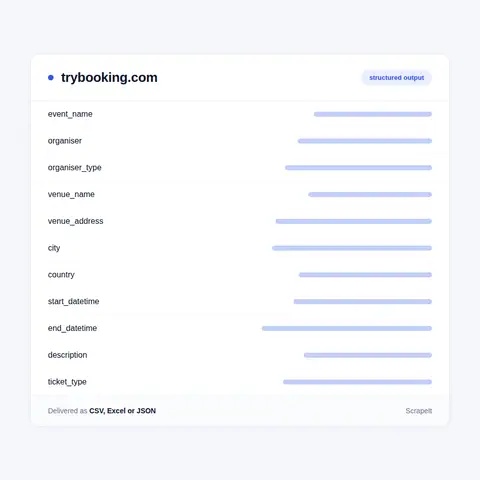
Event records carry the event name, organiser, venue name and address, city, country, start and end date and time, description, and the booking page address.

Country comes from the sitemap the event was found in rather than being parsed from an address, which is more reliable and makes coverage auditable per market.

Ticket type and price records are separate where published, though on this platform many events are free or use a single type, and a row that says so is more useful than an empty price column.

Metadata completeness is recorded as a field. Events here range from a fully described theatre season to a one-line school listing, and knowing which is which lets a downstream application decide what to display rather than discovering the gap at render time.

Every row carries the collection timestamp and the sitemap source.

TryBooking fields in every export
Local coverage, seasonality and scope

Local coverage, seasonality and scope

Local coverage mapping is the main use: what is happening where, including the events that no other source carries, and combined with the major platforms it produces a calendar that is actually complete.

Seasonality in community events is distinctive and visible here - school terms, sporting seasons and fundraising cycles produce patterns that commercial event data does not show because commercial events follow different rhythms.

Organiser type analysis - schools, clubs, charities, small venues - describes the shape of community activity in a region, which is hard to measure any other way.

Scope: published event pages only. No attendee data, no booking flows, no organiser account information beyond the name on the listing. Many organisers here are schools and small volunteer groups, and we collect the event rather than anything about them.

Booking software for the events nobody indexes

TryBooking is an event booking platform used heavily by schools, community groups, clubs and small venues across Australia, New Zealand and the United Kingdom.

It is not a discovery destination in the way the large marketplaces are. People arrive at a TryBooking page because an organiser sent them a link, not because they browsed. That means the platform holds a great many events that exist nowhere else in indexable form.

The structure is unusually helpful for collection. Sitemaps are published per country, with separate event sitemaps for each, so enumeration is a matter of reading the right file rather than crawling an interface. Event landing pages respond directly.

Crawl rules are published and disallow the application paths, the API, the widget embeds and the terms pages - none of which an event listing project needs.

Get a Quote
dev_w
25

Developers

customers
500+

Customers worldwide

pages
1 500 000 000+

Pages extracted

stime
15000+

Hours saved for our clients

Plans

Airplane

€199 / one-time

setup fee - included

Data limits100,000
Frequencyone-time
Run timeup to 5 days
Data storing7 days

Helicopter

€169 / mo

setup fee €499

Data limits250,000
Frequencymonthly
Run timeup to 5 days
Data storing14 days

Glasses

€229 / mo

setup fee €499

Data limits1,000,000
Frequencyweekly
Run timeup to 5 days
Data storing30 days

DNA

€549 / mo

setup fee €799

Data limits3,000,000
Frequency3 times daily
Run timesame day
Data storing90 days

Why link-shared events are invisible without this

There is a category of event that no event dataset contains, and it is a large one.

A school concert, a sports club fundraiser, a church fete, a small amateur production - these are ticketed, they have a page, and they are shared by link rather than listed anywhere searchable. Someone building a local calendar from the major platforms will not find them and will not know they are missing.

A booking platform used by those organisers holds them, and its published sitemaps make them enumerable. For local media, councils, tourism bodies and anyone claiming to know what is happening in a town, that is the difference between a calendar and a partial one.

The second point is the country split. Sitemaps are separated by market, which makes coverage checkable per country rather than inferred from addresses - useful because the platform's penetration differs substantially between its three markets.

The third is the metadata unevenness, which is inherent rather than fixable. Small organisers write short listings. Recording completeness as a field is the honest handling; filtering on it would remove the events that only exist here.

The fourth is that this is a booking tool rather than a marketplace, so there is no ranking, no promotion and no editorial selection - the listings are simply what organisers created, which for research purposes is a cleaner sample than a curated platform.

Our Blog

Reads Our Latest News & Blog

Learn how to use web scraping to solve data problems for your organization

How Artificial Intelligence Is Used In Web Scraping

How Artificial Intelligence Is Used In Web Scraping

Leveraging advances in technology, the AI-powered web scraper has skyrocketed in demand and is helping to expand capabilities by automating tedious daily tasks and speeding up data collection from thousands of websites several times over.

What is Web Scraping and What is it Used For?

What is Web Scraping and What is it Used For?

Web scraping is a method of obtaining web data by extracting it from pages of web resources with the help of a program, that is, in automatic mode. It is used to syntactically convert web pages into more usable forms.

Web Scraping for Machine Learning

Web Scraping for Machine Learning

If you specialize in machine learning, you need to feed large amounts of data to the algorithms. Web scraping is the easiest and the most efficient method of collecting the data from all over the Internet.

scrapeit logo

Who builds and keeps your local event feed

ScrapeIt is a managed extraction company, not a tool you have to learn. Our team builds the pipeline, follows the per-country sitemaps as they change, and repairs the collector before a local calendar starts missing next weekend.

You see a sample first, in your format, over the regions you actually cover, with completeness recorded so you can see what the thin listings look like before deciding how to display them.

FAQ

Why are these events not on the big platforms?

Because they are shared by link rather than listed for discovery. A school concert or club fundraiser has a booking page and no searchable listing anywhere, so a calendar built from the major platforms misses them and gives no sign that it has.

How do you enumerate them then?

Through the sitemaps the platform publishes per country, including separate event sitemaps. That turns an unbrowsable set of link-shared pages into an enumerable one, which is the whole reason this source works.

Why record metadata completeness?

Because listings range from a full theatre season to a one-line school entry, and a downstream application needs to know which before render time rather than after. Filtering on completeness would delete exactly the events that exist only here.

Which countries are covered?

Australia, New Zealand and the United Kingdom, with separate sitemaps per market. Penetration differs substantially between them, so coverage is checkable per country rather than inferred - which matters before promising a complete calendar anywhere.

Do you collect anything about schools or organisers?

Only the organiser name as published on the listing. No account information, no contact details, no attendee data. Many organisers here are schools and volunteer groups, and the event is what we collect.

How does it Work?

Step 1 - Make a Request

You share your needs, expectations, and desired timeframe. We’ll suggest the best solution based on your request and budget.

Step 2 - Configuring Custom Web Crawlers

Our specialists configure the crawlers and extract a sample dataset for your review before proceeding with the full-scale extraction.

Step 3 - Collect and Deliver

Once you approve the sample, we launch the project and start full data collection. We gather, filter, and structure the data for easy use, delivering it on time in your preferred format.

Step 4 - Maintain and Support

Our team manages ongoing processes, monitors website changes, and supports all data extraction cycles. We can also help integrate data into your systems or create dashboards to simplify analysis.

Request a Quote

Tell us more about you and your project information.
Which sites, which fields, how often. A couple of lines is enough.

We reply within 1 business day. No obligation.

scrapiet

Scrapeit Sp. z o.o.
10/208 Legionowa str., 15-099, Bialystok, Poland
NIP: 5423457175
REGON: 523384582