How Can Web Scraping Technology Help the Finance Industry?
Web scraping automates the extraction and aggregation of financial data, makes it easier to find stocks, and allows you to predict the market based on the information.
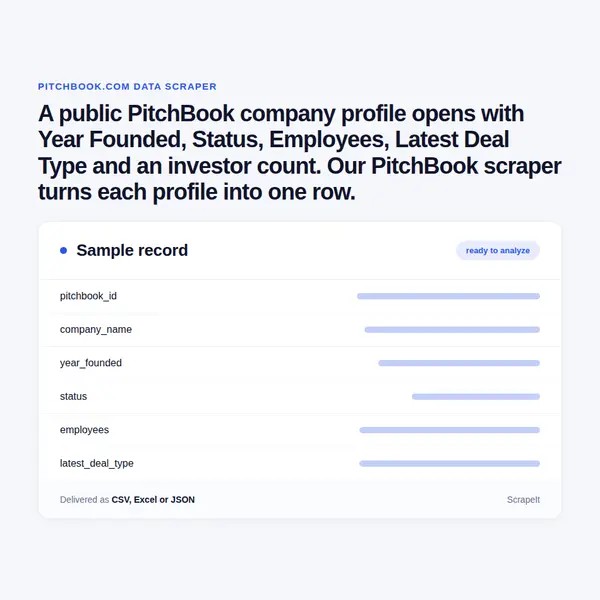
A public PitchBook company profile opens with Year Founded, Status, Employees, Latest Deal Type and an investor count. Our PitchBook scraper turns each profile into one row.
Plans from €169 a month · Free project assessment · Reply within 1 business day
CSV · Excel · JSON · XML · FTP · SFTP · Amazon S3 · Google Cloud
API, JSON feed or CSV, XLSX and JSON files
ScheduleOne-time, monthly, weekly, daily or 3 times a day
PitchBook pages, filters, fields and a schedule
Built, monitored and repaired by our team
API, JSON feed or CSV, XLSX and JSON files
You give us the scope: a list of company names or websites, an industry page such as FinTech or SaaS, a set of investor profiles, or the portfolio behind one investor. We build the crawlers that read those public profiles, run them on your schedule and repair them when PitchBook changes its layout. The site turns away traffic it does not recognise, so anti-bot handling, pacing, proxy rotation and rendering are part of the service.
Each profile becomes one row keyed on its PitchBook ID, and the preview tables - deals, investors, competitors, patents - become linked child tables. Where a profile stops at its preview, we can add facts from the company's own website and from published funding news, each value tagged with where it came from. Every project starts with a free assessment and a sample.
A public profile lives at /profiles/company/ or /profiles/investor/ followed by an ID in the form 432607-24, and that ID is the key on every row we deliver. Company profiles use one template for a seed-stage startup and a listed corporation, with a stock block added for the latter. What a visitor sees without a subscription:
Valuation detail behind the preview, full cap tables and complete deal histories belong to the paid platform and are not part of what we collect. Names of executives, partners and individual angels are personal data and stay out by default.
One profile is a snapshot; the value is in the set. Industry pages under /profiles/industry/ - FinTech, SaaS and the other verticals PitchBook tracks - list companies to watch with their last deal type, the top private companies by last post-valuation, the top public companies by market cap and the most active investors by number of investments, under headline counts of companies, deals, investors and exits. Those lists, the competitor tables and investor portfolios are how a crawl finds the next profiles to read, so coverage grows outward from the companies you start with.
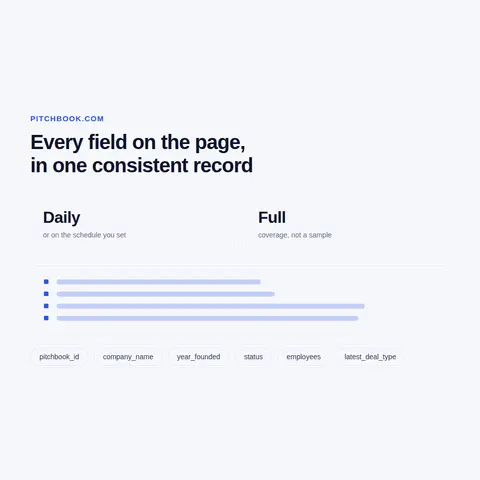
Repeat runs turn the overview into history. When Latest Deal Type moves from Early Stage VC to Later Stage VC, a new round appears at the top of the deal list, Employees changes or Status flips from Private to Public, the change is dated on our side. That is how a PitchBook company database stays current from public pages alone.
Profiles end where the preview ends, so we add what companies publish about themselves: funding announcements and press releases, office locations and product lines from company websites, all matched to the PitchBook ID.
PitchBook is a private market data company, part of Morningstar, and its main product is a subscription platform for venture capital, private equity and M&A research. Alongside it, pitchbook.com publishes free profile pages for companies and investors, built to show how much the platform holds: preview lists stop after the first rows, closed by a You're viewing line that names the total or by a link to request the complete history.
Three page types matter for data work. Company profiles cover startups, PE-backed businesses and listed corporations on one template, and the page title follows the type - a private company is titled Company Profile: Valuation, Funding & Investors, a listed one Stock Performance & Earnings. Investor profiles cover venture firms, accelerators and other backers, with their investments, exits and co-investors. Industry pages summarise a vertical such as FinTech. Profiles also link to PitchBook's own news and analyst research on the same companies and sectors.
Coverage is international: the competitor table of a San Francisco fintech lists peers in Curitiba, Amsterdam and Welwyn Garden City, each with its own profile on the same template.
Delivery: CSV, JSON or XLSX files, our API or a JSON feed. MCP server on request.
Full plan detailsThe public layer of PitchBook answers questions a plain company list cannot.
Combined with funding news, the same rows feed CRM enrichment and quarterly reviews of a portfolio's peers.
Learn how to use web scraping to solve data problems for your organization

Web scraping automates the extraction and aggregation of financial data, makes it easier to find stocks, and allows you to predict the market based on the information.
Data and analytics are opening the door to uncovering ways to combat financial crime based on smart data. And advanced AI analytics and cognitive techniques, machine learning, and automation will improve the inefficiency of existing investigative processes.
Data scraping is the wide term that includes documents, scans and old screens; web scraping is the part that works on websites. We compare sources, daily work, output and cost drivers, give a briefing checklist and walk through two of our projects.

ScrapeIt is a managed web scraping service. We build, run and repair crawlers for company-data and financial sites and deliver the result as CSV, Excel, JSON or through our API. For PitchBook that means public company and investor profiles, joined with funding news and company websites, with field documentation for every column. Runs are one-off or on the schedule you set - daily, weekly or on demand. Plans start from EUR 169 a month, or EUR 199 for a one-time extract.
Still unsure? Write to info@scrapeit.io
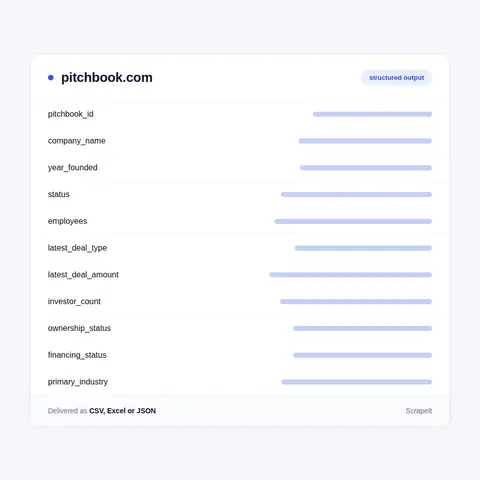
Yes. The ScrapeIt PitchBook API returns the PitchBook ID, Year Founded, Employees, Latest Deal Type, Financing Status and Primary Industry of each profile as JSON from an endpoint we host, refreshed on the schedule you set. The same data also comes as CSV or XLSX files, a JSON feed or straight into your database.
Yes. Company, investor and industry profiles on pitchbook.com open to any visitor without a subscription, and that public layer is what we collect. We collect only publicly available data - everything a visitor can see on PitchBook - and we collect it legally. Personal details such as executive names are left out by default and handled under GDPR.
Yes. Investor profiles show investor type and status, counts of investments, portfolio companies and exits, the latest deals and co-investors. We reach them through the investor tables on company profiles and industry pages, so the database grows with every company you add. Names of individual partners stay out by default.
We deliver what the public profile shows: the deal rows in the preview with type, date, status and stage, amounts and post-valuation where the profile prints them, and the latest deal type and amount in the overview. Full valuation histories and cap tables sit in the paid platform, and we do not promise them. Published funding announcements often fill the gaps, tagged with their source.
Weekly suits most deal-watch projects: the overview changes when a new round, an acquisition or a status change is recorded, and employee counts move slowly. Share price and market cap of listed companies change every trading day, so those fields can run daily. Each run is dated, so the differences between runs become a history.
You share your needs, expectations, and desired timeframe. We'll suggest the best solution based on your request and budget.
Our specialists configure the crawlers and extract a sample dataset for your review before proceeding with the full-scale extraction.
Once you approve the sample, we launch the project and start full data collection. We gather, filter, and structure the data for easy use, delivering it on time in your preferred format.
Our team manages ongoing processes, monitors website changes, and supports all data extraction cycles. We can also help integrate data into your systems or create dashboards to simplify analysis.
Tell us which sites, which fields and how often. A couple of lines is enough to start.
PitchBook data from €169/month. Free project assessment, reply within 1 business day.