Grainger Data: 3 MRO Catalogs with UNSPSC, 250K Products from Cromwell
Full MRO catalogs from Grainger, Fastenal and Cromwell for a product content company: UNSPSC, EAN, every attribute and a taxonomy sheet.
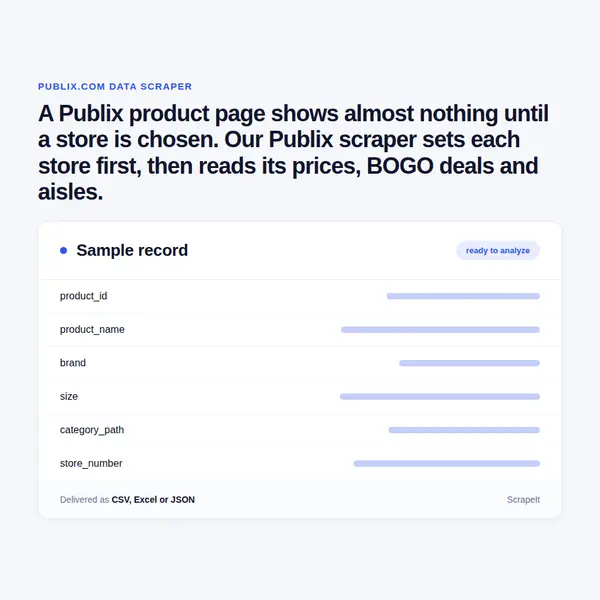
A Publix product page shows almost nothing until a store is chosen. Our Publix scraper sets each store first, then reads its prices, BOGO deals and aisles.
Plans from €169 a month · Free project assessment · Reply within 1 business day
CSV · Excel · JSON · XML · FTP · SFTP · Amazon S3 · Google Cloud
API, JSON feed or CSV, XLSX and JSON files
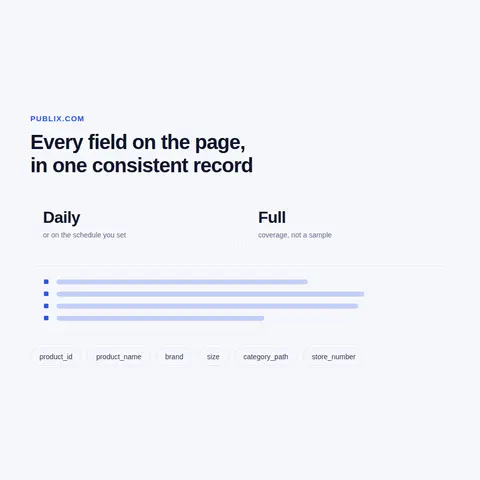
ScheduleOne-time, monthly, weekly, daily or 3 times a day
Publix pages, filters, fields and a schedule
Built, monitored and repaired by our team
API, JSON feed or CSV, XLSX and JSON files
You tell us which Publix stores matter - by store number, town or state - and which departments, brands or search terms to follow. We build the crawler, run it and repair it whenever publix.com changes. Pacing, proxy rotation, CAPTCHA handling and page rendering are included in the service.
Each run selects the store before it reads a single product, and every row carries that store number. A sensible schedule pairs a weekly pass when the new weekly ad goes live with a daily pass for pickup prices; a one-off extract works too. A free project assessment comes first, then a sample from your stores. Plans start from EUR 169 a month, or EUR 199 for a one-time extract.
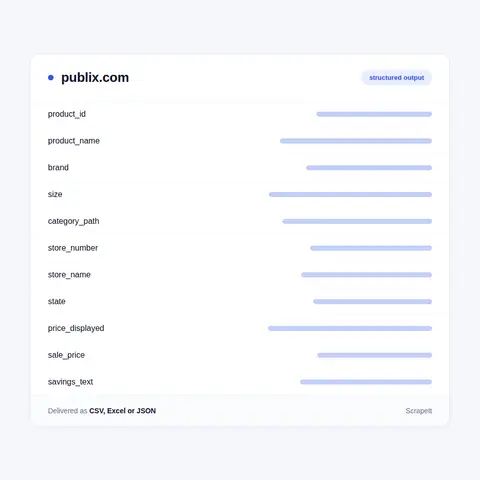
Publix builds its product pages around the shopper's store, so the store is part of the key rather than an afterthought. A product address under /pd/ ends in its product ID - RIO-PCI and digits for packaged goods, other prefixes for deli platters and made-to-order subs. The field groups our Publix scraper returns:
Field documentation arrives with the first delivery and explains every column, including the flag that separates an item Publix priced for that store from one it listed without a price.
A Publix price only means something next to the store and the week it came from. Publix itself warns shoppers that an item on sale at one location may not be on sale at another, and the weekly ad with its BOGO list turns over every week. One extract answers one question for one store; repeated runs answer the rest.
Publix Super Markets describes itself as the largest employee-owned grocery chain in the United States. Its stores are in the South-East - Florida, Georgia, Alabama, South Carolina, North Carolina, Tennessee, Virginia and Kentucky - and next to the main supermarkets it runs the GreenWise Market format, Publix Liquors and Publix Pharmacy.
The website is organised around one choice: your store. Publix calls its catalog a listing of the products it carries by store, and a product page opened without a store says only that no store is selected. Once a store is set, a shopper can browse departments, search, open that store's weekly ad and BOGO deals and build a shopping list that sorts itself by aisle for that store.
Savings live in a hub of four parts: Weekly Ad, Digital Coupons, Extra Savings and All Deals. Extra Savings are offers that sit outside the weekly ad. Digital coupons are clipped to a Club Publix account and applied at the register with the member's phone number. Orders for In-Store Pickup, deli subs among them, are placed on publix.com itself.
Delivery: CSV, JSON or XLSX files, our API or a JSON feed. MCP server on request.
Full plan detailsPublix data is local by design, which is exactly what makes it useful to anyone selling into the South-East.
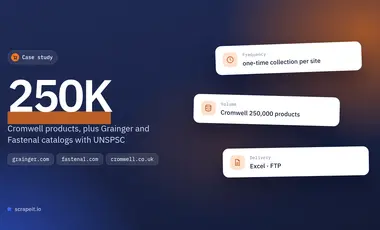
Full MRO catalogs from Grainger, Fastenal and Cromwell for a product content company: UNSPSC, EAN, every attribute and a taxonomy sheet.
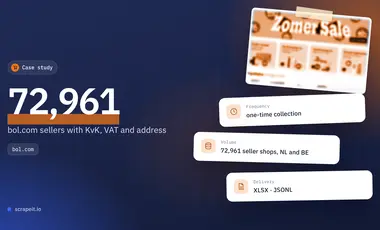
Every seller shop on bol.com with its trade name, business address, KvK and VAT number, collected once: 72,961 shops in 18 days.
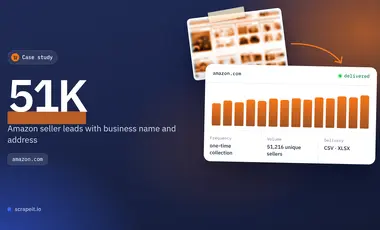
A one-time B2B lead file from Amazon seller profiles: 51,216 sellers with business name and address, 13,366 of them in the US and Canada.
Learn how to use web scraping to solve data problems for your organization
If you sell online, run a marketplace, or advise e-commerce clients, you already know why eBay matters: it’s one of the few places where big retailers compete side by side with thousands of small merchants and private sellers.
E-commerce teams do not just need “some” competitor data anymore. They need a continuous stream of real prices, discounts, stock levels, reviews, and seller behavior from the platforms that actually shape their markets.
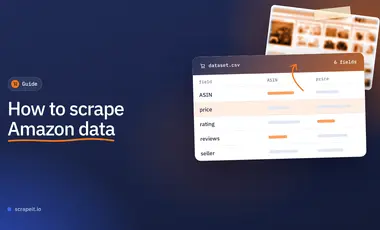
Amazon provides valuable information gathered in one place: products, reviews, ratings, exclusive offers, news, etc. So scraping data from Amazon will help solve the problems of the time-consuming process of extracting data from e-commerce.

ScrapeIt is a managed web scraping service: we build, run and maintain the crawlers and deliver the dataset, so your team works with rows instead of browsers. Store-based grocery catalogs suit that model well, and Publix is a clear case - one product can carry a different price, deal and aisle in every store. Files come as CSV, Excel, JSON or JSONLines, or through our API, a JSON feed or a load into your database; an MCP server is available on request. Any personal data that turns up is handled under GDPR.
Still unsure? Write to info@scrapeit.io
Yes. The ScrapeIt Publix API returns product ID, store number, displayed price, BOGO flag, aisle and nutrition facts as JSON from an endpoint we host, refreshed on the schedule you set. The same data also comes as CSV or XLSX files, a JSON feed or straight into your database.
Yes. Product pages, the weekly ad, BOGO lists and the aisle markers of a shopping list are shown to any visitor who picks a store on publix.com. We collect only publicly available data - everything a visitor can see on Publix - and we collect it legally.
Yes, and that is the normal setup. Every row carries the store number, and the same product is read separately in each store you name, because Publix sale items can differ from one location to another. Repeated runs turn those rows into a dated series per product and store.
No. Publix displays prices for items currently on sale and for items available through In-Store Pickup. For the rest we still deliver the product, store, aisle and details with a no-price flag, and the price column fills in on the run after the item goes on sale.
Once per ad cycle for each store, timed just after the new weekly ad goes live, since the BOGO list changes with it. For pickup prices or Extra Savings, a daily run can be added for the same stores.
You share your needs, expectations, and desired timeframe. We'll suggest the best solution based on your request and budget.
Our specialists configure the crawlers and extract a sample dataset for your review before proceeding with the full-scale extraction.
Once you approve the sample, we launch the project and start full data collection. We gather, filter, and structure the data for easy use, delivering it on time in your preferred format.
Our team manages ongoing processes, monitors website changes, and supports all data extraction cycles. We can also help integrate data into your systems or create dashboards to simplify analysis.
Tell us which sites, which fields and how often. A couple of lines is enough to start.
Publix data from €169/month. Free project assessment, reply within 1 business day.