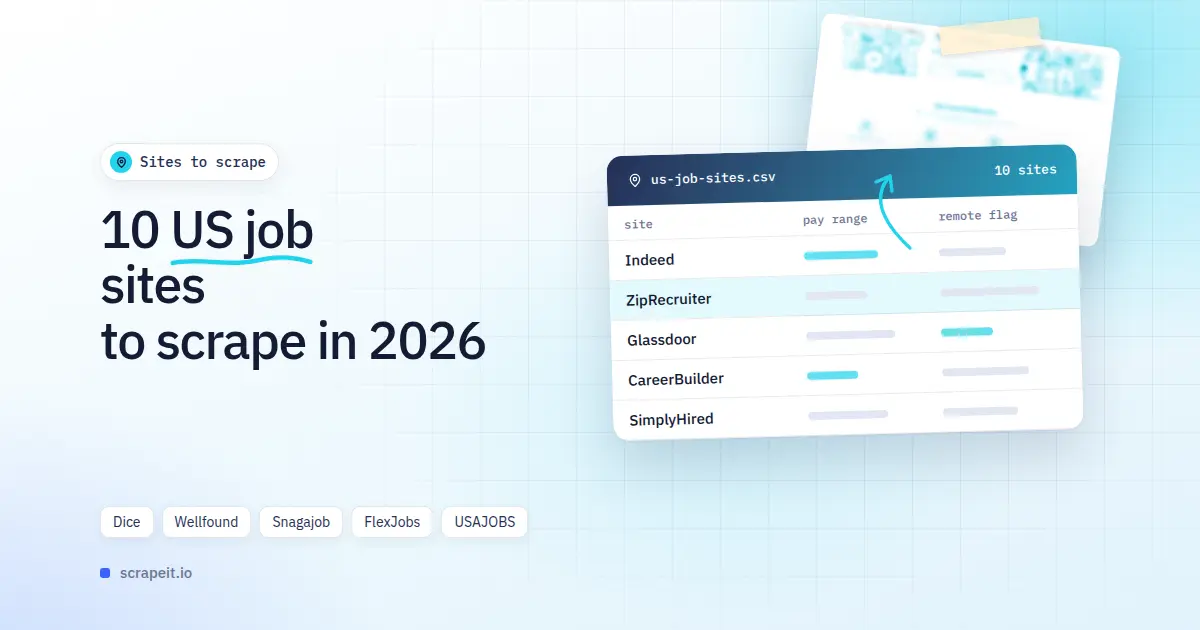
US job sites all show a title, an employer, a city and often a pay range. To a buyer of job data they are ten different sources: aggregators that add salary estimates of their own, niche boards with fields the general boards do not carry - contract terms, equity bands, hourly rates per store - and the federal board.
Below: the fields to settle, each site, merging boards and two US projects. For the service, see our job data scraping service.
Who this list of US job boards is for
It is for teams buying job postings as data: HR-tech products and aggregators, staffing agencies, compensation and labour-market analysts, and investors who read hiring as a company signal. We grouped the sites by role - five aggregators and general boards, four niche boards for tech, startup, hourly and remote work, and the federal board.
What US job postings share and where the boards differ
Salary data from US job postings needs the most care: several states require a pay range in postings, and boards fill the gaps with salary estimates. Four fields need a rule before the first load:
- Pay and its source. Keep the line as printed, add minimum, maximum and period, and flag employer-stated pay apart from a board estimate.
- Work arrangement. Each board has its own words, such as On-Site on Dice or Telework eligible on USAJOBS. Map them to one field and keep the original.
- Location and employer. City and state split into columns, ZIP and coordinates where shown, and who placed the ad: the employer, a staffing agency, a franchise operator or Company Confidential.
- Dates and reposts. An age such as 4d becomes a date only with the collection time, and a repost moves an old role back up, so keep first-seen and last-seen dates per job id.
10 US job sites worth scraping, board by board
The order follows how much of a typical US brief a site answers on its own; it is not a ranking of the sites' quality.
1. Indeed: a board and an aggregator in one
Indeed takes employer postings and indexes career sites, applicant tracking systems and other boards, so one vacancy can arrive under several jk job keys. A row holds title, employer, city and state, posting date, job type, remote and hybrid indicators and a sponsored flag. What sets Indeed apart is the salary_source field: employer-stated pay or Indeed's own estimate, which vanishes once the employer adds real pay. Expired postings stay addressable by key, so a register of keys turns a vanished row into a close date. Best for: demand counts by metro after dedupe and benchmarks on employer-stated pay. See the Indeed scraper page.
2. ZipRecruiter: the employer side of a distribution network
ZipRecruiter, a US job marketplace, sells employers distribution: one posting goes out to a network of other job sites. Its postings repeat what a buyer often holds, so the value sits on the employer side - company pages with open jobs, salary and reviews pages, and a salary directory by title and place, delivered separately. Posting rows carry the normalised title, city and state, a remote flag, types such as contract-to-hire and pay flagged as employer-stated or estimated. The .com, .ca and .co.uk sites are separate indexes, so we pin the country of every run. Best for: which employers distribute jobs and at which pay. See the ZipRecruiter scraper page.
3. Glassdoor: employer ratings, company reviews and pay
Glassdoor, owned by Indeed, is a workplace review site and a job board in one, and a numeric employer ID joins its tabs. A signed-out visitor sees the overall rating out of five, the share who would recommend the employer, factor ratings such as compensation and benefits, and the newest company reviews with Pros and Cons. Authors are anonymous and stay so in the data. Salary pages give a pay range per job title with the number of salaries behind it, and listings label pay Employer provided or Glassdoor est. Best for: employer branding and investment research on rating trends. See the Glassdoor scraper page.
4. CareerBuilder: the source system on every posting
CareerBuilder now runs on Monster's platform under their common owner, BOLD, so expect shared inventory, much of it from small and mid-market employers in healthcare, education, logistics and skilled trades. Its distinctive field is provenance: each posting names the applicant tracking system it came through, such as iCIMS or Workable, which turns deduplication into a join and shows which ATS vendors carry volume in a sector. The key is the UUID at the end of the address; the slug changes when a title is edited. Pay is stated or shown as a Monster Estimated Salary, and some postings read Company Confidential. Best for: ATS market share and regional wage benchmarks. See the CareerBuilder scraper page.
5. SimplyHired: an aggregator with ratings from Indeed
SimplyHired is a job aggregator operated by Recruit Holdings, the group behind Indeed and Glassdoor. A relisted vacancy gets a fresh base64 key, so repost chains are matched on employer, title, location and description. A row carries title, company, city and state, the Remote or Hybrid marker, a company rating drawn from Indeed reviews, salary as free text and a Sponsored flag. Search takes a city and state, a ZIP code or the value Remote, so the remote share of a metro is one query away. Browse hubs by title, city, company and salary widen coverage beyond search. Best for: time-to-fill proxies and remote share. See the SimplyHired scraper page.
6. Dice: contract terms and skills for tech roles
Dice, operated by DHI Group, is a US board for technology and engineering roles, and IT staffing firms carry a large share of its inventory. Its employerType field reads Direct Hire, Recruiter or Other, which separates direct employers from agencies. Contract work is a field too: CONTRACT_W2, CONTRACT_CORP_TO_CORP or CONTRACT_INDEPENDENT, with a term such as six months. A skills array mixes canonical names with poster-typed strings, so we deliver it verbatim and mapped. Rows also hold a visa sponsorship flag and postedDate beside modifiedDate, which tells a new requirement from a refreshed one. Best for: contract versus permanent demand per skill and metro. See the Dice scraper page.
7. Wellfound: salary and equity on startup roles
Wellfound is the startup job marketplace once called AngelList Talent, and angel.co still redirects to it. A posting carries a salary range with currency and period and, beside it, an equity band or the words No equity - a field most job boards do not print. The company block adds a one-line pitch, an employee band and badges such as Growing fast and Recently funded. Postings also state visa sponsorship, the remote policy and the country an applicant must be in. A closed job is reported as gone, so closures are dated with confidence. Best for: startup pay by stage and headcount, and funding-to-hiring signals. See the Wellfound and AngelList scraper page.
8. Snagajob: hourly pay store by store
Snagajob is a US marketplace for hourly work in restaurants, retail chains, warehousing, healthcare support and hotels. A posting's structured data holds a minimum, a maximum and the unit HOUR, while the site's own estimated wage band goes into separate columns. A national brand posts the same role for every site it runs, each copy with its own id, street address and rate - repeats to roll up for opening counts, and the pay variation you buy the data for. The brand name and the location name typed by the operator often differ, which separates corporate stores from franchisees. Best for: local hourly pay benchmarks and chain openings by metro. See the Snagajob scraper page.
9. FlexJobs: screened remote and flexible roles
FlexJobs is a US subscription job board for remote, hybrid and flexible work, and a research team hand-screens every vacancy before it is listed. That screening sets its data apart: a curated sample of flexible roles, not a remote filter on a general board. A signed-out visitor sees the listing cards: job title, a work arrangement such as Hybrid Remote, a schedule such as Full-Time or Flexible Schedule, pay with its unit - Annually, Hourly, Weekly or Monthly - where a listing shows it, the locations, which can read Work from Anywhere in U.S., and the posting age. Best for: the supply of remote and part-time work by arrangement, pay period and place. See the FlexJobs scraper page.
10. USAJOBS: grades, series and hiring paths
USAJOBS is the federal government's employment site, and every announcement fills the same Overview labels, keyed on the control number in its address. A row holds the agency, the salary range with pay scale and grade, such as GS 13 on the General Schedule, the occupational series, duty locations, the security clearance level, and the hiring paths, from Open to public to Veterans. Status runs from Accepting applications to Hiring complete, and closed announcements keep their address, so past hiring can be backfilled and time to hire measured. Best for: federal hiring by agency, series and grade. See the USAJOBS scraper page.
Built In, Monster and other boards are on our list of all job boards we scrape.
Get Data for your Business
We extract the data you need from any website to satisfy all your business requirements with 100% accuracy.
- Free Sample Data Sets
- Regular Data Delivery
- Legal and GDPR compliance
Get a quote
Job board scraping: how to scrape job boards into one dataset
Indeed, Glassdoor and SimplyHired belong to one group, CareerBuilder shares a platform and an owner with Monster, and ZipRecruiter forwards postings to other sites. Three rules keep demand from being overstated:
- One schema, source kept. Source site, its job id, normalised title, employer, city, state, work arrangement, pay with its source, first seen and last seen.
- Match, do not delete. To remove duplicate job postings across boards, rows are matched on employer, normalised title, city and state; matched rows share a vacancy key and every source row stays.
- Keep the grains apart. Glassdoor reviews, salary directory pages and wage estimates never enter one total with posted jobs.
What our US projects taught us about duplicates and coverage
Overlapping searches, one record per employer
A US property-technology startup wanted a copy of a public employer directory behind a search form with a captcha on each new query. Any three letters at the start of a word in a name matched, so the same employer kept coming back: 1,376,889 rows became 988,996 unique employers once rows with the same name and employer ID were merged. Title and city searches on Indeed or Dice overlap the same way, so we key on the board's own id. Case: 988,996 employer records from a captcha-gated search.
A national list built city by city
A local-marketing company wanted fresh Google Maps leads every weekday. Google Maps answers one search for one trade in one place, so each keyword ran across the 1,000 largest US cities, three keywords a day. Indeed and Wellfound cap how deep one search goes, so a national pull is built the same way: title by city. Case: Google Maps data from US cities every weekday.
How ScrapeIt collects US job market data
ScrapeIt is a managed service: we build, run and repair the crawlers, and anti-bot handling - pacing, proxy rotation, CAPTCHA handling and rendering - is part of the service. Output stays at posting and employer level: no resumes, no candidate profiles, no reviewer names. A project starts with a free assessment, and a sample can be ordered first; ready files for Indeed and Glassdoor are on our data sample page. Field documentation comes with the dataset, and runs are one-off or on the schedule you set. Plans start from EUR 169 a month, or EUR 199 for a one-time extract.
Files come as CSV, Excel (XLSX), JSON, JSONLines or XML, through our API (an endpoint we host), a JSON feed, SFTP, Amazon S3 or a load into your database. See all US sites we scrape and the UK job sites to scrape in 2026.
FAQ
What are the best US job sites to scrape?
Start with Indeed, ZipRecruiter, CareerBuilder and Glassdoor, then the niche board that fits: Dice for contract tech, Wellfound for startups, Snagajob for hourly pay, FlexJobs for remote work, USAJOBS for federal hiring.
Is scraping job sites in the US legal?
We collect only publicly available data - everything a visitor can see on the site - and we collect it legally. Recruiters' names and contacts are personal data: we handle them under GDPR and leave such fields out by default.
Where does SimplyHired get its salary information?
Pay on a listing comes with the posting itself as free text, and many listings show none. The averages on its salary pages are labelled as approximations from third-party submissions, and company ratings come from Indeed reviews, so we deliver both as separate, labelled tables.
Can I get US job data through an API?
Yes, through ours. An endpoint we host returns the postings as JSON, with parsed pay and its source flag, refreshed on the schedule you set.
How often should US job postings be refreshed?
Daily for new postings, reposts and closures, since a weekly run misses short-lived vacancies. Weekly or monthly suits pay benchmarks and Glassdoor ratings.