Jobware Scraper for German Job Ads and Employer Data

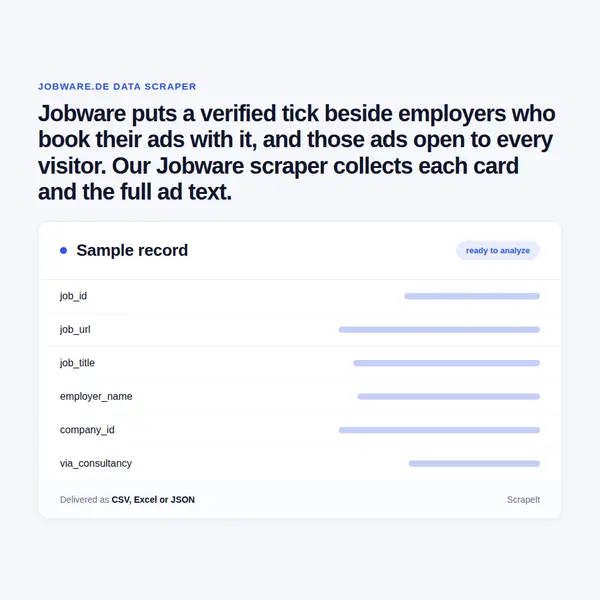
Jobware puts a verified tick beside employers who book their ads with it, and those ads open to every visitor. Our Jobware scraper collects each card and the full ad text.

Plans from €169/month · Free project assessment · Reply within 1 business day

Jobware Scraper
Solutions

Jobware scraping as a managed service

You tell us what to cover - a Berufsfeld such as IT or Ingenieure, a list of cities, a set of employers or the whole board - and how often. We build the crawler for jobware.de, run it and repair it when Jobware changes its pages, so nothing needs installing on your side. Pacing, proxy rotation, CAPTCHA handling and page rendering are part of the service, not extras.

German labels stay as Jobware prints them, with a normalised column beside each: Vollzeit becomes full-time, Home-Office a remote flag, a relative date such as Vor 7 Stunden an exact timestamp. Every run is stamped, so each ad carries the dates it was first and last seen. Field documentation comes with the first delivery, and a project starts with a free assessment or a sample.

What our Jobware data scraper collects

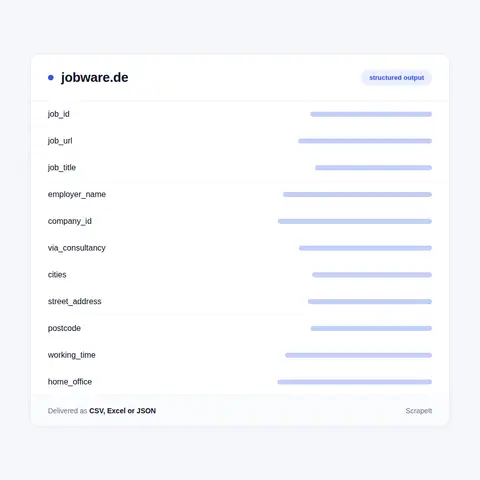
Each Jobware ad lives at an address that ends in a nine-digit number, and that job id is the key a row keeps from run to run. Around it, the scraper reads the search card and the ad page:

  • Identity - job id, ad URL, the job title as written including its (m/w/d) gender tag, and the Neu badge that marks a fresh ad.
  • Employer - advertiser name and logo, the company id from the employer link, and the home town shown in the employer box. When a recruitment consultancy advertises, the name reads über plus the consultancy, and we keep that form so consultancy searches can be split out.
  • Location - one or several cities per ad, the street address and postcode printed for the workplace, or a region such as Großraum Heidelberg where the employer names no town.
  • Working time - the Vollzeit, Teilzeit and Home-Office labels, plus the ad type behind the Anzeigenart filter: job, internship or apprenticeship.
  • Dates - the publication date, shown as a relative time on recent ads and as a calendar date after that.
  • Ad text - the employer-designed ad split into its usual blocks: introduction, tasks, requirements, what the employer offers and how to apply, with a start date or reference number when the ad states one.
  • Salary - pay printed in the ad text, and, on a project run with an account registered through Jobware's sign-up form, Jobware's own salary estimate, shown after sign-in as an upper value and labelled Schätzung when it is estimated.
  • Source flag - whether the ad was booked with Jobware, shown by the verified tick beside the employer name.

Names, phone numbers and e-mail addresses of recruiters printed inside an ad are personal data and stay out of the dataset by default.

What our Jobware data scraper collects
Building a Jobware dataset beyond single ads

Building a Jobware dataset beyond single ads

Coverage on Jobware starts from its own directories. Category pages exist per Berufsfeld, per city and per Anstellungsart - Teilzeit, Werkstudenten, Freelancer, Minijobs, Quereinsteiger, Befristung - and combine into addresses such as IT jobs in Berlin. Search sorts by relevance or date and narrows by working time, ad type and four experience level bands: Einsteiger, Professional, Senior and Lead. Paging runs out before the largest categories do, so we slice by field, city and band and merge on the job id.

The Inserentenverzeichnis is an advertiser directory of every company with live ads, A to Z, each linked to its ad list. The Unternehmensprofile, Jobware's company profiles, add a self-description, a benefits list from Gleitzeitregelung to Mobilitätsbudget, and awards. Together they make an employer table that joins to the ads.

Repeated runs turn cards into a history: when an ad appeared, how long it stayed, when it came back, how an employer's volume moves by month. Ads Jobware takes in from other sources show their card to anyone but ask for a sign-in before the full text; when that text matters, a project can run on an account registered through Jobware's own sign-up form.

About Jobware and how the board is organised

Jobware was founded in Paderborn on 1 May 1996 and calls itself the first German online job market. It belongs to Medien Union of Ludwigshafen and has worked with established publishing houses for years. The board runs in German throughout, and its employer mix is broad: one IT category page alone lists a federal police agency, a municipality, a state IT office and private IT service firms.

Two search modes share the home page: the Stichwortsuche with a job title and a place or postcode, and a KI-Suche that takes a wish described in the visitor's own words. Browsing runs three ways - Berufsfeld, Standort and Anstellungsart - each with a live count of open ads.

The promise to applicants is Kein Ghosting. Jobware says every position is checked before it goes live, and its Feedback-Garantie chases an employer that has not answered an application for two weeks - a service that covers only ads booked on Jobware. The verified tick beside an employer name marks ads placed on Jobware itself, which is why a buyer of Jobware data should keep it as a source flag: those are the ads the Feedback-Garantie covers, the rest widen the board's reach.

Ad pages keep the employer's own layout and add Pendelzeit berechnen, a commute calculator beside the workplace address, plus similar jobs based on the current search.

Get a Quote
dev_w
25

Developers

customers
500+

Customers worldwide

pages
1 500 000 000+

Pages extracted

stime
15000+

Hours saved for our clients

Plans

Jobware Scraping Plans and Pricing

Airplane

€199 / one-time

setup fee - included

Data limits100,000
Frequencyone-time
Run timeup to 5 days
Data storing7 days

Helicopter

€169 / mo

setup fee €499

Data limits250,000
Frequencymonthly
Run timeup to 5 days
Data storing14 days

Glasses

€229 / mo

setup fee €499

Data limits1,000,000
Frequencyweekly
Run timeup to 5 days
Data storing30 days

DNA

€549 / mo

setup fee €799

Data limits3,000,000
Frequency3 times daily
Run timesame day
Data storing90 days

Delivery: CSV, JSON or XLSX files, our API or a JSON feed. MCP server on request.

Full plan details →

Why scrape Jobware ads

Jobware's labels do part of the analysis before any text is read. Working time, home office, ad type and experience band are labels and filters, not phrases buried in a description.

  • Hiring demand by field and city - new ads per Berufsfeld and Standort, week by week, from publication dates.
  • Employer activity - which companies advertise, how often and where, and whether they book with Jobware or reach it through other channels.
  • Flexible work share - Home-Office and Teilzeit labels give the share of remote and part-time roles per field.
  • Skills and requirements - task and requirement blocks, parsed for tools, degrees and languages, show what employers in Germany ask for.
  • Consultancy market - ads placed über recruitment consultancies show which firms run searches, for which roles and in which regions.
  • Entry routes - internships, apprenticeships and Werkstudenten posts per employer show who builds a pipeline of young staff.
  • Pay signals - salary printed in ads, and Jobware's estimate where the project runs on a signed-in account.

Our Blog

Reads Our Latest News & Blog

Learn how to use web scraping to solve data problems for your organization

How Artificial Intelligence Is Used In Web Scraping

How Artificial Intelligence Is Used In Web Scraping

Leveraging advances in technology, the AI-powered web scraper has skyrocketed in demand and is helping to expand capabilities by automating tedious daily tasks and speeding up data collection from thousands of websites several times over.

What is Web Scraping and What is it Used For?

What is Web Scraping and What is it Used For?

Web scraping is a method of obtaining web data by extracting it from pages of web resources with the help of a program, that is, in automatic mode. It is used to syntactically convert web pages into more usable forms.

Web Scraping for Machine Learning

Web Scraping for Machine Learning

If you specialize in machine learning, you need to feed large amounts of data to the algorithms. Web scraping is the easiest and the most efficient method of collecting the data from all over the Internet.

scrapeit logo

About ScrapeIt

ScrapeIt is a managed web scraping service: we build, run and repair the crawlers, and you receive the data. German job boards bring their own chores - gender tags in titles, relative dates, ads designed by each employer with tasks and requirements laid out differently. We solve those in the parser, deliver CSV, Excel, JSON or a database load on a daily or weekly schedule, and handle personal data under GDPR. Plans start from EUR 169 a month, or EUR 199 for a one-time extract.

FAQ

Do you offer a Jobware API for job ad data?

Yes. The ScrapeIt Jobware API returns the job id, title, employer, cities, working-time labels and publication date as JSON from an endpoint we host, refreshed on the schedule you set. The same data also comes as CSV or XLSX files, a JSON feed or a load into your database.

Is it legal to scrape Jobware?

Yes. Search cards, the ads employers book with Jobware, company profiles and the advertiser directory are open to any visitor. We collect only publicly available data - everything a visitor can see on Jobware - and we collect it legally. Contact persons named in ads are left out by default.

How do you scrape Jobware ads that come from other sources?

Their search card - title, employer, labels, city and date - is visible to anyone, and we collect it like any other. The full text opens only after a sign-in, so when a project needs it we run on an account registered through Jobware's own form. Every row carries a flag saying whether the ad was booked with Jobware.

How often should Jobware data be refreshed?

Daily for demand tracking. Fresh ads show relative times such as Vor 24 Minuten next to the Neu badge, so a daily run dates each new ad to the day, while a weekly run can miss an ad that opens and closes between two runs. Employer tables and company profiles change slowly, so a weekly pass is enough for them.

Can you scrape Jobware salaries as well as ad text?

Yes, in two columns. One holds pay the employer printed in the ad; the other holds Jobware's own figure, which appears only after sign-in, so it is collected when the project runs on an account registered through Jobware's sign-up form. That figure is an upper value marked Schätzung when it is an estimate, and keeping the label means it is never mistaken for an employer's offer.

How does it Work?

Step 1 - Make a Request

You share your needs, expectations, and desired timeframe. We’ll suggest the best solution based on your request and budget.

Step 2 - Configuring Custom Web Crawlers

Our specialists configure the crawlers and extract a sample dataset for your review before proceeding with the full-scale extraction.

Step 3 - Collect and Deliver

Once you approve the sample, we launch the project and start full data collection. We gather, filter, and structure the data for easy use, delivering it on time in your preferred format.

Step 4 - Maintain and Support

Our team manages ongoing processes, monitors website changes, and supports all data extraction cycles. We can also help integrate data into your systems or create dashboards to simplify analysis.

Request a Quote

Tell us more about you and your project information.
Which sites, which fields, how often. A couple of lines is enough.

This form is protected by Google reCAPTCHA, which loads when you start filling it in. If you prefer not to use it, email us at info@scrapeit.io. Privacy & Cookie Policy

We reply within 1 business day. No obligation.

Jobware data from €169/month. Free project assessment, reply within 1 business day.

scrapiet

Scrapeit Sp. z o.o.
10/208 Legionowa str., 15-099, Bialystok, Poland
NIP: 5423457175
REGON: 523384582